

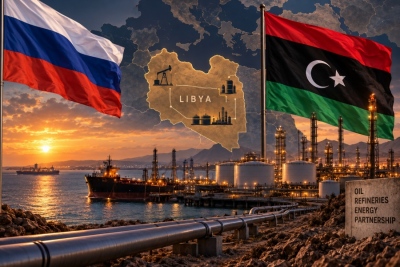
It is already clear that, as a result of current events, the Middle East will never be the same again. Russia is not participating in military operations, yet it is being invited to join in constructing a new regional order. The Russian Embassy in Libya reported that Tripoli is persistently inviting Moscow, represented by Russian energy companies, to participate in restoring Libya's energy sector.
Not the first invitation to Moscow
This is not the first such proposal. In late July, Ali al-Qaidi, Minister of Investment in the parliament-appointed government, noted in an interview with RIA Novosti that Libya relied heavily on initiating joint projects with Russia related to the restoration of energy infrastructure and the sale of petroleum products as a separate area of cooperation. These expectations were not born out of nowhere. In 2024, Libya's internationally recognized government sent envoys to negotiate with Tatneft regarding the potential construction of two oil refineries in Benghazi and Tobruk. The parties departed on a positive note, but the project never moved forward for purely political reasons. The municipalities of Benghazi and Butnan, where the aforementioned cities are located, are under the control of Khalifa Haftar's Libyan National Army (LNA). Haftar opposes the government in Tripoli, although active hostilites between the two sides have ceased since 2020. Subsequently, following the LNA's failed offensive, a ceasefire agreement was signed, which is maintained through UN mediation and monitoring.
Libya fractured after the "Arab Spring"
Libya collapsed as a unified state as a result of the 2011 Arab Spring. Today, fifteen years later, Western countries and, in particular, the United States do not hide the fact that the protests of that period were largely inspired and fueled by intelligence services and their financial backing. It is enough to recall Hillary Clinton's blunt speech in which she described the killing of Muammar Gaddafi: "We came, we saw, he died." As a result, a country with abundant oil reserves and fresh water—no less valuable in the arid Middle East—was fractured into raging, warring factions and regions. The conflict grew so intense and bloody that, within a few years, entire regions voluntarily began switching sides between the two main forces.
The current territorial balance
At present, the territorial balance in Libya is structured as follows. The Government of National Accord in Tripoli fully controls seven municipalities in the northwest of the country, holds about half the territory in three more, and maintains an enclave in the municipality of Wadi al-Hayat, including the Awbari Oasis. Khalifa Haftar's Libyan National Army controls most of the country: from the border with Egypt in the east, almost the entire shared border with Algeria in the west, and two-thirds of the Mediterranean coast along the Gulf of Sirte in the north. The entire southern border, within the municipalities of Murzuq and Kufra, forms a grey zone of the Libyan Desert inhabited by various nomadic tribal groups, such as the Tuareg, Bedouins, and Toubou. Neither of the two active governments attempts to enter these dry and water-starved southern regions, partly because there is no oil production there either.
Libya's oil wealth
If you look at a map of Libya's mineral wealth, many things immediately fall into place. The largest oil fields and natural gas condensate reserves are grouped into three main clusters. In the south, there are twelve production units located in a triangle between the cities of Sharara, Ubari, and Murzuq. From here, a primary oil pipeline runs north, collecting crude from a series of scattered fields on the El Hamra plateau before reaching the Mediterranean coast. A major oil refinery and two oil terminals once operated there. A natural gas pipeline from the large Wafa oil and gas field also reaches this area. On the coast, Libyan natural gas enters the main Greenstream pipeline and continues onward to Italy.
The LNA controls the most powerful fields
However, the most powerful oil and gas fields are controlled by the Libyan National Army. These include several dozen production units located in close proximity to the coast, stretching from the port of Es Sider to the port of Zueitina. In the past, Benghazi and Tobruk housed major refineries and marine terminals, from which Libyan crude was exported to the rest of the world. Without overwhelming you with unfamiliar names, we will simply add that, at the time of the country's collapse, Libya possessed nine major offshore terminals for transshipping crude oil. Today, seven of them, including the most powerful ones such as Es Sider (250,000 barrels per day), Zawiya (240,000), Ras Lanuf (220,000), and Marsa Al Hariga (90,000), have long been shut down. Only the Bouri and Al Jurf terminals remain operational, managing meager output levels of 35,000 and 20,000 barrels per day, respectively. Only the Zawiya refinery remains active in the refining sector, but even it was struck a month ago, triggering a fire in several of its storage tanks.
Libya facing a total energy crisis
Based on available data, it can be assumed that a comprehensive energy crisis has emerged in a country recently torn apart by civil strife. It is so deep and widespread that the Tripoli-based Government of National Unity is negotiating on behalf of its opponents in the LNA, and the latter are making no effort to block them. Libya is offering Russian companies access to its domestic market by rebuilding or constructing new refineries that will be supplied with raw materials from rich local deposits. The greatest advantage is that Russia is being offered complete control over the refining process and, most importantly, legitimate trade in gasoline, kerosene, diesel, and other resulting petroleum products, not only within Libya but also for export. Simply put, this amounts to refining approximately 350,000-380,000 barrels of oil per day—the exact volume processed by Libyan refineries before the events that split the country in two.
Russia sets security as a prerequisite
Official Moscow is not rejecting these proposals, but rightly points out that while Russia has the capacity to execute such an ambitious project, everything hinges on security issues. These range from protecting capital investments to ensuring the stable operation of the entire chain of production, transportation, refining, and supply of oil and petroleum byproducts. However, in the East, a proverb was born about a donkey loaded with gold opening any gate, and the situation in Libya is such that all involved stakeholders, without exception, would welcome the restoration of a critical economic sector and the availability of fuel for daily needs. Russia, too, traditionally maintains neutrality in Middle Eastern conflicts, because one never knows what the future holds.
www.bankingnews.gr



Readers’ Comments