

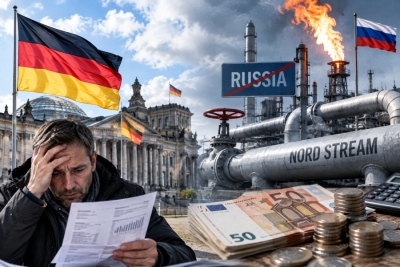
The bill that Germany is paying for its energy decoupling from Russia is heavy, with Berlin having spent more than €50 billion solely on support and stabilization measures during the energy crisis. The energy crisis and Germany's decision to move away from Russian natural gas have caused immense fiscal costs for Europe's largest economy. According to data from the German Ministry of Finance cited by Bild, the federal government has spent a total of €50.4 billion on support and stabilization measures during the energy crisis. This is an amount corresponding to an average of around €600 for every resident of Germany. And this is only the beginning.
At €50.4 billion, the direct bill
The amount of €50.4 billion concerns direct government spending to address the fallout of the energy crisis. The bill includes, among other things: price caps on natural gas and electricity, the emergency aid granted in December, as well as other state support measures for households and businesses. In other words, the German state was forced to dig deep into its pockets to mitigate the impact of soaring energy costs. The sum of €50.4 billion, however, does not capture the true total cost of the energy transition.
The bill is much larger
The €50.4 billion does not include expenditures for constructing the new LNG terminals that Germany had to build to replace Russian gas supplies. It also excludes losses suffered by German industry due to high energy costs. Nor do they fully reflect the long-term consequences of high energy prices, which continue to burden households, businesses, and particularly energy-intensive German manufacturing. Thus, the €50.4 billion essentially represents the direct and measurable bill of the crisis, not the complete cost of the energy rift with Russia.
600 euros out of every German's pocket
The scale of the figure becomes even more striking when translated into a cost per capita. On average, it corresponds to around €600 per resident of Germany. This is a figure resulting from state interventions aimed at absorbing part of the energy shock and avoiding even greater pressure on households and businesses. However, the fact that these are public expenditures means that the cost is ultimately transferred to the state budget and, by extension, to German taxpayers.
The paradox: 50.4 billion for energy vs 30.6 billion for Ukraine
The comparison made by Bild is particularly revealing. Germany has spent approximately €30.6 billion on aid to Ukraine. At the same time, direct support and stabilization measures due to the energy crisis alone amount to €50.4 billion. That is, the bill for the energy crisis is almost double the financial aid provided to Ukraine. And this is without accounting for investments in LNG, losses in German industry, and the ongoing burden of high energy prices.
German industry pays the price
The big question now is not only how much money the German state has spent, but also how severely the country's manufacturing base itself has been damaged. For decades, Germany relied on cheap and relatively abundant Russian energy, which served as a critical advantage for its industrial competitiveness. The abrupt change in the energy model overturned this balance. Businesses found themselves facing higher energy costs, greater uncertainty, and the need to seek new suppliers and infrastructure. For an economy heavily reliant on manufacturing, the economic shock was immense.
The big question for Berlin
The German case now highlights one of Europe's greatest economic dilemmas. Phasing out reliance on Russian energy was a strategic choice governed by geopolitical criteria. Yet the cost of this choice is proving to be exceptionally high. At €50.4 billion for direct state interventions alone—about €600 per resident—the total bill is even larger when factoring in LNG infrastructure, industrial losses, and long-term price impacts. And the starkest aspect is that Germany has already paid almost twice as much money to manage its internal energy crisis as it has allocated for support to Ukraine. The question now is whether Berlin will be able to absorb this cost without paying an even higher price in economic growth, industrial competitiveness, and public finances.
www.bankingnews.gr











Readers’ Comments