

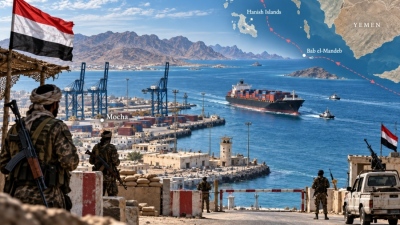
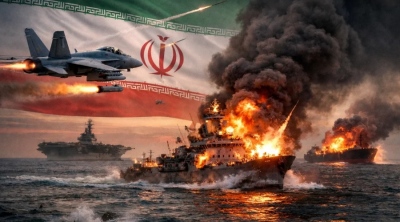
A dramatic upheaval that could transform Yemen and the Red Sea into a second major front of the war with Iran is underway, as Iranian-backed Houthis executed a lightning advance along the western shores of Yemen, seizing the strategic port city of Mocha and, mere hours later, the critical island of Perim at the entrance to the Red Sea.
The speed of the advance has provoked severe recriminations and mutual accusations among allies of the US across the region, with sources describing a «fiasco of epic proportions» and an absolute failure of political and military leadership.
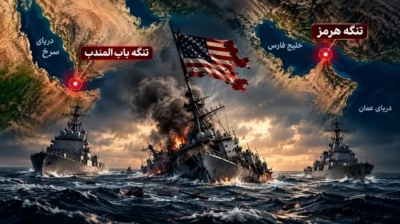
The most alarming factor is that this development emerges during a period when Iran preserves effective control over the Strait of Hormuz, while the Houthis gain expanded leverage over Bab al-Mandab, generating an explosive landscape for international commercial and energy corridors.
«We were requesting air cover, it never came»
According to a source within the armed forces of Yemen speaking to CNN, pleas for close air support began on Thursday morning, once it became evident that the Houthis were advancing toward Mocha.
«The Houthis threw everything they had into the battle», the source noted, describing consecutive waves of combatants, ballistic missiles, and other available armaments.
The same source asserted that they contacted CENTCOM, the US Central Command, receiving assurances that the situation was being monitored closely and that Saudi air support was en route.
«Yet air support never arrived. And now Mocha has fallen», the source stated pointedly.
Seizure of Perim too: the Houthis squeeze Bab al-Mandab
Just hours later, on Friday, the Houthis captured Perim as well, a vital island at the entryway to the Red Sea.
The island is situated at a strategic node, effectively bisecting the Strait of Bab al-Mandab in two.
Its capture equips the Houthis with an essential tactical advantage and, according to analysis from CNN, fosters conditions of heightened de facto oversight by Tehran over yet another pivotal maritime lane.
This shift is extraordinarily consequential for international shipping, as Bab al-Mandab functions as the gateway toward the Suez Canal corridor.
Fresh shock for oil markets
The weight of these developments is not confined to Yemen.
Effective control over the Strait of Hormuz by Iran, paired with the consolidation of the Houthi posture at Bab al-Mandab, forges a dual geopolitical vice surrounding indispensable energy and shipping corridors.
Bab al-Mandab is less vital than Hormuz for global energy markets, yet millions of barrels of crude oil and vast volumes of merchandise transit through it daily.
Its importance has climbed further since the onset of the war with Iran, given that Saudi Arabia has rerouted a share of its outbound flows through this specific sea passage to circumvent Hormuz.
A severe new breakdown across Bab al-Mandab could consequently spark a renewed rally in petroleum prices, carrying grave repercussions for the international economy.
«They do not need advanced weapons to shut the Strait»
Amr Al-Bidh, a leading official of the Southern Transitional Council (STC) of Yemen, warned that the Houthis do not even need to deploy sophisticated missile hardware to threaten Bab al-Mandab.
«They do not need advanced weapons to close Bab al-Mandab. They can simply mount a cannon onto a truck», he declared pointedly.
As he pointed out, this capability constitutes formidable bargaining leverage that the Houthis will continue to hold.
Trump refused to strike the Houthis
Concurrently, disclosures regarding high-level communications between Saudi Arabia and the American administration are prompting fresh questions.
Crown Prince Mohammed bin Salman of Saudi Arabia reportedly contacted American President Donald Trump twice on Thursday, urging the US to strike the Houthis.
According to a source cited by CNN, Donald Trump refused to intervene militarily.
The White House stated that the US is focused on defending core national security interests, including guaranteeing freedom of navigation in the Red Sea, while simultaneously seeking to empower regional allies to assume a primary role in managing localized crises.
«Fucking fiasco of epic proportions» in Riyadh and Washington
The swift collapse of Mocha and the negligible resistance mounted by government units unleashed a wave of mutual finger-pointing.
A regional source informed CNN that the debacle cannot be blamed solely on forces from Yemen.
As the source contended, it represents a «complete failure of political leadership», marked by intense internal disputes and decision-making paralysis in Riyadh.
The same source mentioned that not a single Saudi airstrike was conducted throughout that pivotal day, despite real-time intelligence tracking the progress of the assault.
The characterization employed was exceptionally blunt: «A Saudi-American fucking fiasco of epic proportions».
«Ghosts» in the army of Yemen
However, not all observers agree that responsibility rests solely on Saudi Arabia and the US.
Mohammed al-Basha, a risk advisor to the American government and private sector regarding the Arabian Peninsula, argues that a significant portion of culpability lies with the leadership of Yemen itself.
As he explained, the anti-Houthi coalition suffers from a deeper affliction: an absence of political cohesion and unified command and control.
Even more telling are details concerning the authentic strength of government forces.
A Western source familiar with field operations remarked that when the Houthis reached Mocha, they encountered drastically hollowed-out units.
Military rosters reportedly contained a massive number of «ghost soldiers», fictitious personnel registered solely to draw salaries.
According to that source, actual troop numbers amounted to merely around 20% of the manpower officially listed on paper.
UAE withdrawal left an enormous vacuum
The crisis was compounded by the withdrawal of the United Arab Emirates from Yemen.
The UAE had historically formed part of the Saudi-led coalition in Yemen, but pulled out its remaining contingents in January following a demand by Saudi Arabia amidst bilateral disputes.
The crucial dimension, according to CNN sources, is that Saudi Arabia never backfilled the footprint left behind across barracks and installations.
«It makes no sense. You take the primary backer of ground forces who had been doing this job for 10 years, and you suddenly tell them to leave without filling the void», observed Amr Al-Bidh.
In his view, this was the direct result of strategic deficiency and poor operational management.
The US had already deployed over 100 military advisors
The episode takes on added weight in light of an earlier disclosure by CNN.
More than 100 American military advisors had been dispatched to Saudi Arabia, providing intelligence services and target identification support for the military operations of the Kingdom.
According to an American official, this personnel was integrated into a newly established joint task force formed in recent weeks amid intelligence indicating that Iran was stepping up operational aid for Houthi attacks.
Total American military personnel inside Saudi Arabia is estimated at approximately 200 service members.
Houthis move east: new threat on the horizon
The capture of Mocha and Perim equips the Houthis with far greater operational maneuverability and stronger leverage at the negotiating table.
Concurrently, it unlocks fresh opportunities for deploying maritime craft and launching strikes from distinct sectors across the Red Sea.
Regarding subsequent maneuvers, Mohammed al-Basha estimated that the Houthis will likely pivot toward the east.
Satellite imagery and open-source intelligence, according to him, indicate that the Houthis are mobilizing combat elements.
At the same time, an advisor to the Supreme Leader of Iran hailed the advance of the Houthis along the western shores of Yemen as a «clear victory», arguing that the American populace and the allies of Washington are paying the price for economic distress and the ambitions of Donald Trump.
The landscape is now unmistakable: the crisis is no longer confined to Hormuz. With Iran ratcheting up pressure across the Persian Gulf and the Houthis establishing control over critical nodes of Bab al-Mandab, the Red Sea is turning into a perilous new theater, carrying immediate fallout for crude oil, commercial shipping, and the global economy.
www.bankingnews.gr



Readers’ Comments