

Across the Greek internet over recent days, intense speculation has circulated regarding a letter from the SSM (Single Supervisory Mechanism, the European banking supervision arm under the European Central Bank), which allegedly contains the phrase «systemic risk» concerning the over-indebtedness of certain corporate groups.
What is the actual reality? Looking past the rumors, let us examine the concrete data.
In the case of Greek banks, the dilemma has now been recorded with figures that leave no room for alternative interpretation by one of the most authoritative international bodies: the International Monetary Fund.
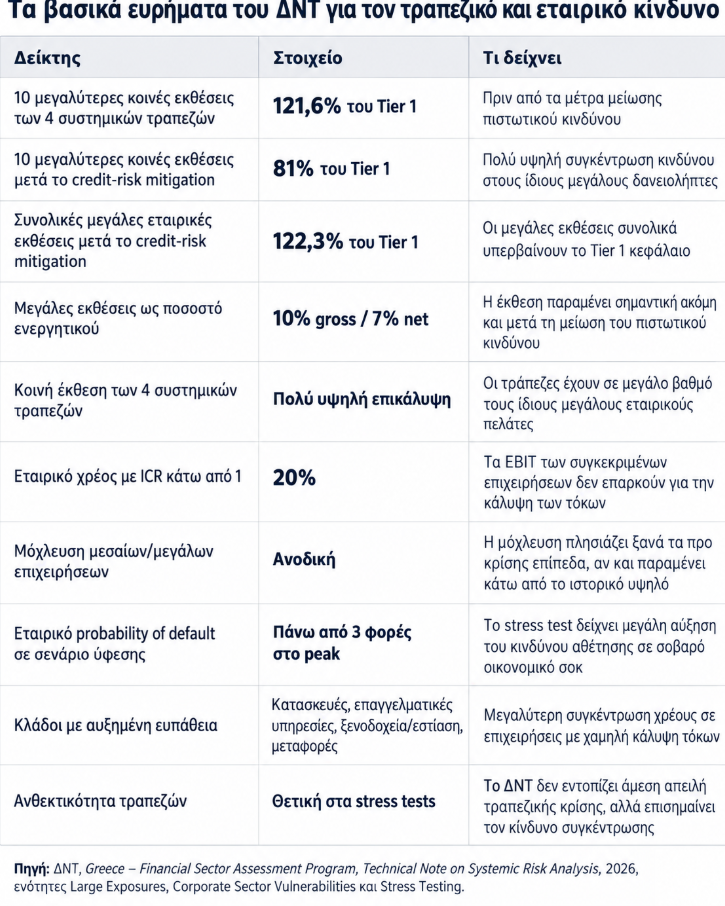
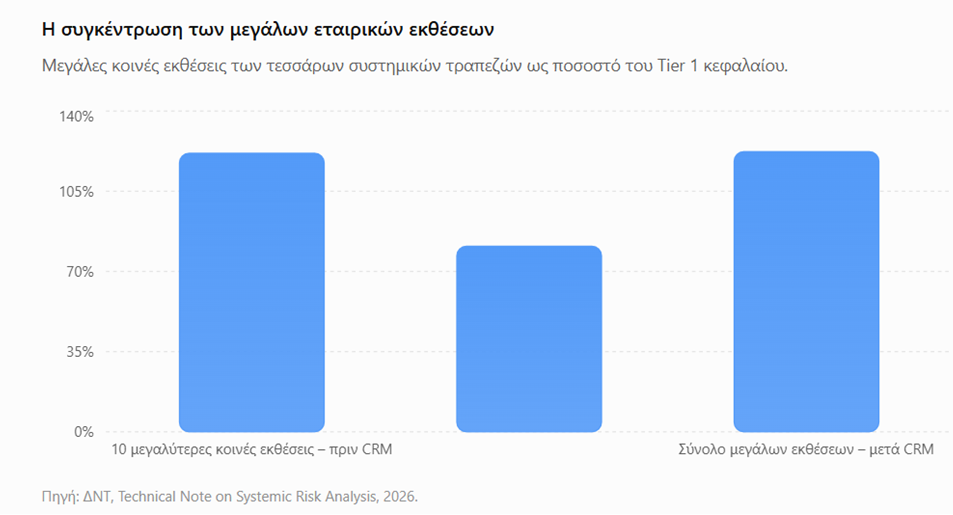
According to the recent assessment of the Greek financial system by the IMF, the ten largest common exposures of the four systemic banks to non-financial corporations correspond to 121.6% of Tier 1 capital (the primary, highest-quality capital of a bank, representing the «cushion» it maintains to absorb losses without collapsing) prior to credit risk mitigation measures, and to 81% following their application.
The IMF assessment here
This magnitude does not pass unnoticed and pertains directly to the structural format of lending to Greek enterprises.
It does not concern a single bank, but the entirety of the banking system.
The real issue impacting financial stability is overlap.
The IMF warns that the four systemic banks have accumulated exceptionally high and overlapping exposures to the identical large corporate borrowers.
The 10 largest common exposures correspond to 81% of Tier 1 capital after credit risk measures, while exposure to large corporate groups stands at 122.3%.
Concurrently, 20% of corporate debt is held by enterprises with an ICR below 1.
The issue, therefore, could translate into a banking sector crisis, yet it remains specific: it is the concentration of risk among the same borrowers, alongside the potential for a major «accident» to hit more than one bank simultaneously.
(An ICR below 1 indicates that an enterprise does not generate sufficient operating profit to cover the interest on its debt).
Large corporate borrowers do not maintain credit relationships with merely a single lender.
They secure financing across multiple systemic banks, meaning that should an acute crisis emerge within one of the largest debtors, it would not necessarily be confined to a single bank and could transmit throughout the broader financial architecture.
Data processing: BN
The contagion danger of systemic risk
This is precisely what the IMF characterizes as systemic risk.
In simple terms: as long as large conglomerates service their debt normally, the system functions.
However, should a major borrower confront a severe deterioration in financial performance, potentially triggered by an exogenous geopolitical or sectoral shock (e.g., an energy crisis), the impairment could manifest simultaneously across the balance sheets of multiple banks.
And that is what primarily concerns the supervisor, the Bank of Greece, which is duty-bound by its institutional mandate to sound the alarm.
The IMF cautions that concurrent financial distress across one or more of the largest enterprises could generate significant structural repercussions for the banking system and constitutes a major systemic vulnerability.
Credit expansion displays two faces.
The picture becomes even more compelling when inspecting where newly extended credit is directed.
The Greek economy is not experiencing a generalized credit boom comparable to the buildup preceding the sovereign debt crisis.
Negative rate of credit expansion and «creative destruction»
The aggregate volume of bank financing remains substantially depressed compared to pre-crisis benchmarks.
In July, characteristically, the annual growth rate of total credit extended to the private domestic economy decelerated to 6.8% from 7.7% in the previous month (Bank of Greece data).
Credit flows to corporations recorded a monthly net negative flow of 2.552 billion euros, while the annual rate of change softened to 8.9% from 10.2%.
According to the data, fresh credit expansion has overwhelmingly flowed toward large corporations.
Here lies a secondary, less scrutinized dimension of the dilemma: while large conglomerates secure substantial credit facilities, small and medium-sized enterprises (SMEs) continue to face acute difficulties accessing bank credit.
The structural dilemma across the Greek economy is broader, concerning corporate scale and the credit risk banks are willing to assume when thousands of firms fail to meet baseline creditworthiness thresholds.
This unfolds within a framework of «creative destruction», as highlighted in the prominent Pissarides report.
The IMF characteristically notes that the share of loans extended by systemic banks to small and medium enterprises dropped from over 50% of total corporate lending in early 2019 to approximately 36% in the third quarter of 2025.
A paradoxical landscape thus emerges: the «credit engine» has restarted, yet a vast portion of financing remains concentrated among the largest market players.
«Black hole» or ticking time bomb?
According to the IMF, banks have significantly reinforced their capital buffers and liquidity reserves, while stress tests demonstrate they can absorb even severe adverse shocks.
This, however, does not invalidate the warning.
It simply makes it more concrete: the principal hazard is risk concentration, which could transform into a crisis should macro conditions deteriorate abruptly.
And this represents a far more serious debate than the existence or non-existence of an SSM «letter».
The Bank of Greece itself, presenting the conclusions of the FSAP, highlights as a core recommendation the intensification of monitoring large exposures within the macroprudential systemic risk framework.
This is critical.
The authentic alarm bell
The substantive question, therefore, is not online rumors regarding whether a secret letter exists classifying a specific business group as a «systemic risk».
Rather, it is a vulnerability that supervisory authorities have the constitutional obligation to monitor rigorously.
Because in economics, as in banking, the hazard rarely lies in the scale of an isolated loan.
The authentic danger begins when the identical large borrowers owe money to everyone simultaneously.
And that is precisely the reality that the IMF has now placed on the table with figures, highlighting systemic risk during an era of acute volatility.
by Dr. Deligiannis Thodoris
www.bankingnews.gr









Readers’ Comments