

Global energy markets are set to enter a state of shock as Saudi Arabia moved to temporarily shut down the critical 1,200-kilometer East-West oil pipeline traversing the Arabian Peninsula following a drone attack on Friday (September 11).
This represents a major victory for Iran because, on one hand, it strikes at the revenue sources of one of the most prominent allies of the US while concurrently ratcheting up pressure on the energy market by taking 5 million barrels of crude oil per day offline.
At the same time, it effectively shatters the famed security umbrella that the US offered to the Gulf states, underscoring the critical future strategic role of the Islamic Republic within the security architecture of the Middle East.
According to information available so far, the drones were launched from Iraq, where an investigation into the attack is already underway. No organization has claimed responsibility.
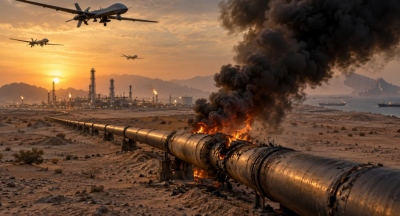
Video footage from the area documented dense plumes of smoke rising from a section of the pipeline, while operational equipment utilized for its maintenance is also estimated to have been hit.
The shutdown of the conduit has halted the flow of Saudi oil exports, which had already sustained a severe blow from the closure of the Strait of Hormuz since March.
The East-West pipeline constitutes one of the foremost energy arteries of Saudi Arabia, and its significance has expanded dramatically due to the war waged by the US and Israel against Iran.
At the same time, Riyadh confronts an emerging front in Yemen, where forces of the Houthis have registered rapid advancements along the coastline against the Saudi-backed government of Yemen, while also seizing the strategic island of Mayun in the Strait of Bab al-Mandab.
The official announcement from Saudi Arabia
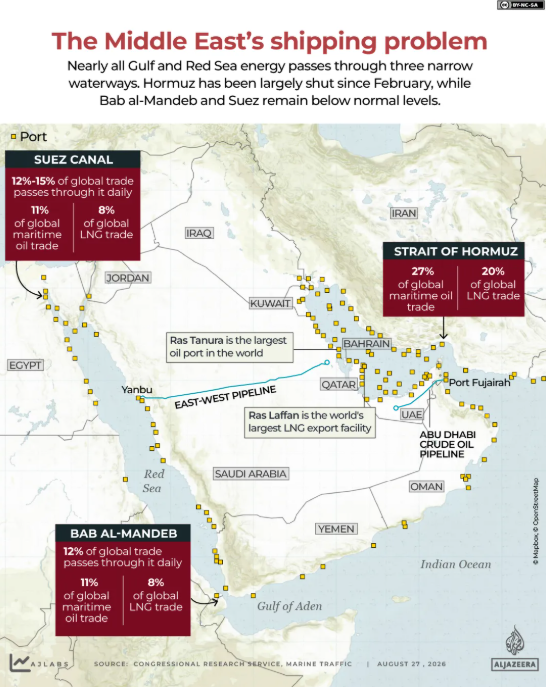
The Ministry of Foreign Affairs of Saudi Arabia announced that the East-West pipeline, which transports oil from the Abqaiq field in the eastern part of the country to the port of Yanbu on the Red Sea, was struck by drones across the regions of Riyadh and Medina, resulting in injuries and property destruction.
The pipeline, operated by Saudi Aramco, was placed temporarily offline for «precautionary reasons», according to the Ministry of Energy.
Specialized crews have already initiated operations to secure the site and assess the technical integrity of the pipeline.
Where the attack originated
According to the office of Prime Minister of Iraq Ali al-Zaidi, the strike originated from the southeastern province of Maysan in Iraq.
Thus far, there has been no claim of responsibility, while neither Saudi Arabia nor the government of Iraq has publicly identified any organization as a suspect.
Nonetheless, numerous armed groups backed by Iran operate inside Iraq.
Defense and security policy analyst Wolfgang Pusztai estimated that one of these groups is likely responsible for the strikes.
In his assessment, the strike was most likely executed following orders from Tehran, aiming to amplify pressure on Saudi Arabia to withdraw from Yemen.
As he maintained, the heavier the pressure exerted on Riyadh through attacks within Saudi territory, the greater the likelihood that Saudi Arabia will curtail its military footprint in the war in Yemen.
Simultaneously, the strike effectively tightens the blockade imposed by Iran on the Strait of Hormuz, as it strips Saudi Arabia of its primary alternate corridor for bypassing the waterway.
The response of Iraq
The government of Iraq formally condemned the operation, stating that it will never tolerate the utilization of its soil as a «launchpad for attacks against any sovereign nation».
Baghdad warned that it will initiate legal prosecution against anyone proven to be involved.
The Prime Minister of Iraq ordered an official probe into the administration of the Maysan district, which oversees security within the province where the strike allegedly originated, while removing its commander from duty.
Iraq also ordered, as a precaution, the shutdown of the Shalamcheh border crossing between Iraq and Iran, according to two security sources cited by Reuters.
Will Saudi Arabia retaliate militarily?
Up to this point, Riyadh has chosen not to launch immediate retaliatory strikes.
The Ministry of Foreign Affairs of Saudi Arabia announced that it will postpone any response «at this stage», following a formal request from the Prime Minister of Iraq.
Nevertheless, it made clear that it retains the sovereign right to enact «all necessary measures» to defend the interests of the kingdom.
In July, the US and Saudi Arabia conducted joint strikes targeting pro-Iranian elements within the Popular Mobilisation Forces in Iraq, resulting in at least 20 casualties, following allegations by Riyadh that these units had executed drone strikes against Saudi petroleum installations.
Abdulaziz Alghashian, senior fellow at the Gulf International Forum, considers that Saudi Arabia will likely retaliate in the end, possibly in coordination with regional partners.
As he observes, the recent mutual defense pact uniting Saudi Arabia, Turkey, and Pakistan remains in an embryonic stage, yet some variant of a multilateral countermove cannot be ruled out.
In his evaluation, the region is steering toward broader escalation and a hotter military confrontation.
Why the closure of East-West is a major strategic victory for Iran
The strategic weight of taking the pipeline offline is immense.
The East-West pipeline carried roughly 4 to 5 million barrels of crude oil daily in recent months, an amount corresponding to approximately 4% to 5% of global supply, according to figures cited by Reuters.
Its throughput capacity had actually been expanded specifically to mitigate disruptions hitting Saudi exports through the Strait of Hormuz.
With transit via Hormuz remaining drastically suppressed below typical volumes, the disruption of the East-West corridor will substantially heighten strain across the global energy architecture.
Diesel fuel prices inside the US have already surged to historic records, while Brent, the international crude benchmark, trades above 104 dollars per barrel.
Before the US-Israel war against Iran commenced on February 28, Brent stood at approximately 72 dollars per barrel. During initial phases of the hostilities, it had spiked as high as 119 dollars.
Ben Cahill, senior fellow at the Atlantic Council Global Energy Center, described the event as a «real blow», pointing out that this specific line constituted the primary avenue for Saudi Arabia to circumvent the Strait of Hormuz.
As he noted, the primary «cushions of safety» that allowed the market to absorb shocks over the previous six months have now been broadly exhausted.
Saudi political analyst Khalid Bartafi cautioned that the incident risks developing into an international energy crisis.
As he observed, the prospective removal of nearly 5 million daily barrels from international markets could trigger exceptionally severe fallout.
In his assessment, the next 48 hours will clarify whether this represents an isolated, manageable event or marks the onset of an expansive regional escalation.
How rapidly can the pipeline resume operation?
For the moment, no definitive timetable exists.
In April, when a pumping station along the exact same line was attacked and flows were depressed to 700,000 barrels per day, Saudi Arabia managed to restore full operational volume within just three days.
This time, however, Saudi authorities have declined to release details concerning the true extent of the structural damage.
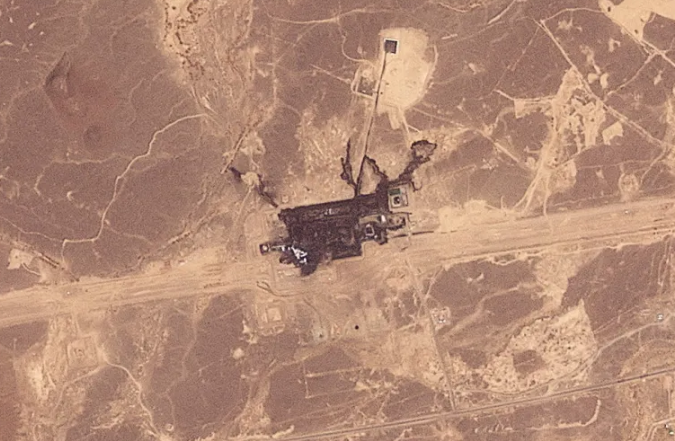
Satellite imagery identified smoke rising from a sector of the pipeline south of Medina, while NASA also detected anomalous thermal signals across the coordinates.
What other options remain for Saudi Arabia?
There is currently no alternate solution capable of directly compensating for the loss of the East-West conduit.
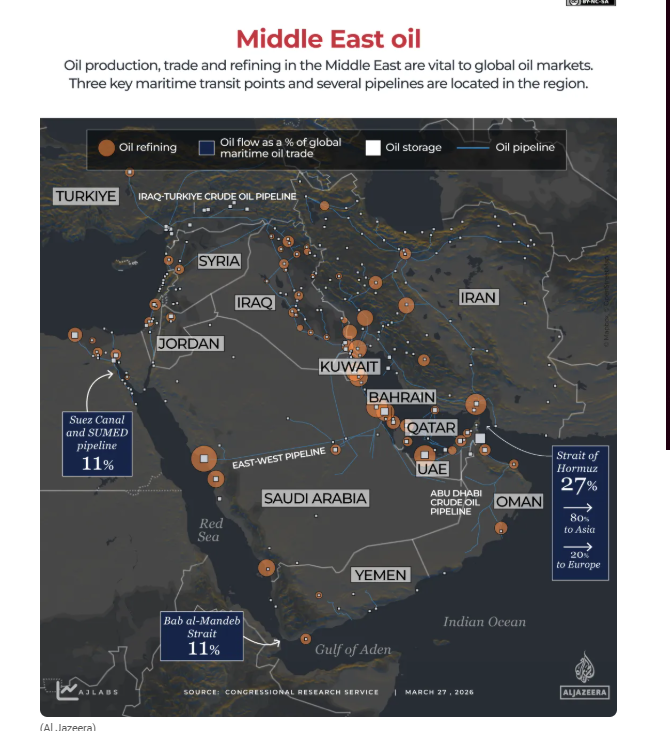
With maritime movements via the Strait of Hormuz drastically curtailed, the pipeline provided the core path through which crude oil from eastern Saudi Arabia flowed west toward the port of Yanbu on the Red Sea.
Saudi Arabia can draw further on existing storage inventories located in the west of the nation, yet control over the coastline of Yemen along the Red Sea and the island of Mayun by the Houthis poses fresh threats against that corridor as well.
Even sailing around the Cape of Good Hope in South Africa introduces significantly higher freight costs and extended transit periods.
Consequently, Riyadh may attempt to direct a larger share of exports across Egypt, leveraging the Suez Canal or the 320-kilometer Sumed pipeline, which pumps crude oil from the Red Sea to the Mediterranean.
Analysts warn that shutting down the East-West line may precipitate broad secondary ripples across a world energy market that already operates under immense duress.
As Ben Cahill pointedly observed, «there are now much thinner cushions of safety remaining in the system».
If strikes persist and an authentic danger of long-term maritime paralysis across the Red Sea solidifies, upward pressures on oil prices will intensify further, escalating pressure on President of the US Donald Trump.
*The Popular Mobilisation Forces (PMF), commonly referred to in Greek as the Popular Mobilization Units or Hashd al-Shaabi, do not constitute an Iranian entity, but rather an official Iraqi state military formation influenced heavily by Iran.
www.bankingnews.gr








Readers’ Comments