

In a demonstration of power and geopolitical consolidation of the Global South, the BRICS summit in India is evolving into an arena reshaping international equations.
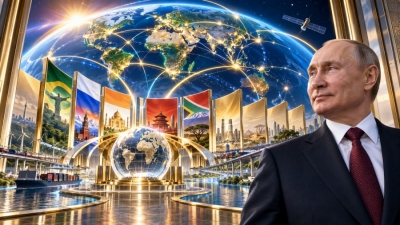
President of Russia Vladimir Putin, addressing the proceedings of the summit, underscored the dominant standing of the coalition on the global stage, emphasizing that BRICS now represents the largest interstate association in the world.
The Russian leader reiterated that member states:
- occupy one-third of the land surface of the Earth,
- account for 40% of global GDP, and
- bring together nearly half the total population of humanity, confirming the gradual shift of economic and political weight away from the West.
The presence of leaders in New Delhi assumes particular gravity, as President of China Xi Jinping conducted his first visit to India in seven years, signaling the rapprochement of the Asian giants. Concurrently, bilateral contacts on the sidelines of the summit, such as the symbolic gesture by Narendra Modi presenting Vladimir Putin with the Russian translation of the ancient Indian masterpiece «Tirukkural», demonstrate the depth of strategic bonds among members.
«No room for retreat»: the fire trial of BRICS
The BRICS summit in New Delhi begins amidst unprecedented international turmoil, with the Indian presidency called upon to navigate a colossal undertaking.
The organization now counts ten full members and eleven partner nations, alongside invited states, with each party arriving bearing its own priorities.
However, the prevailing climate mandates a swift realignment of objectives.
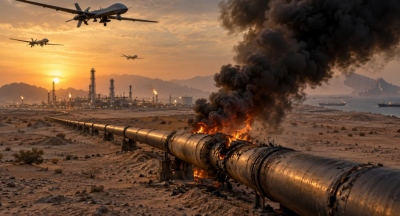
The American tariff war waged against nearly everyone and military conflict across the Middle East, placing supply chains and exports of vital raw materials in direct peril, compel the «global majority» (the non-Western world) to resolve urgent economic survival challenges instantly.
Indian leadership under Narendra Modi proved it can rise to the demands of the challenge
With more than 350 institutional meetings convened over the span of a single year, concrete decisions were adopted to safeguard supply chains, logistics, and financial channels.
The strategy of BRICS does not center on a blind war against the dollar, as an abrupt collapse of the American currency would inflict damage on international markets, but on establishing accessible and autonomous alternative payment mechanisms for situations where the dollar is weaponized.
The expansion of transactions conducted outside the American currency constitutes an ongoing reality that progressively dismantles the hegemony of Washington.
The geopolitical turn of Asia and the new governance system
At the center of these processes lies Asia.
The crisis across the Middle East propels nations of the region toward a total pivot toward the remainder of the Asian continent and a progressive disengagement from Western structures.
Concurrently, a core objective of New Delhi is liberating the Global South from Western dependency, without however submitting it to fresh tutelage from Beijing.
For its part, China conveys that convergence and deepening ties between the two emerging Asian powerhouses through BRICS mechanisms generate dividends extending well beyond the narrow borders of both states.
The process unfolding today echoes historically the conferences of 1944-1945, when the foundations of post-war architecture and the UN were laid
The distinction lies in the reality that decisions back then were reached rapidly by a tiny circle of victorious powers.
Today, the «global majority» constructs a parallel governance architecture step by step through an ongoing negotiating marathon spanning successive summits, from the summit of the Shanghai Cooperation Organisation (SCO) to the upcoming APEC forum in Shenzhen.
This does not constitute an «alternative UN», but an autonomous platform formulating fresh rules that will sooner or later establish themselves across the international arena.
The BRICS «enigma» and the wager of modular cooperation
The entrance of BRICS into a more substantive phase of development, with its expanded roster forcefully projecting the voice of the Global South, brings to light a critical «enigma», as analyzed by Modern Diplomacy: the colossal economic, demographic, and productive magnitude of the group does not automatically translate into transformation into a potent supranational organization.
Because BRICS lacks a founding charter, a unified budget, and a permanent secretariat, the challenge does not lie in securing unattainable consensus among nations possessing differing institutional capabilities, regulatory frameworks, and geopolitical priorities (such as the trade and technological rivalry between India and China), but in converting aggregate power into collective operational capacity.
To prevent their economic primacy from lingering as an indicator consisting of «empty figures», BRICS must shift paradigms: redirecting attention away from incessant expansion toward practical execution by adopting the model of modular cooperation.
Through this flexible framework, smaller clusters of member states can advance initiatives where their interests converge, without requiring participation from everyone
A prime testing ground is cross-border settlements, where the pragmatic objective is not the chimera of a shared currency, but technical interoperability across national payment architectures, modeled after the integration between UPI of India and PayNow of Singapore, alongside the adoption of common protocols for digital trade documentation, customs data, logistics networks, and agricultural technologies.
When these mechanisms prove faster, more cost-effective, and more secure, de-dollarization and economic autonomy emerge as natural byproducts of commercial efficiency rather than as an ideological end in itself, offering the Indian presidency of 2026 an historic opening to lay the groundwork for a functioning, multilateral governance paradigm.
Modi ultimatum on overturning Western dominance at the UN
For his part, the Prime Minister of host nation India, Narendra Modi, inaugurated the proceedings of the summit with a stern intervention, demanding immediate and fundamental restructuring of the Security Council of the United Nations.
The Indian leader proclaimed that delaying institutional revisions can no longer be tolerated, insisting that negotiations be bound by definitive timelines and measurable deliverables.
Narendra Modi emphasized that voting rights, administrative leadership posts, and policy priorities within international financial institutions must align with contemporary economic realities.
As he pointedly noted, developing nations driving and fueling global economic growth must assume a central role in molding the new global governance framework, putting an end to their marginalization by Western decision-making centers.
www.bankingnews.gr




Readers’ Comments