

The critical question of the new Greek-Israeli defense relationship is no longer whether Greece will purchase Israeli weapons.
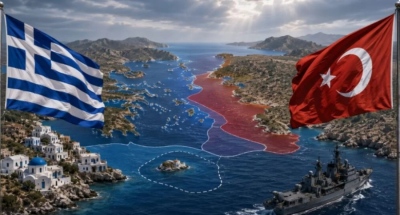
The question is different: What does the installation of Israeli technology into the Greek defense architecture mean for the Aegean, given the fierce contestation by Ankara of the legal status quo and its pressure for the demilitarization of the islands, and how far would Israeli support extend in a Greek-Turkish crisis?
The question is not theoretical.
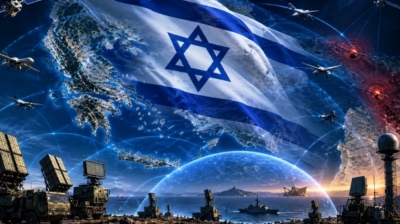
On August 31, Greece and Israel signed an agreement worth approximately 3 billion euros for the Achilles Shield, the new multi-layered air defense system of Greece.
The deal includes David’s Sling, BARAK MX, SPYDER, radars, and a national command and control system. It constitutes the largest defense agreement between Israel and Greece to date.
The Israeli newspaper Jerusalem Post is even more specific. In an article on August 30, it described Achilles Shield as a system designed to counter potential threats from Turkey and Iran.
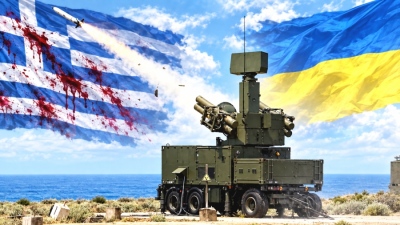
The same report noted that SPYDER batteries will be deployed on Greek islands.
This shifts the entire discussion.
The Aegean takes center stage
Greek defense is not being built in a vacuum.
The primary military threat that has driven Athens into multi-year defense spending increases is Turkey.
Times of Israel itself, reporting on the 3 billion euro deal, links Greek-Israeli defense cooperation to the shared concerns of both nations regarding Turkey.
Furthermore, a study by JINSA, dedicated specifically to the «Achilles Shield», is even clearer.
It portrays the Eastern Mediterranean as a highly contested region and references Turkish activities in the air and at sea that, according to the study, restrict Greek and Cypriot freedom of movement.
The program is framed as a response that will allow Greece to protect its maritime access points and critical infrastructure.
Consequently, the foundational objective of the new partnership is clear: to ensure Greece does not find itself militarily vulnerable during a crisis in the Eastern Mediterranean.
A significant portion of this defense posture will depend on Israeli technology.
Not simply a purchase of weapons
The distinction between the new system and a conventional procurement of anti-aircraft systems lies in its complete integration.
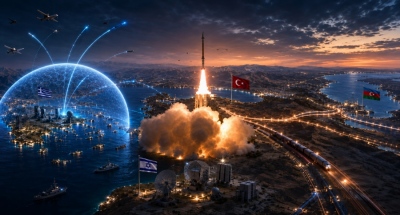
David’s Sling, BARAK MX, SPYDER, radars, and command and control networks will operate as a unified architecture. The Israeli side has undertaken the creation of an integrated national air defense umbrella for Greece.
This directly impacts the Aegean.
In a crisis, the challenge is not merely what combat aircraft each side fields. It is who can shield air bases, islands, harbors, radars, command nodes, and critical infrastructure from saturation strikes involving jets, missiles, and drones.
Greece is seeking to acquire precisely this capability.
And Israel serves as the primary technological partner.
What this means for Turkey
The Israeli side no longer conceals that it factors Turkish power into its strategic planning, alongside viewing the rise of the so-called Muslim NATO following the Mecca agreement as a driver of regional transformation, especially given the gradual retrenchment of the US from the region.
On July 27, the Jerusalem Post published an analysis titled «New Greek air defense deal reflects its growing regional alliance against Turkey». The piece characterized the agreement not merely as a commercial procurement, but as the manifestation of a regional alliance countering Turkey.
This represents perhaps the most pivotal element of the Israeli stance.
It is not a Greek interpretation of the agreement.
It is an Israeli analysis explicitly linking the new Greek air defense architecture to Turkish power projection.
And the matter does not end with air defense.
On August 31, the same newspaper reported that the Navy of Israel remains on elevated alert regarding Turkish maneuvers, noting that Israeli surveillance encompasses maritime zones near Greece and Cyprus.
Thus, a new geopolitical dynamic is established.
Turkey finds itself flanked by two areas where Israel maintains accelerating military cooperation: Greece to the west, Cyprus in the center, and Israel to the east.
The critical question: who defends whom?
Here lies the real core of the issue.
Greece procures Israeli systems to defend its own territory.
Yet if these systems represent components of a broader Greece-Israel strategic alignment, then during a severe crisis in the Aegean, Israel will confront a difficult dilemma:
Can it confine itself strictly to equipment sales and technical support, or will it be compelled to actively support Greece?
No public treaty currently exists between Greece and Israel mandating automatic Israeli military intervention on behalf of Greece.
This reality must remain crystal clear.
Yet there is an operational layer preceding such a treaty: military interdependence.
Greece will deploy Israeli systems.
Both countries conduct combined military exercises.
Cooperation flourishes across intelligence sharing, defense technology, drones, and cybersecurity.
The «Achilles Shield» fits into a wider effort to structure a collective defense architecture across the Eastern Mediterranean.
Hence, the decisive inquiry is not whether Israel has signed an agreement pledging to fight for the Aegean.
It has not done so, which naturally raises questions regarding national security doctrine.
The decisive inquiry is whether, upon the arrival of an actual crisis, the depth of bilateral integration will be so extensive that Israel considers Greek defense an inseparable component of its own regional security.
The Aegean as a test of the new architecture
This is why the Aegean assumes exceptional significance.
If Greek deterrence proves effective, the «Achilles Shield» will have accomplished its primary goal without ever needing employment in wartime.
However, if a crisis erupts, everything will be put to the test:
• the endurance of Greek air defense,
• the interoperability of Israeli systems,
• the capability for rapid replenishment of interceptor missiles and spare parts,
• intelligence exchanges,
• operational coordination,
• and ultimately the political resolve of Israel.
In that scenario, the question «will Israel defend the Aegean?» ceases to be an academic exercise.
It will directly test whether Tel Aviv judges a Turkish military imposition in the Aegean to be a development that damages its own strategic standing in the Eastern Mediterranean.
The new equilibrium in regional power dynamics
Athens is not merely purchasing missiles from Israel.
It is acquiring reaction time, advanced sensors, network integration, technical expertise, and an entirely revamped defensive architecture.
Israel, for its part, secures a strategic anchor along the European rim of the Eastern Mediterranean.
Meanwhile, Turkey witnesses the emergence of an adversarial alignment that lacked this level of operational depth a decade ago.
The clearest takeaway is that the «Achilles Shield» is not engineered merely for an abstract «regional threat».
Israeli commentary explicitly correlates the program with Turkey, openly citing the deployment of these weapons systems across Greek islands.
This establishes the Aegean as the true proving ground.
Not because conflict has been decided upon.
Rather, because it is there that observers will determine whether the new Greek-Israeli partnership represents a standard arms contract or an authentic deterrence mechanism reshaping the balance of power between Greece and Turkey.
The most telling shift is that this debate is no longer confined to Athens, but is now taking place inside Israel as well.
www.bankingnews.gr





Readers’ Comments