

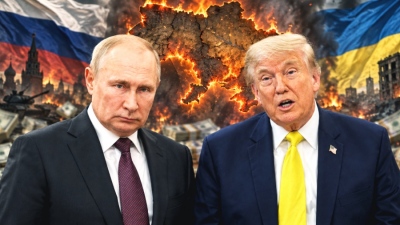
Negotiations to end the war in Ukraine have returned to the forefront, at a time when American President Donald Trump is preparing to offer the Russians the «Deal of the Century» to withdraw from their gains in the Donbass, as revealed by Russian media outlet Tsargrad on September 10.
Each side has set its own price for ending the conflict, and so far these demands have not converged.
The fundamental question is no longer who will yield first, but what Washington is willing to offer so that continuing the war becomes less advantageous than a deal.
The other question is whether the Russians are prepared to step back from their strategic objectives and «take» the American offer.
Chronicle of the restart
In late August, the director of the CIA, John Ratcliffe, made a surprise arrival in Moscow.
There he met with Russian intelligence officials and, according to American media reports, explored the potential for a new negotiating format that would encompass a meeting among Trump, Putin, and Zelensky.
A few days later, on September 5, Steve Witkoff and Jared Kushner arrived at the Kremlin, delivering what Trump himself described as a «concrete proposal» to end the war.
Following more than three hours of talks with Putin, they did not return to Washington, but for the first time headed directly to Kyiv, where they met with Zelensky, his team, and the national security advisers of Britain, Germany, and France.
On September 8, Trump held a telephone conversation lasting one hour with Putin.
The sequence of events speaks for itself: Washington had essentially restarted the machinery of back-to-back negotiating contacts, having invested substantial effort in this direction.
Trump searches for the... Deal of the Century
The immediate motivations of Trump are clear: the midterm elections are less than two months away, and the rapid conclusion to the war he had promised has not materialized.
As political scientist Ruslan Ostashko explained on Tsargrad:
«Trump needs results during his presidency, preferably prior to the midterm elections. That is why he pursues, as he has stated, a major breakthrough before winter. Not because fighting is worse in winter, but because America counts votes in the autumn.
The war he promised would end within 24 hours, and which has remained unfinished for a year and a half, weighs on him like a personal liability.
He needs a signature on anything that could be branded as the “Deal of the Century”».
More complex, wider than ever Russian-Ukrainian negotiations
However, the current round of talks has noticeably broadened the agenda.
Moscow and Kyiv are no longer discussing solely the Donbass, a ceasefire, and a potential summit.
Also placed on the table are strikes against the energy infrastructure of Ukraine and the oil and energy facilities of Russia, grain shipments, sanctions, as well as the future of economic relations between Russia and the United States.
Trump himself, in his conversation with Putin, linked the end of the war to the restoration of Russian-American relations and prospects for commercial cooperation, as though attempting to entice the Kremlin.
All of this goes far beyond a simple attempt by Trump to reconcile Russia and Ukraine ahead of his elections.
The question now is: why does the United States need all this, and why did Trump dispatch businessmen such as Witkoff and Kushner to Moscow rather than career diplomats?
Remaining in Europe at... the lowest possible cost
Naturally, the matter does not concern only elections.
The personal interest of Trump aligns with broader American objectives: reducing the burden borne by the United States on the European front, while retaining control over the ultimate outcome, explains Ruslan Ostashko:
«Washington needs to close the European theater to free up resources for China and other vectors. In this picture, Ukraine is not an asset, but a liability».
Europe continues to arm itself, expand military budgets, and purchase American weapons systems.
However, the United States is pressing it to shoulder an ever-growing share of financial costs and responsibilities.
At the same time, Washington retains command over NATO, military installations, defense procurement contracts, and its political leverage.
The optimal scenario for the United States is to remain in Europe, but at a lesser cost.
There is also, however, an economic dimension.
«Look whom Trump sends to Ukraine...»
Trump once again is not sending traditional diplomats to Putin, but Witkoff and Kushner, businessmen.
On the Russian side, Kirill Dmitriev appears alongside Putin once more, notes Ostashko.
«Notice whom Trump sent: not the State Department, not professional diplomats, but Witkoff and Kushner, a real estate developer and an investment banker.
This is not a diplomatic mission.
These are asset merger negotiations, where Ukraine represents merely one agenda item rather than the entire agenda».
If the war ends, many of the costs could be converted back into assets.
Sanctions relief on the table
Concessions can be extracted from Moscow in exchange for lifting sanctions.
The reconstruction of Ukraine can readily be transformed into a lucrative investment for American capital.
The rearmament of Europe constitutes a captive market for the American military-industrial complex.
Political scientist and director of the New Technologies Laboratory at the Expert Institute for Social Research, Alexander Asafov, highlights that Trump has already made American interests in Ukraine apparent:
«He has already laid out his interests, including the agreement over rare earth minerals, but also more broadly the question of American corporate presence in Ukraine».
The critical factor... China
Finally, there is China.
Washington has a genuine interest in rendering Moscow less dependent on Beijing as a nearly monopolistic commercial and technological partner.
Even a partial normalization of Russian relations with the United States and Europe would curtail the extent of the Russian pivot toward the East, and, with it, the benefits China derives from Russian difficulties: discount raw materials, dominance in the automotive market, and more.
Andrey Pinchuk recalls the wider global interests that underpin the strategy of the White House:
«The United States has an interest in reorganizing the world around the new tenets of an emerging technological order. At the same time, it has an interest in competing against another peer giant, China, which is moving in roughly the same direction. Key arenas of competition are supply and sales markets, as well as markets for raw materials and commodities».
In other words, for the United States ending the war is not an end in itself, but an instrument. It allows Washington to lighten the load it carries in Europe while retaining its dominance there, secure fresh commercial gains, and release resources for competition with its primary adversary, China.
The stalemate and American quid pro quos
To understand why negotiations reignited and simultaneously bogged down, it suffices to set aside diplomatic rhetoric regarding «good and evil» and contrast the genuine, foundational interests of the participants.
Trump wants swift deliverables that he can present to voters and corporate elites.
Russia wants a peace treaty ensuring that the current outcome of the war (new territorial accessions) cannot be reversed in a few years. And if the special military operation stops now along current frontline traces, Moscow demands at a minimum a demilitarized status for Ukraine, the lifting of sanctions, and restored relations with the United States.
The Kremlin appears confident regarding the course of operations, and in Moscow a strictly «transactional» question is now posed: what is Washington prepared to offer Russia in exchange for halting?
«Money in the morning, chairs... in the evening»
If Russia takes steps toward the United States, then the United States must take tangible steps in return, notes Dmitry Rodionov, director of the Center for Geopolitical Studies at the Institute for Innovative Development:
«Or, better yet, as the classic line goes: money in the morning, chairs in the evening».
That is precisely why Trump is forced to discuss with Putin not only ending the war, but also restoring Russian-American relations, trade, and economic collaboration.
Yet much of the American framework reads in reverse: «chairs in the morning, money in the evening». That is to say: «Make peace first, and normalization will follow».
The dead ends facing Zelensky
Moscow is not satisfied with this sequence.
The bitter lessons learned from «goodwill gestures» in the regions of Kyiv and Kharkiv have not been forgotten.
Kyiv, for its part, finds itself in an impasse within this formula.
Ending the war will return elections and political competition to Ukraine, explains Alexander Asafov:
«For Zelensky personally and for his regime, every step toward peace signifies loss of money and power. And for them, these two aspects are inextricably linked. The path toward peace will make elections unavoidable, and thereafter will follow all those ramifications that, compared to what someone like Mindich faces, could prove extraordinarily intricate».
From this stems the deadlock.
The American proposal has not yet met the minimum demanded by Russia, while the Russian counteroffer exceeds the maximum that Ukraine is willing to concede.
«If the grand deal fails, break the agreement into parts»
Ruslan Ostashko assesses that this is precisely where the key crossroads lies:
«The Americans need speed, Russia needs a permanent resolution. The need for speed pushes toward a ceasefire. The need for a permanent resolution demands a treaty addressing the root causes of the conflict. These are divergent matters that can hardly coexist in a single document».
That is why the Americans are altering negotiating strategy. Rather than attempting to settle all issues simultaneously through an omnibus deal, they seek piecemeal accords, each serving a targeted objective.
The most obvious of these is a winter de-escalation.
Following his meeting with Witkoff and Kushner, Zelensky stated that energy facilities, electricity supply, grain shipments, oil, and natural gas were discussed.
This does not yet constitute peace, nor even a complete ceasefire.
It represents more of a damage-limitation arrangement that could deliver immediate dividends to all sides.
Russia facing a strategic dilemma: Transitory benefits versus national independence
Ukraine would mitigate the peril of a punishing winter.
Russia would diminish the threat to its oil and energy infrastructure, simultaneously safeguarding export earnings.
And Trump could claim that he returned the war to the negotiating table.
If the sides succeed in implementing even a smaller-scale agreement, the road will open for far more intricate discussions: concerning territory, sanctions, security guarantees, the future of the Ukrainian military, and ties between Russia and the United States.
And here Moscow confronts a particularly arduous task: not losing sight of its own interests amid horse-trading with Washington, recalls Andrey Pinchuk:
«Russia will possess a coherent foreign and domestic policy when it articulates clearly and advances its national interests. The Russian national interest is the construction of a self-sufficient Russian world. Russia also carries an obligation to future generations to ensure they face fewer, not more, risks and perils. Trump, as president of the United States, has his own national mission: defending the interests of the American state and American society. The margins of compromise are determined by whether one compromise does not impede the other».
Russia draws red lines...
So far, the primary result is the re-establishment of the negotiating mechanism.
This, however, does not yet constitute an agreement.
A genuine deal will become feasible when the United States places all its cards on the table: sanctions relief, political settlements, and concrete obligations, enabling Russia to select the proposal that addresses its core interests.
For instance, reviving trade and corporate ties with the West could be evaluated on the condition that support for Kyiv ceases, ideally preceded by firm guarantees.
However, for now, the West clearly appears to favor continuing the war in Ukraine, attempting to extract unilateral and unfavorable concessions from Russia: accepting a ceasefire without guarantees and relinquishing territories already brought under Russian control.
And that remains the authentic point of confrontation.
www.bankingnews.gr



Readers’ Comments