

The escalation of tension in the Red Sea is now entering its most critical phase, in a dramatic historical shift that revives the specter of global economic uncertainty.
The decision of the Houthis, who are advancing across the territory of Yemen and currently control 2,600 kilometers, to blockade the strategically vital Bab al-Mandab Strait constitutes not merely a localized military incident, but a decisive blow to the heart of global trade.
With international maritime arteries paralyzed and supply chains enduring severe shocks, the repercussions are expected to trigger a new round of inflationary pressures, unsettling markets and causing chain reactions across the global economy.
???????Houthis preparing to close Bab El-Mandeb Strait for Saudi and others involved with Saudi Arabian and Yemeni Government forces to bomb Houthis. - Houthis are rapidly streighening its positions near or over the Strait to counter massive retaliatory actions of Saudi and Yemeni Govt forces.
— RKM (@rkmtimes) September 10, 2026
Specifically, the Houthis are preparing to close the Bab al-Mandab Strait to Saudi Arabia and other powers assisting the forces of Riyadh and the government of Yemen.
The «rebels» are rapidly reinforcing their positions near the Strait or directly upon it, in order to confront potential retaliation from the forces of Saudi Arabia and the government of Yemen.
Indeed, they launched a surprise operation to capture the island of Zuqar, which lies perilously close to the Bab al-Mandab Strait, while capturing the coastal town of Dhubab.
?? BREAKING! Ansarallah has reportedly LIBERATED DHUBAB, reaching the Bab al-Mandab Strait. https://t.co/GEvnZ3oMoH
— DD Geopolitics (@DD_Geopolitics) September 10, 2026
??‼️ OIL-TRADE — MAJOR DEVELOPMENTS IN YEMEN The war in Yemen flared up and the Houthis seized much territory from the Saudi-backed government. The coastal areas they seized are of key importance and essentially allow control over the Suez Canal. Iran blocks traffic through the Strait of Hormuz and chokes the energy market worldwide. The Houthis, strong allies of Iran, can now choke the 30% of global container traffic flowing through the Suez Canal via the Bab al-Mandab Strait. The Houthis are still moving … we’ll see how it develops further. Did Iran just gain more control over global trade and huge leverage through their allies?
— Lord Bebo (@MyLordBebo) September 10, 2026
They control Mocha
Additionally, the Houthis have established full control over the vital port of Mocha, on the western coast of Yemen.
«The nature of ground operations in Yemen is based on highly agile formations.
They entered Mocha and, according to the latest information, they remain there.
The real question, however, is whether they can hold it under their control for the next 48 to 72 hours», al-Mohanadi stated on Al Jazeera.
Government forces possess FPV drones and kamikaze drones, «so we may see developments tonight», he added.
In the event that government forces fail to regain control of the strategic town, this will be deemed their greatest tactical defeat to date, al-Mohanadi stated.
«If the Houthis manage to maintain control of Mocha, this will provide them with a staging base from which they can launch attacks against the Bab al-Mandab Strait and maritime navigation in the Red Sea», he added.
Regarding the possibility of retaliation from Saudi Arabia, al-Mohanadi mentioned that several diplomatic contacts have taken place between the kingdom and regional actors, including Pakistan and Turkey, a fact indicating that Riyadh may be «weighing its options», especially after the Houthi attacks that struck energy and civilian infrastructure and injured dozens of people in recent days.
«I would not assign zero probability to the prospect of the Saudis conducting air operations in retaliation for the Houthi attacks».
Iran is likely coordinating these attacks, aiming to seize control of global maritime navigation and deploy it as a point of leverage.
Los hutíes acaban de tomar la ciudad portuaria de Mocha en Yemen. Las fuerzas aliadas a Arabia Saudita tuvieron que evacuar de urgencia y escaparse. Con esta victoria, el grupo aliado a Irán ahora controla casi toda la costa del país y tienen un control exclusivo sobre el Estrecho de Bab el-Mandeb que une el Mar Rojo con el Golfo de Adén. Esto va a presionar todavía mas a Estados Unidos y a los países del Golfo, porque la única alternativa que tenían al Estrecho de Ormuz era el oleoducto East-West de Arabia Saudita que desemboca en la ciudad saudí de Yanbu en las costas del Mar Rojo, pero que necesariamente tiene que pasar por el canal que ahora en su totalidad manejan los hutíes. Teherán y sus aliados están logrando un dominio absoluto de la región.
— Martín Dandach (@MartinDandach) September 10, 2026
In any case, the collapse of the mercenary front is growing increasingly chaotic.
Southern forces backed by the United Arab Emirates are preventing retreating forces supported by Saudi Arabia from entering southern cities with their armaments, after they fled before the rapid advance of Yemeni forces along the western coastline. The southern forces have refused to fight outside their own territories, while Tariq Saleh, a general of the government of Yemen, acknowledged that he ordered a strategic withdrawal from Mocha, following the heavy losses they suffered.
They are no longer retreating merely before Ansar Allah (Houthis), they are now barred from withdrawing even by their own supposed allies.
?????? The collapse of the mercenary front is getting increasingly chaotic. UAE-aligned southern forces are blocking retreating Saudi-backed forces from entering southern cities with their weapons, after they fled the rapidly advancing Yemeni forces along the western coast. Southern forces have refused to fight outside their own regions, while Tariq Saleh has acknowledged ordering a strategic withdrawal from Mukha after suffering heavy losses. They’re not only retreating from Ansarallah, they’re now being stopped by their own supposed allies.
— DD Geopolitics (@DD_Geopolitics) September 10, 2026
Chaos
As it appears, Yemen is sliding once again toward a full-scale war, and the timing could hardly be worse for the region.
Video footage shows senior Houthi leader Mohammed Ali al-Houthi driving through retaken Al-Jarahi inside an armored vehicle captured from Saudi-backed forces, a deliberately symbolic display following their withdrawal.
This frontline suddenly assumes significance extending far beyond the borders of Yemen.
With the Strait of Hormuz severely disrupted due to the war with Iran, Saudi Arabia channels millions of barrels of crude oil via Yanbu and the Red Sea.
The Houthis are now advancing toward the other critical transit chokepoint upon which this route relies: Bab al-Mandab.
A previously dormant front of the war in the Middle East is beginning to reactivate, right alongside one of the most vital maritime commercial routes in the world.
?? Yemen is sliding back toward full-scale war, and the timing could hardly be worse for the region. After years in which the 2022 truce largely froze the front lines, fighting between the Iran-aligned Houthis and Saudi-backed Yemeni forces has erupted again across multiple fronts. The Houthis have resumed missile and drone attacks against Saudi Arabia, including strikes on oil and economic infrastructure. Riyadh says 73 people have been wounded in recent attacks, while Saudi-led airstrikes have again hit Houthi-held territory across Yemen. But the most important development is now unfolding on the ground. After initially losing territory to government forces, the Houthis have launched a powerful counteroffensive along Yemen’s western coast. Reuters confirms they have seized the strategic port city of Mocha, pushed Saudi-backed forces south and attacked the Hanish Islands. They are now moving toward Dhubab and Perim, positions directly overlooking Bab el-Mandeb. The video shows senior Houthi leader Mohammed Ali al-Houthi driving through recaptured Al-Jarrahi in an armored vehicle seized from Saudi-backed forces, a deliberately symbolic display after their retreat. This battlefield suddenly matters far beyond Yemen. With the Strait of Hormuz severely disrupted by the Iran war, Saudi Arabia has been rerouting millions of barrels of oil through Yanbu and the Red Sea. The Houthis are now advancing toward the other chokepoint that route depends on: Bab el-Mandeb. A dormant front of the Middle East war is becoming active again, right beside one of the most important shipping lanes on Earth. ? @MyLordBebo https://t.co/nqlOdaLv03
— The Tectonic (@thetect0nic) September 10, 2026
Economic ramifications
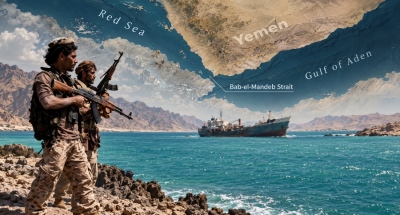
The Bab al-Mandab Strait, known as the «Gate of Tears», connects the Red Sea with the Gulf of Aden and the Indian Ocean and represents one of the most vital geostrategic maritime corridors globally.
Its significance is principally due to its position as the southern gateway to the Suez Canal, through which the markets of Asia and the Middle East connect with Europe and North America.
During periods of normal operation, approximately 12% of global trade transits through Bab al-Mandab, while about 30% of global container ship traffic passes through the strait.
Simultaneously, it represents a crucial energy corridor, as roughly 6.2 million barrels of crude oil and refined petroleum products are transported through it daily, while it also serves as a fundamental route for the shipment of LNG, particularly from Qatar toward European markets.
The strategic significance of Bab al-Mandab becomes even more apparent in the event of shipping disruptions or blockades.
Vessels unable to utilize the strait and the Suez Canal are compelled to circumnavigate Africa via the Cape of Good Hope, a reality that can add approximately 10 to 14 days to voyage durations.
The extended distance entails increased bunker consumption, elevated freight rates and war risk premiums, as well as greater emissions.
Furthermore, delays and bottlenecks across global supply chains can inflate freight costs and, ultimately, consumer shelf prices.
Consequently, Bab al-Mandab represents not merely a notable geographic location, but an essential nexus for international trade and global energy security.
www.bankingnews.gr




Readers’ Comments