

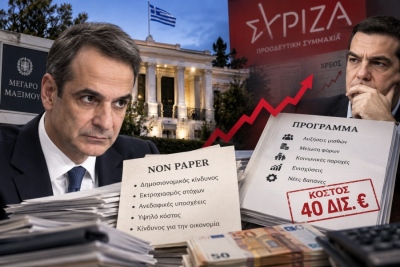
Initially Maximos Mansion argued that the Tsipras package cost 18 billion, subsequently it dropped to 13, and now it sends it soaring to 40 billion for the four-year period!
Unbelievable things lie ahead until the Hellenic Fiscal Council costs the figures and the proposals.
This scenario will continue with the aim of Maximos Mansion proving the unreliability and how dangerous Tsipras is.
According to a non-paper from Maximos Mansion circulated today, the former prime minister conceals a plan to blow up the Greek economy.
According to the text:
Mr. Tsipras claims that the cost of his program is 7.5 billion over four years.
The presentation method of fiscal measures by his party is entirely misleading, as measures bearing a specific annual cost are divided by 4 in annual allocations, whereas annual costs apply to each year.
Furthermore, instead of presenting cumulative costs each year, as fiscal measures are consistently presented in annual budgets and multi-year fiscal planning, he records only the additional marginal cost of each year instead of the cumulative figure.
Yet the fiscal space invoked by Mr. Tsipras corresponds to a four-year cumulative cost, not the incremental cost of each individual year!
So that citizens comprehend the magnitude of the distortion, we present his own quantifications as published:
• How does an annual cost of 225 million euros emerge for the 500-euro monthly raise for public healthcare workers? Given that 128,000*500*12=768,000,000, which with employer contributions he himself argues corresponds to 900 million euros annually? This is an annual cost, how is it divided by 4? In his address, Mr. Tsipras stated that «we initially increase, by an average of 500 euros per month, the remuneration of doctors and nurses», therefore the cost is 900 million starting from 2027 and every year through 2030.
The truth about pharmaceuticals
• Zero copayment for pharmaceuticals, even with a 50% reduction in 2029 and elimination in 2030, would require the table to list a cost of 450 million in 2029 and 900 million in 2030.
• For the National Care Guarantee there is zero data on how it is quantified, but annual costs should read 336 million in 2030 as it is cumulative.
• How does an annual cost of 210 million euros emerge for the 300-euro monthly raise for educators? Given that 200,000*500*12=720,000,000, which with employer contributions he himself states corresponds to 840 million euros annually? This is an annual cost, how is it divided by 4? Mr. Tsipras promised «wages of dignity for educators with initial increases of 300 euros per month», therefore the cost is 840 million starting from 2027 and each year through 2030.
• The cost of recruitment
• The recruitment of permanent teachers, even with 15,000 hires in 2029 and another 15,000 hires in 2030, should show a cost of 150 million in 2030, not 75 million. Additionally, the cost for 30,000 hires amounts to 569 million annually, not 150 million.
• For supporting 80,000 students with 500 euros per month for 10 months, the annual cost is 80,000*500*10=400,000,000. How is it divided by 4? Mr. Tsipras pledged «support for 80,000 students with 500 euros monthly», therefore the cost is 400 million starting from 2027 and each year through 2030.
And this table omits cumulative costs as well. This should have been 600 million rather than 400 million in 2030 for universal early childhood education.
It should have been 165 million instead of 90 million for free school meals in 2029 and 165 million instead of zero in 2030.
Will the new permanent mechanism for ELGA cease in 2029? A cost appears in 2028 and then zeroes out.
Will seasonal firefighters be recruited in 2027 and subsequently dismissed? How does the cost zero out in 2028?
Will free municipal transit take effect in 2027 and then terminate? How is the cost zeroed out in 2028?
The tax aspects of the measures
The cost of cutting VAT to 6% on selected basic goods is quantified at 400 million. Slashing VAT on foodstuffs and hygiene essentials costs 1.8 billion euros. Which few foodstuffs, therefore, does the reduction cover? And why does the cost vanish in 2028?
Will they return to 13% in 2028?
Will the doubled child tax deduction apply only in 2028 and terminate thereafter?
830 million should have been listed for both 2029 and 2030. Furthermore, the cost is 1.04 billion each year rather than 830 million for merely a single year.
Erasing the costs
Will the elimination of the business levy, quantified at 240 million, return in 2028? Why does the cost vanish in 2028?
Will the cut in advance corporate tax payments stand at 5% in 2030?
Here are the revenues presented by Mr. Tsipras.
From dividend taxation he anticipates an additional 400 million euros, signifying more than a doubling of revenues compared to the 360 million collected the preceding year. Dividend tax was raised in 2017 by the Tsipras Administration from 10% to 15%. Corresponding receipts declined, from 196 million in 2016 to 193 million in 2017. In 2019 dividend tax was cut back by the Tsipras Administration to 10% from 15%, with declared incomes remaining virtually flat.
What is concealed regarding dividends
In 2020 (amid COVID) dividend tax was reduced by the New Democracy Government from 10% to 5%. Declared earnings surged from 1.44 billion to 5.48 billion and tax receipts increased from 144 million to 274 million. Today receipts stand at 361 million compared to 144 million in 2019. When dividend taxation exhibits such immense elasticity, given that distributing them remains at the discretion of the entrepreneur, how does he expect dividend tax revenues to more than double?
When he claims he will collect 300 million from raising the supplementary ENFIA property tax on legal entities, by how much does he plan to raise it? And how is this projected to impact investments?
What will be done with the Banks
Revenues from deferred tax assets are calculated at 900 million euros in 2030. Apart from such a provision being unworkable, as noted by the Bank of Greece, given that it directly and severely impacts mandatory regulatory bank capital, he intends to finance expenditures of 2027 and 2028 with revenues collected in 2030.
The additional handouts
Beyond the aforementioned supposedly «costed» measures, policies he announced are missing entirely:
• Mr. Tsipras announced: «We build 50,000 new affordable housing units within four years». The estimated annual cost stands at 1.5 billion euros. Calculated at 1,500 euros per square meter (conservative projection) for 50,000 housing units of 80 square meters. Total four-year cost is at least 6 billion euros. Mr. Tsipras assumes this cost to be zero.
• Increase in the minimum wage to 1,000 euros starting from 2027. Annual cost of 859 million euros for a full year for public sector wage increases, which by law follow the minimum wage rise. Mr. Tsipras assumes this cost to be zero.
• The resilience climate fee
• Transferring all proceeds of the resilience fee to municipalities. Estimated annual cost of 0.59 billion euros. The sum is already tied up in approved projects and indemnities payable through the Natural Disasters Program over the next three years, the vast majority of which operates via municipal and regional funding. Consequently, disbursing an extra sum to municipalities from already contracted works represents additional expenditure. Mr. Tsipras assumes this cost to be zero.
• Increasing investment funding disbursed by the Green Fund to municipalities. Estimated annual cost of 0.16 billion euros. Mr. Tsipras assumes this cost to be zero.
• New Philodimos municipal program utilizing 250 million from the national PDE and 450 million from EIB loans annually, totaling 700 million per year and 3.5 billion euros over five years. Estimated annual cost of 0.7 billion euros. The national PDE already maintains predefined allocation thresholds for regions, municipalities, and infrastructure initiatives via ministries. An extra 250 million signifies expanding PDE ceilings and therefore supplemental spending. Moreover, EIB borrowing does not constitute fiscal revenue (it is financial), while municipal expenditure counts toward net primary spending limits and the primary balance. Mr. Tsipras assumes this cost to be zero.
• One and a half billion annually from the national component of public investments toward the National Convergence Fund. Estimated annual cost of 1.5 billion euros, as an additional increase in the ceilings of the National Public Investment Program will be required. Mr. Tsipras assumes this cost to be zero.
The conclusion reached by ND
This is therefore the complete «costed» program of Mr. Tsipras, carrying a cost exceeding 40 billion euros across four years rather than 7.5 billion.
We do not know whether this deceptive costing occurred deliberately or through ignorance. We call upon him once more, therefore, to submit his proposals to the Hellenic Fiscal Council and acknowledge his errors, even belatedly.
www.bankingnews.gr









Readers’ Comments