

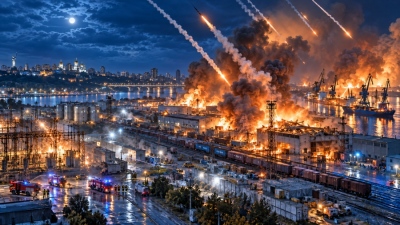
Another incident has sounded the alarm for Greek shipping. The tanker New Andros, linked to Adamantios Polemis' New Shipping Ltd, was hit by a drone in Iraqi territorial waters while carrying approximately 2 million barrels of Iraqi fuel oil. The attack triggered a fire on the vessel, which was extinguished by Iraqi rescue vessels, with no injuries or loss of human life reported.
Restricted access maritime zone
The incident comes at a particularly tense time in the Persian Gulf and the wider Middle East, as maritime transport faces increasing threats from drone strikes and other attacks. Iran's Islamic Revolutionary Guard Corps (IRGC) announced on Wednesday (September 9, 2026) that a restricted access zone will extend from Iran's Chabahar toward parts of the Gulf of Oman and the Arabian Sea, with exact coordinates to be announced later. The announcement follows statements made on Sunday by Mohsen Rezaei, secretary of Iran's Supreme National Security Council, who, according to state media, said that Iran would establish a restricted access zone outside the Strait of Hormuz in the coming days.
Cry of anguish from Greece and 17 nations
Just 24 hours earlier, the world's largest maritime powers publicly raised the alarm, warning that "parallel systems" are being created in shipping, with vessels operating outside traditional frameworks of safety, insurance, and transparency. The Consultative Shipping Group, in which Greece participates, warns that developments are no longer merely temporary crises, but signs of a deeper structural shift in the way global trade functions.
80% of global trade carried by sea
Global maritime authorities warned that the emergence of "parallel systems" threatens to create a two-tier shipping industry internationally, undermining trust and safety at sea. In a joint statement issued today, Tuesday (September 8, 2026), the Consultative Shipping Group (CSG) — an informal mechanism for cooperation among maritime authorities of 18 countries worldwide — noted that more than 80% of global trade is carried by sea. "Without maritime trade, supply chains would fragment and the global economy as we know it would come to a sudden halt," the statement said. It warned that maritime supply chains have faced repeated disruptions that "increase uncertainty and add friction to the efficiency of global supply chains," pointing to events such as the Covid-19 pandemic, the war in Ukraine, drought in the Panama Canal, and the US-Iran war.
The conflict in the Middle East has created a major bottleneck in global shipping this year due to blockades and fighting in and around the crucial Strait of Hormuz, a waterway south of Iran. Prices of oil and other commodities, such as fertilizers, have skyrocketed as a result. The CSG warned on Tuesday that "discretionary trade measures" are reinforcing the impact of developments affecting navigation. "Global shipping works best when rules are clear and consistent around the world," the statement added. "Uncertainty regarding future access to ports or routes can impact long-term commercial planning. When countries begin taking divergent approaches, regional initiatives or stagnant multilateral processes weaken the coherence of the system." "Fragmentation of rules directly leads to market fragmentation and ultimately higher costs for businesses and consumers," it warned.
Unprecedented intervention
The announcement represents the first public intervention by the CSG since its founding more than 60 years ago. Members of the group include Greece, Singapore, Denmark, Japan, Canada, the United Kingdom, the Netherlands, and South Korea. The same statement highlighted that geopolitical pressures on shipping "are not temporary shocks," but "indications of a structural shift in the operating environment of international commerce." "Shipping routes are increasingly being transformed into tools of pressure and risk," they said. "Sovereignty, resilience, and prosperity depend on partnerships and practical cooperation and coordination to preserve an open global trading system."
The "shadow" fleet
At the same time, CSG members warned that a growing number of vessels are carrying out activities that circumvent sanctions, while an "unregulated shadow fleet... of hundreds of vessels operating outside normal insurance, safety, and transparency frameworks" is further fragmenting global supply chains. "This creates parallel systems within global shipping, increases risk, and bypasses environmental and safety standards, undermining trust and predictability in maritime markets," the CSG said. "The result is a two-tier system, one governed by rules and the other by opacity, ultimately weakening both." The group called on maritime states to "actively support and preserve the core principles governing shipping," arguing that existing international rules must apply across all jurisdictions, alongside political support "to develop and maintain common standards." "Strong international cooperation is not a restriction of sovereignty. It is a prerequisite for effective governance in an interconnected world," the CSG stated. "Allowing fragmentation to deepen undermines the global rules-based maritime framework and increases the risk of disruptions at critical maritime transit points," it added. "As the closure of the Strait of Hormuz demonstrates: when shipping supply chains fragment, the global economy fragments with them."
Growing concerns for shipping
Brian Wessel, director general of the Danish Maritime Authority, which chairs the CSG, told the Financial Times that maritime states took this rare public step due to growing concerns over the fragmentation of the shipping sector and the erosion of standards set by the International Maritime Organization (IMO), the UN body that regulates the shipping industry. "For decades, we built global trade on the premise that ships could move freely across borders. That premise is now under pressure," he said, adding that "a level global playing field and the global regulations we have built over many years at the IMO were taken for granted." Members of the Consultative Shipping Group account for more than one-fifth of global trade in terms of fleet capacity.
Scenarios for a Hormuz transit fee
On Monday, Tehran reported that it is close to an agreement with Oman regarding the management of navigation through the Strait of Hormuz, through which approximately one-fifth of global oil and gas previously passed. It remains unclear whether a transit fee will be imposed. Shipowners and maritime organizations have warned that imposing a fee would set a dangerous precedent, potentially leading other countries bordering critical maritime passages to adopt the same practice. At the same time, US, EU, and UK sanctions against Russia and Iran have driven the rapid growth of a "shadow" oil tanker fleet, which now numbers more than 1,500 vessels according to TankerTrackers.com — nearly one-fifth of the global tanker fleet. Almost all of these vessels lack traditional insurance policies. During the summer, the Caroline Bezengi, a shadow fleet vessel carrying approximately 800,000 barrels of Russian crude oil, struck a mine off the coast of Oman without traditional protection and indemnity (P&I) insurance, potentially leaving the Omani government facing millions of dollars in cleanup costs.
www.bankingnews.gr




Readers’ Comments