

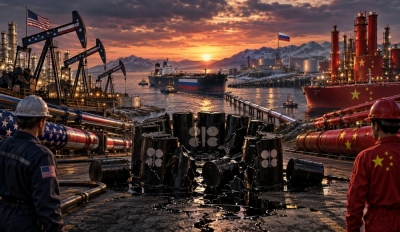
The moves of OPEC+ have now ceased to materially affect the global oil market and have turned into more of a psychological factor rather than a real driver of price formation. Although the alliance's decisions continue to influence sentiment between buyers and sellers, they are no longer able to radically alter the situation. According to Rossiyskaya Gazeta, the actual contenders for the role of oil market regulator are now China and the United States.
China and US at the center of the energy game
China, as the world's largest oil importer, was expected to import up to 11.6 million barrels per day in 2025, a quantity that corresponds to roughly 11% of global demand. At the same time, it possesses vast strategic reserves, which are estimated between 1.2 and 1.4 billion barrels. On the other hand, the United States is also claiming the role of key market regulator. American production stands at 13.8 million barrels per day, the highest level globally. Although the US holds significant petroleum reserves, these have decreased following extensive market interventions carried out during the course of this year. Furthermore, Washington exerts substantial influence over the oil production of countries such as Guyana, Canada, and Venezuela, bolstering US energy dominance.
Why OPEC+ weakened
According to energy analyst Kirill Rodionov, the period of maximum influence for OPEC+ on the global market has already passed due to two key factors. The first is the continuous increase in oil production in North and South America. The second is the slowdown in global demand growth, which is partly linked to the rapid electrification of transport in China. In the world's largest automotive market, electric and plug-in hybrid vehicles already account for more than half of new passenger car sales, causing a shift in crude demand. Rodionov noted that an oil "supply race" was expected to begin in 2026, with the participation of OPEC+ countries, but the crisis in the Strait of Hormuz upended those plans.
The Strait of Hormuz determines the balance of power
Without the full restoration of production and exports from the Persian Gulf countries, the market will need more than a year to return to a balance between supply and demand, even if production growth continues in non-OPEC+ countries. Today, Iran and the United States are considered the primary actors determining the smooth passage of tankers through the Strait of Hormuz. In this sense, they act as informal regulators of the oil market. However, because these are two adversaries incapable of reaching an agreement, the result is uncertainty and volatility. Even if the passage's operations are fully restored, creating an oil supply surplus remains a distant prospect. The managing director of DA Consulting, Daniil Tyun, estimates that a significant portion of production could be restored within one to two months, reaching approximately 70% of previous levels within three months and 90% within six months. The complete recovery of the remaining quantities, as well as exports, is expected to require more time, prolonging global market instability.
Russia's opportunity and problems
In this environment, Russia theoretically possesses the ability to increase its oil production and exports. However, according to the head of the Russian National Energy Security Fund, Konstantin Simonov, the country still falls short of the production quotas outlined in the OPEC+ agreement by nearly one million barrels per day. At the same time, maritime transport issues across the Black Sea have led to a small reduction in Russian oil exports over the past month, a factor that may cause a further decline in Russian output in the coming period.
www.bankingnews.gr


Readers’ Comments