

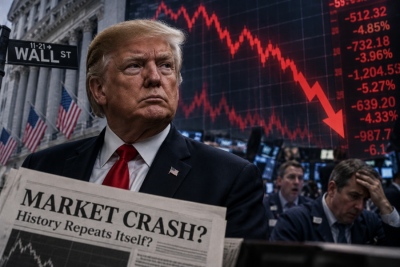
The second presidential term of Donald Trump carries many features, but one word seems to describe it with precision: "volatility." In less than two years, the American president has unleashed a trade war against most US allies, led the nation into direct military conflict in the Middle East, and repeatedly exerted pressure on two consecutive Federal Reserve chairs, demanding lower interest rates despite the inflationary fallout caused by his other two policies. Amidst this backdrop of turmoil, however, the S&P 500 continues its upward trajectory, recording an impressive gain of roughly 33% since Trump's election victory on November 5, 2024. The explosive growth of new sectors, such as artificial intelligence (AI), has enabled Wall Street to overlook increasingly heightened political uncertainty until now. Nevertheless, risks are compounding, and the question being raised is whether the US stock market crash risk is rapidly reaching a critical tipping point.
The contradiction of Trump policy
Under Donald Trump, US economic policy has begun to diverge significantly from several of the administration's stated objectives, including cooling inflation and paring down public debt. The escalation of war in Iran pushed US inflation to 3.4% year-over-year in July, well above the 2% target established by the Federal Reserve. Persistently elevated inflation makes it vastly more difficult for the Fed to enact interest rate cuts. The reason is that while lower interest rates can support the economy by reducing borrowing costs, they can simultaneously amplify inflationary pressures, exacerbating the broader macroeconomic picture and feeding persistent economic turbulence.
The warning from Turkey
Turkey stands out as a classic example of the structural hazards that can emerge from such an economic policy. Between 2021 and 2023, the nation pushed through aggressive rate cuts while inflation remained at exceptionally high levels, triggering a severe cost-of-living crisis from which it is still attempting to recover. According to the analysis, Trump appears not to have absorbed lessons from other countries' missteps. As part of an ongoing pressure campaign, the US president is now threatening to cut off trade with all nations running a trade surplus against the US unless the Federal Reserve cuts rates. If implemented, such extreme measures could unleash a fresh spike in inflation and make any potential interest rate cuts functionally impossible.
Can Wall Street withstand new political uncertainty?
Historically, stock market performance is driven more by economic fundamentals, corporate innovation, and earnings growth than by the immediate effects of government policy decisions. However, there are growing signs that the unorthodox choices of the Trump administration are beginning to spill over into the real economy. One of the most prominent indicators that investors are growing uneasy originates within the bond market. Bond yields are rising sharply, with the 10-year US Treasury yield now moving near 4.80%. US Treasuries are considered the benchmark for the risk-free rate in the American economy, meaning that when yields climb, borrowing costs rise across the board for businesses and households alike. This development arrives at a particularly challenging juncture for the tech sector, which is currently committing hundreds of billions of dollars in capital expenditures to construct artificial intelligence data centers, directly elevating corporate debt risks.
S&P 500 at historically extreme valuations
The threat of a market panic is further intensified by the historically inflated valuation of the S&P 500. The Cyclically Adjusted Price-to-Earnings (CAPE) ratio currently stands at 41.4, compared to a historical average of 17.4. This level approaches the historical peak of 44 recorded in 1999, right before the dot-com bubble collapsed into one of the largest market meltdowns of modern history. While this metric does not guarantee that a downturn is imminent or easily timed, it clearly indicates that the safety buffer for investors has narrowed drastically, creating a clear extreme market valuation warning.
What investors should do now
The core rule of financial markets remains that time in the market beats timing the market. Even if the probability of a sell-off is mounting, predicting its precise onset is impossible. This creates the risk that investors sell out too early and miss out on a potential continuing rally. However, according to the analysis, Trump's policy choices appear to be becoming more, rather than less, aggressive. In this environment, investors can mitigate portfolio risks through broader diversification, selecting profitable businesses with reasonable valuations and limited downside potential. At the same time, holding a cash reserve could prove vital, ensuring available capital is ready for strategic buying opportunities should equities experience a severe stock correction.
The S&P 500 "trap"
The question now being asked is whether investors should simply buy the S&P 500 index. The analysis highlights that Motley Fool Stock Advisor has selected 10 stocks it considers to be superior investment opportunities right now, with the S&P 500 excluded from that specific list. According to the same source, those 10 equities were chosen based on long-term growth prospects and their potential to deliver significant returns in the years ahead. Prominent examples cited include Netflix and Nvidia. Netflix was added to the list on December 17, 2004, and a hypothetical $1,000 investment made that day would have grown to $421,997 according to the analysis. Similarly, Nvidia was recommended on April 15, 2005, where a $1,000 investment would have expanded to $1,413,876. This long-term track record is cited as the primary reason investors monitor Stock Advisor's selections closely. The core takeaway for market participants is that against a backdrop of elevated valuations, climbing bond yields, stubborn inflation, and heightened political volatility, strategic diversification and stock selection become paramount. Whether the market is indeed on the precipice of a crash remains to be seen, but the variables that historically precede major corrections are undeniably assembling once again, signaling a heightened risk environment.
www.bankingnews.gr












Readers’ Comments