

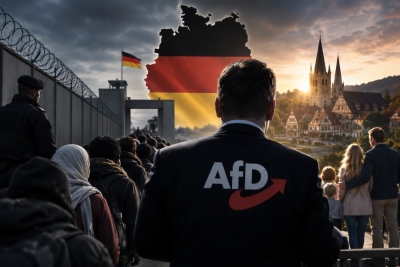
Alternative for Germany (AfD) recorded a significant surge in the Saxony-Anhalt state election, taking first place with 44% of the vote. However, the anti-immigration and pro-Russian party falls three seats short of an absolute majority, meaning it will have to either find a coalition partner or attempt to govern as a minority government. Both options mean that many of the party's programmatic positions may never be implemented, as Germany's mainstream parties have refused for years to cooperate with the AfD, creating what has been dubbed a "firewall" against the far-right. One potential path could be an agreement with the left-wing populist BSW party, which on Monday criticized the "firewall" and shares some of the AfD's positions regarding Germany's immigration policy and Ukraine.
AfD leaders in Saxony-Anhalt are also attempting to reach out to the more right-wing elements of the center-right Christian Democratic Union (CDU), although German Chancellor Friedrich Merz has explicitly ruled out any cooperation. Discussions regarding potential alliances in the coming days will be decisive for the state's future path, as Germany's federal system grants the 16 states significant powers in areas such as education, culture, policing, and public broadcasting. The AfD—a party that Germany's domestic intelligence agency has classified as "confirmed far-right extremist"—has made no secret of its desire to use power in Saxony-Anhalt as a template for the rest of the country. Its candidate for state premier, Ulrich Siegmund, told CNN during the campaign that he hopes a party victory will mark the end of some of the federal government's "crazy" policies. First, however, the party will have to confront Saxony-Anhalt's budget deficit, as well as the challenges that come with transitioning from opposition to governance. As it now stands on the threshold of power, here is a closer look at the party's 258-page platform—a radical vision outlining its goals for the state and for Germany as a whole.
"Remigration": Mass deportation of migrants at the center
At the heart of the AfD platform lies a comprehensive overhaul of immigration policy, which includes the immediate deportation of irregular migrants, the expansion of mass detention facilities, and the return of citizens not of German origin to their countries of origin—a policy the party calls "remigration". The AfD contends that the region has "exhausted" its capacity to receive refugees, "not only in terms of security policy, but also in terms of cultural identity." "People obligated to leave the country must be detained pending their deportation under our government," Siegmund stated in a recent interview. In one section of its manifesto, the AfD calls for a "remigration offensive" targeting Ukrainians, arguing they should return home since "large parts of Ukraine are considered safe zones." However, Johannes Kieß, deputy director of the Else-Frenkel-Brunswik Institute (EFBI) for Democracy Research at the University of Leipzig, estimates that immigration policy is one of the hardest areas for immediate action, as states are restricted by federal law and existing regulations. "I would expect major legal uncertainty and chaos," Kieß stated. The AfD has also repeatedly called for Germany to end its support for Ukraine and develop closer ties with Russia, putting it at odds with other major parties and the federal government, which has been Ukraine's largest financial and military backer since the start of the full-scale Russian invasion in 2022.
Education: "More Bismarck, less Hitler"
Education represents another key pillar of AfD policy. Siegmund has pledged to overhaul Saxony-Anhalt's school curriculum and "de-ideologize" schools, including through a ban on the Pride flag and the promotion of "traditional" German values. AfD politicians in Saxony-Anhalt want lessons to focus more on periods of German history prior to World War I and World War II and less on Germany's Nazi past, in line with the party's stated desire for Germans to leave behind feelings of guilt and focus on national pride. "More Bismarck, less Hitler," remarked Hans-Thomas Tillschneider, the party's cultural policy spokesman in the region, in an interview with German media. During his campaign, Siegmund pledged to reform Saxony-Anhalt's school curriculum and "de-ideologize" the state's schools. "We want a completely new, a completely different educational policy," he said. "Political influence on children as we experience it—political indoctrination—is not the job of schools." The party platform also provides for separate classes in which refugee children will be taught apart from other children by refugee teachers, with instruction conveying the message that staying in Germany is strictly temporary. Additionally, under AfD plans, children with disabilities would also be taught separately.
Culture: Campaign against "anti-German art"
The AfD has promised what it calls a "new, patriotic cultural policy", arguing that state institutions should play a more active role in promoting German national identity. As part of its state manifesto, the AfD has pledged to cut funding for what it characterizes as "anti-German" art. When asked to clarify the term, Tillschneider replied that "anti-German art is German art that does not want to be German," referencing a performance he attended where the work of a classic German composer was reinterpreted through "feminist deconstruction". The AfD has stated that artists and cultural organizations seeking state funding will have to sign a declaration that they will not treat Germany and its culture with contempt. The party platform states that the previous state government assigned excessive cultural significance to the Bauhaus, the famous German art school, as part of its agenda for "modern thinking." For the AfD, the movement lacks sufficient German identity. Critics have pointed out clear similarities to the way the Nazis attacked modern art. "The AfD is attacking the Bauhaus using the exact same words the Nazis used 100 years ago," Culture Minister Wolfram Weimer told the Associated Press. "And that is why democrats, whether conservative or left-leaning, are pushing back." Kieß told CNN that Saxony-Anhalt would quickly become "poorer, both materially and culturally" as a result of AfD policies.
The end of the "firewall"?
One of the biggest questions facing Germany after the AfD's electoral success concerns the effectiveness of the so-called "firewall" against the far-right. There is now growing acceptance of the view that this policy may have contributed to the rise of the far-right, as it shields the party from the accountability that comes with holding executive power and facing the realities of governance. The "firewall" also leads to awkward coalitions among mainstream parties that struggle to find common policy ground and govern effectively. Nevertheless, German Chancellor Friedrich Merz, the Christian Democratic Union, and other mainstream parties have pledged to maintain the "firewall" against the AfD.
AfD electoral victory opens new chapter
"If this result is not a mandate to govern, then what is?" Siegmund said at a press conference on Monday. "For this exact reason, our goal now is to organize such a stable majority in the coming days and weeks. There are different ways this could happen: either through support, even full support, from a parliamentary group or through individual lawmakers." Developments in Saxony-Anhalt could also impact two other regional elections taking place in Germany this month. In the northeastern state of Mecklenburg-Vorpommern, the AfD leads with approximately 35%, according to the latest Infratest dimap poll. Another strong electoral performance by the AfD could also have broader implications for the next German federal election, expected in 2029. Although the AfD was founded as recently as 2013, opinion polls suggest that if federal elections were held today, it would win the most votes.
www.bankingnews.gr












Readers’ Comments