

Star Bulk, the world's third-largest dry bulk shipping company with a fleet of 145 vessels, is set to list its shares on the Greek stock exchange, following its listing on the US Nasdaq stock exchange. There, its market capitalization reached 3.5 billion dollars with a fleet value of 4.5 billion dollars, distributing 1.6 billion dollars to shareholders since 2020 and 620 million dollars in share buybacks since 2018. In the first half of 2026, the company reported net profits of 203.5 million dollars, while distributing a quarterly dividend of 0.90 dollars.
The public offering
From tomorrow, Tuesday 9/9, until Friday 11/9, the public offering of 4,400,000 shares will take place with a maximum price of 25.5 euros (112.8 million euros), while the price range is expected to be announced today. In the public offering, the P. Pappas family will also contribute capital up to the amount of 6 million euros, while shares will be acquired by the entire management team, without the 10% discount. The dual listing on Euronext, as Mr. Pappas highlighted, is taking place firstly because market prospects for dry bulk shipping remain favorable, as the orderbook for new builds remains low while demand grows at healthy rates. Secondly, the Greek capital market has evolved into a network of eight European exchanges with over 1,800 listed companies and a single trading platform, and thirdly because, due to geopolitical developments, the company prefers to have more than one option regarding its exchange listing venue.
We do not need capital
The owner of Star Bulk argued that the company has no need for capital since, through its balance sheet, it could borrow 1-1.5 billion dollars. The listing is a "decision of free will," and the company is proceeding to raise 100 million euros to provide genuine liquidity for shareholders. The company, he added, will not seek the highest possible valuation, but a valuation that leaves value margin for investors, approximately 20% below its net asset value (4.5 billion dollars). Responding to questions, the shipowner clarified that the company prefers to buy vessels when the shipping market is down (having sold over 50 vessels in recent years), whereas when the market is strong, the company executes share repurchases with significant benefit for shareholders. Regarding the US dollar, he noted that a strong dollar does not favor shipping, while estimating that interest rate increases will follow a moderate path without major spikes. Star Bulk has completed ship repairs in Greece worth over 120 million dollars, funds that would have been directed to Turkish shipyards were it not for the Greek shipyards.
Message to investors regarding shipping risk
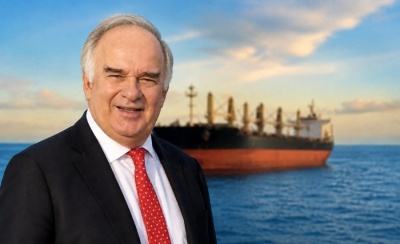
Mr. Pappas sent a message to investors, reminding them that a strong balance sheet does not eliminate the volatility and cyclicity of the shipping industry; therefore, "investors need to be cautious and make decisions after analyzing companies and the market, rather than being swept away by forecasts and promises of quick profits." Before his address, Mr. Pappas recalled that on September 6, 1974, upon returning to his university in the US, he had to choose between TWA and Canadian Pacific. The former airline had more expensive tickets, and after speaking with a friend, he was persuaded to travel with the second carrier. Ultimately, choosing the cheaper tickets proved lifesaving, as that first TWA flight crashed.
The six pillars of the investment proposal
In his speech, the chairman of Star Bulk, Mr. Sp. Kapralos, emphasized that "the company's presence aims to serve as a starting point for other reputable shipping companies to choose Athens. At the same time, all market participants must ensure that the investing public understands the cyclicality of the sector, as it is a cyclicality that can bring massive returns but also carries significant risks of financial loss." As detailed by Star Bulk's chief financial officer, Mr. Sp. Simos, the six pillars of the investment proposition are:
First, the largest dry bulk investment platform in the US in terms of market capitalization, cargo volume, and fleet size of 145 vessels with an average fleet age of 12 years. Of these, 80 are ECO vessels and 96% are equipped with scrubber systems. Since 2014, the company has completed 10 mergers and acquisitions.
Second, all subsidiaries are 100% owned by Star Bulk, ensuring all benefits flow directly to shareholders. The company also maintains the lowest operational and administrative costs in the industry.
Third, a robust balance sheet with 565 million dollars in cash reserves against 1 billion dollars in net debt for the half-year. Pro forma liquidity exceeds 620 million dollars with 50 million dollars in undrawn liquidity, while net debt per vessel stands at 50.1% of the vessel's scrap value, representing a 72% reduction since 2020.
Fourth, the company is focused on capital allocation to shareholders, maintaining continuous quarterly dividends with 100% cash flow coverage. The dividend policy supported a dividend of 0.90 dollars per share in the second quarter (3.60 dollars annualized), with a minimum cash reserve per vessel of 2.1 million dollars. Additionally, the company completed share buybacks valued at 100 million dollars, providing added flexibility in returning capital and value to shareholders due to share cancellations.
Fifth, the company maintains strong corporate governance providing robust oversight and accountability, while management initiatives are aligned with long-term shareholder value creation.
The sixth pillar is the implementation of environmental ESG policies and sustainability practices, as the company leads the sector in decarbonization with a modern fleet utilizing efficient fuels that comply with environmental regulations, alongside ongoing investments in technology and operational efficiency to support low-carbon shipping.
Pafilas Dimitris
dpafilas@yahoo.com
www.bankingnews.gr









Readers’ Comments