

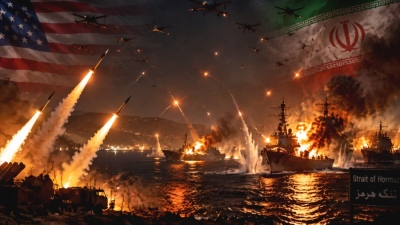
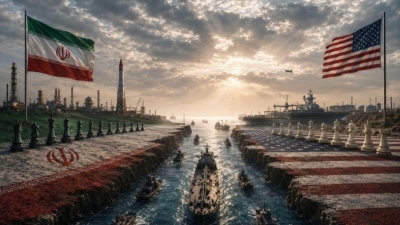
Ultimately, the small war; a simple conflict as US President Trump calls the tension in the Persian Gulf is turning out to carry a massive bill. The Americans found themselves at a complete standstill in Hormuz, failed militarily, and now vessels cannot pass through, with only 2 or 3 US ships smuggling through Hormuz when over 100 ships passed daily before the war. Meanwhile, Iran announced that it is not only closing the Strait of Hormuz completely, but is also creating an exclusion zone outside Hormuz, making navigation even more difficult.
President Trump published a photo simulating Iran as his head, while US officials maintain there will be no nuclear deal with Iran, as the objective is to completely destroy all of Iran's capabilities. The reality is that Iran is deliberately delaying, intending to prolong tensions and escalation until November 3, 2026, when the US midterm elections take place, aiming to exert maximum pressure on Trump either through escalation or an explosion in gasoline prices, thereby impacting the electoral result. Nevertheless, Iran's national security chief Major General Mohsen Rezaei revealed that Iran tested a new anti-ship missile, which was the cause behind the hasty withdrawal of the aircraft carrier USS George Washington and a destroyer.
Iran National Security: Declares new "exclusion zone" inside and beyond Hormuz – The Strait closes completely - The US terrified by a new missile
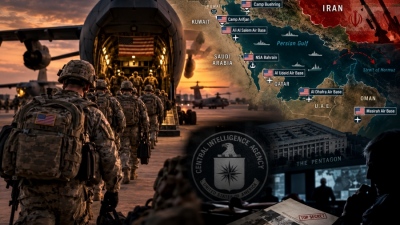
Iran's national security chief Major General Mohsen Rezaei announced that a new exclusion zone will be declared outside the Strait of Hormuz in the coming days, warning that any vessel entering the area without coordination with Iran will be placed on an Iranian sanctions list. Major General Mohsen Rezaei, secretary of the Supreme National Security Council, stated that the zone "will begin from the US Navy blockade line and extend into parts of the Persian Gulf," covering the section leading toward loading ports. Vessels moving toward the strait from any side and entering the designated area, he said, will face sanctions with consequences for insurance and future passage. He also made clear that Hormuz is "completely closed and under the control of the armed forces," dismissing US President Trump's claim that the strategic waterway remains open as a "big lie." Before Iran closed Hormuz, more than 100 ships carrying over 100 million tons of cargo passed through it daily; now, only 7 to 8 ships carrying essential goods for Iran pass through the waterway. "The Americans are trying to smuggle 5 to 6 ships through at great cost, but these ships are usually hit," stated Major General Mohsen Rezaei. He added that Iran has not decided to sink the ships carrying contraband, as they carry oil and would damage the regional environment. He also announced that a memorandum will be signed in the coming days for a new corridor in the Strait of Hormuz, with entry and exit managed entirely by Iran. The top security official further revealed that Iran successfully tested a new anti-ship missile, stating the test was conducted directly above a US Navy vessel 48 hours ago. "For the first time, we tested our anti-ship missile over an American warship"... "This special missile caused panic and chaos for the Americans, causing them to flee." Trump had planned a 10-day war against Iran, but surprise Iranian strikes on US support bases and troop positions, including the Titin base in Jordan and positions in Erbil, forced the US into a war it cannot win.
Baghaei (Iran Foreign Ministry spokesman): The US started the war, expects the rest of the world to pay the price
The US started the war but expects the entire world to pay its cost, asserted Iranian Foreign Ministry spokesman Esmail Baghaei. Baghaei, in a post on the platform X, referred to what he viewed as Washington's distorted narrative regarding the causes of insecurity in the Strait of Hormuz and the disruption of international commercial navigation. He wrote that the Strait of Hormuz was completely open until February 28, when the US and the Israeli regime attacked Iran.
"Washington imposed an illegal and violent war on our region and disrupted the normal flow of maritime navigation. Tankers have been halted, trade has been disrupted, and energy prices are on an upward trajectory," Baghaei pointed out, emphasizing that "now Washington is trying to portray Iran as responsible for this disruption and insecurity caused by the US itself, forcing the entire world to pay the heavy price of its illegal actions." Baghaei added: "According to Washington's narrative, the war started by the US must, through a reversal of reality, be presented as a cost borne by the world due to Iran's behavior. The US started the war, but expects the entire world to pay its cost, while simultaneously framing Iran as responsible for the chaos they created. This reversal of reality is completely irrational and baseless!"
US Department of Energy: Trump does not need a nuclear deal with Iran... he will destroy it completely
US Secretary of Energy Chris Wright stated that the Trump administration might not conclude a nuclear deal with Iran, pursuing instead a policy aimed at completely destroying Iran's capacity to acquire nuclear weapons in the future. Wright claimed that the United States has so far significantly degraded Iran's ability to develop nuclear capabilities and indicated that the US president will continue adopting an active approach to weaken Tehran's capabilities rather than trying to reach an agreement. "There may be no nuclear deal at all," he stated on ABC News' "This Week." "We may simply destroy their ability to possess nuclear weapons. A deal might be deferred to the next government in Iran. We really do not know."
Reuters: Dramatic decline in commercial shipping at Hormuz – only 10 ships per day pass through
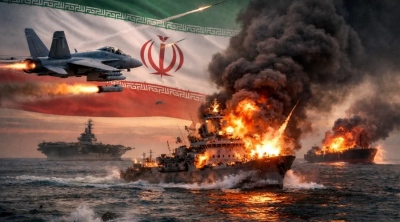
"Over the past 10 days, an average of only 10 ships carrying crude oil have passed through the Strait of Hormuz—the lowest number since May," highlights Reuters. According to shipping data from Kpler, 15 cargo ships passed through Hormuz on September 4, 13 on September 5, and traffic dropped to 10 on September 6. US Secretary of Energy Chris Wright admitted that the volume of oil traffic through the Strait of Hormuz is lower than it was prior to US strikes on Iran. Pentagon Central Command reported that US forces attacked three Iranian oil tankers near Kharg Island, Jask, and the Gulf of Oman. In retaliation, Iranian forces struck three US-linked oil tankers in the Strait of Hormuz, and Reuters later reported that the IRGC launched ballistic missile strikes targeting a US aircraft carrier and a destroyer.
Small war, big bill: Or how Trump wants to hide his defeat in Hormuz ahead of elections
Trump calls the war with Iran a "small military conflict" in order to mislead the American public ahead of the November 3, 2026 elections, claiming the importance of Hormuz has diminished because of access to Venezuelan oil. However, rising energy costs, market disruption, and Washington's search for alternative routes indicate a vast gap between the White House narrative and the reality of the US economy.
The US is clearly misleading
On the surface, Trump is attempting to present a picture of absolute success regarding the situation: America holds the upper hand on the ground, the war has not created significant costs for the US, Hormuz is no longer a decisive bottleneck, and alternative oil routes exist. However, bringing these statements together reveals a fundamental contradiction. If Hormuz is truly under complete US control, why is the White House simultaneously emphasizing the construction of alternative routes? And if the war is "no big deal," why is Washington seeking alternative routes and new oil sources to reduce its vulnerability to energy disruptions?
The American narrative fails to convince...
On one hand, Trump wants to sell the image of "control over Hormuz" to the American market and public opinion. On the other hand, the significance of Hormuz and the risk of its disruption remain glaringly obvious to the energy market. The reality is that virtually controlling a route on a map is vastly different from having an operational trade route. Restoring the Iraqi oil route to Syria, constructing pipelines, securing them, making investments, increasing production, and building transit and refining capacity are not projects that can replace a vital bottleneck like Hormuz in a matter of weeks or months. Venezuelan oil can also be understood within this exact same framework. Trump attempts to present American access to Venezuelan oil as an immediate trump card against the energy crisis—as though Washington, through a political agreement, suddenly had a vast oil source at its disposal to neutralize market disruption. Even assuming all of Washington's claims regarding the extent of US access to Venezuelan reserves are true, the process will not unfold easily or quickly. Underground oil does not enter the market simply by announcing a deal. Ramping up production requires investment, rebuilding facilities, equipment, workforce, transport infrastructure, export capacity, and refining capability, taking considerable time to generate a viable, significant flow. Therefore, Venezuelan oil at this junction serves more as a propaganda tool in Trump's hands than an immediate energy solution.
The American voter remains unconvinced
Trump needs to tell Americans not to worry if the war causes turmoil in Hormuz. America has alternative oil sources; if fuel prices rise, another outlet has been found; if the war continues, it is no big deal; and if war costs escalate, America still wins. This is where the midterm elections in November come into play. The November 3 elections could determine the extent of Republican control in Congress, and the war in Iran comes at a time when energy costs and everyday living expenses for Americans have surged. Polls also show that the conflict could become a major political vulnerability for the Trump administration. For this reason, Trump's rhetoric cannot be viewed merely as a collection of scattered observations. It creates a campaign narrative: It is not a war... it is a small conflict. Hormuz is no big deal... an alternative route exists. We are not lacking oil... we have Venezuela. And costs have not risen; America ultimately wins.
Gasoline heading toward $6 in the US
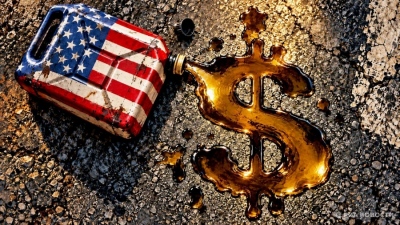
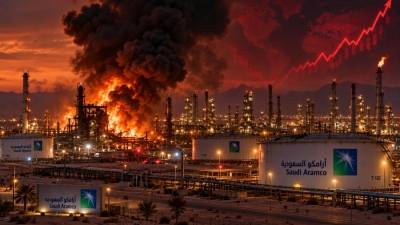
The price of gasoline in the United States has hit a historic high of $5.85 per gallon, an increase that directly drives up costs for transport, agriculture, construction, and distribution, ultimately passed onto consumer goods. The global food market reflects the same story. The FAO Food Price Index reached 133.3 points in August, its highest level since November 2022. The FAO explicitly cited the consequences of the war in Iran and regional trade disruptions as key factors putting pressure on food markets, alongside weather conditions. More expensive gasoline means pricier transportation; costlier transportation means more expensive food and goods; and higher inflation translates into greater pressure on American households—precisely the chain reaction capable of turning an external crisis into a domestic electoral issue.
Changing the name
Even the attempt to change the name and framework of military operations can be evaluated in this context. The Pentagon had announced that Operation Epic Fury concluded on May 5. However, in August, the Air Force was instructed to refrain from using that title for ongoing operations. This shift in terminology, combined with recent statements from Trump and his vice president regarding avoiding the word "war," demonstrates that Washington attaches great importance to managing the war narrative. The problem is that while the name of the war can be changed, the bill for the conflict remains high... Trump can claim it is not a war... yet 18 American soldiers have been killed and over 400 wounded, with costs reported in recent assessments surpassing $37.5 billion. He can claim Hormuz is unimportant... yet oil and shipping markets continue to react to the turmoil in this strategic waterway.
Trump needs a success story for the elections
A narrative where the war is small, costs are manageable, Hormuz has been rendered irrelevant, and the US has alternative oil sources. Venezuelan oil, the route to Syria, and downplaying the conflict are all components of this exact story. However, ballot boxes are not filled with White House narratives; they are filled with people's real-life experiences regarding fuel prices, food, housing, and the cost of living. Trump can change the word "war" to "conflict"; he can erase "Epic Fury" from Pentagon rhetoric; he can call Hormuz "superfluous" and point to Venezuelan oil as a "solution." Yet he cannot change the number displayed on the gas station sign.
www.bankingnews.gr


Readers’ Comments