

The Israeli-American war against the Islamic Republic of Iran is evolving into a conflict where attackers' calculations have foundered, while Washington's allies suffer severe economic losses.
The failure of a «superpower» to prevail over a regional power signals that the global equilibrium cannot return to its pre-war state.
A further consequence is that the rules of the global economy, trade, and finance can no longer be dictated exclusively by Western powers.
The crisis in the Strait of Hormuz provides a vivid portrait of how hegemony can run aground in a narrow maritime corridor.
Across Europe and Asia, Washington's allies confront crises for which they were ill-prepared, particularly concerning energy supply.
Repercussions, however, extend to nations outside the US alliance system, whose factories, agricultural holdings, and households rely on identical trade corridors.
Europe pays yet another war bill
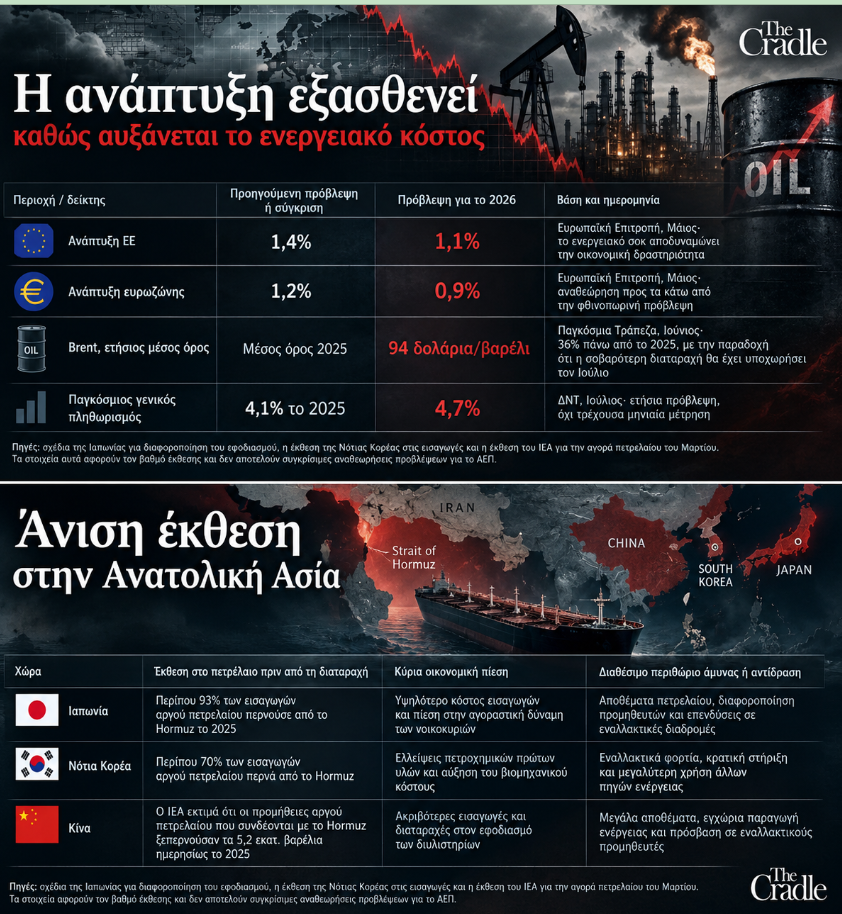
The crisis and blockade in the Strait of Hormuz have driven up energy costs, forcing the EU to downgrade economic growth projections for 2026 and generating intense cost pressures across the continent.
This fresh burden arrives atop energy disruptions and public spending obligations linked to the war in Ukraine.
The sharp rise in energy expenses has driven up outlays across industrial manufacturing and logistics.
The halting of navigation through the Strait has exposed Europe to serious risks of jet fuel and refined product deficits.
Elevated utility bills and climbing commercial overhead squeeze household purchasing power and batter consumer sentiment.
European governments have introduced tax relief and emergency support programs, although national policy responses vary.
The blockade has produced a shared energy and supply shock, yet its consequences hinge on each nation's industrial framework, import reliance, and capacity to absorb higher costs.
The European Commission forecast in May revised EU growth downward to 1.1% and eurozone growth to 0.9%.
The World Bank assessment in June similarly cut global growth projections, while the International Monetary Fund (IMF) update in July raised its global inflation outlook.
These metrics originate from different institutions and distinct forecasting rounds, yet they point to the exact same strain: pricier energy undermines growth and complicates efforts to cool inflation.
EU industrial engines under severe pressure
Germany, the largest economy in Europe, faces renewed pressures across manufacturing.
Sectors including chemicals, automotive production, and heavy manufacturing remain highly exposed to elevated energy overhead.
Pricier crude oil and liquefied natural gas (LNG) push up production expenses, while supply disruptions from the Persian Gulf threaten shipments of petrochemical feedstocks, packaging materials, and other industrial inputs.
France generates roughly 70% of its electricity from 57 operational nuclear reactors, affording a degree of protection against the shock.
Transportation networks and household consumer expenditures, however, remain exposed.
Most passenger cars, commercial vehicles, and merchant vessels still depend on petroleum-derived fuels, with higher transit freight rates passing through to final product prices, from groceries to furniture, as an inflationary shock unfolds...
The prospect of jet fuel shortages ranks among the gravest threats to civil aviation.
Airlines have faced escalated operating costs and flight cancellations, even in areas where physical fuel volumes remained adequate. In May, the EU Energy Commissioner warned of long-term supply hazards, while noting the absence of an immediate shortage.
Paris faced mounting demands to shield consumers, yet fiscal constraints narrowed its room for maneuver.
The French Finance Minister spoke out against blanket tax reductions, favoring temporary and targeted assistance.
The political dilemma persists: households demand relief at the exact moment the government seeks to rein in its budget deficit.
Italy, burdened by elevated public debt, confronts an identical predicament. Cushioning households and commercial enterprises carries substantial costs during a phase of rising borrowing yields.
Italian Prime Minister Giorgia Meloni has demanded greater leeway under EU fiscal regulations, spotlighting the friction between energy relief programs and budgetary discipline.
Britain's vulnerability as an island economy
The blockade and the war in Iran have dealt a twin shock to the British economy through energy channels and commercial trade.
Although the United Kingdom sources substantial oil and gas volumes from domestic output and Norway, its procurement costs remain linked to global benchmark prices. Purchasing from a separate producer does not insulate an economy from a global pricing spike.
London's central worry is the prospect of reigniting inflation alongside sluggish output expansion.
The latest available data from the British Office for National Statistics (ONS) revealed headline consumer price inflation of 2.9% in July, up from 2.6% in June.
Food and non-alcoholic beverage inflation settled at 1.3%.
Accelerating headline inflation magnifies pressure on households already dealing with a elevated cost of living.
The Bank of England monetary policy statement in July warned that inflation is projected to climb «as higher energy costs continue to filter through the broader economy». Efforts to tame price growth risk placing additional strain on an already fragile economy.
Higher oil benchmarks have intensified pressure on civil aviation. Major hubs including Heathrow and Gatwick rely on uninterrupted fuel logistics, leaving them vulnerable to protracted Persian Gulf disruptions.
As an island nation, Britain relies heavily on maritime shipping for consumer commodities and industrial components.
When maritime routes between Asia and Europe bypass the Red Sea to transit around the Cape of Good Hope, extended voyage times raise shipping costs and delay cargo arrivals.
These reroutings exacerbate the Hormuz shock, yet they concern an entirely separate shipping lane and offer zero egress for commercial hulls trapped inside the Persian Gulf.
British defense commitments create further operational demands. London and Paris have spearheaded multinational planning for a maritime security mission in Hormuz once operational parameters allow.
Protecting commercial shipping lanes requires surface combatants, personnel, and stable financing, swelling commitments for a state already struggling to balance defense appropriations with public service requirements.
Asia bears the brunt of supply disruptions
In the East, reliance on Persian Gulf hydrocarbon output is even more direct.
East and South Asia figure among the regions most exposed to the crisis, while expectations that diplomatic channels would swiftly restore safe passage have repeatedly proven premature.
The effective closure of the Strait has severed a vital supply conduit servicing Asian industrial belts.
The US Energy Information Administration (EIA) calculates that 84% of crude oil and petroleum condensate alongside 83% of LNG transiting the Strait of Hormuz in 2024 sailed to Asian markets.
China, India, Japan, and South Korea represent primary off-takers, though they entered the crisis with divergent reserve buffers, distinct domestic energy endowments, and varying options to replace disrupted volumes.
Their exposure cannot be gauged purely through gross import tallies.
Equally vital is the financial capacity to underwrite substitute flows and move them through consumer networks.
Japan's costly import dependency
Japan entered this disruption facing an aging demographic profile, labor deficits, exceptionally high sovereign debt ratios, and decades of subdued domestic demand and deflation.
The Hormuz shock introduced an external supply-side price surge at a time when inflation had already supplanted deflation as an urgent macroeconomic concern.
For an economy that sourced over 90% of its crude imports via this passage prior to the conflict, shipping paralysis elevates the cost of core manufacturing inputs and erodes purchasing power.
A depreciated yen compounds the dilemma, as domestic importers must mobilize more yen to settle dollar-denominated invoices, even prior to any crude price increases in dollar terms.
To counter inflationary momentum, the Bank of Japan hiked its benchmark lending rate by 25 basis points in June to 1%.
This adjustment extended monetary tightening, increasing domestic borrowing costs while households and commercial entities faced pricier imports.
Subsequently, Japan and the US coordinated a rare bilateral currency market intervention to prop up the yen, yet relief proved fleeting. The currency resumed its slide as elevated American yields continued to underpin the dollar.
Warning signs continue to mount across the Japanese economy.
A further policy rate hike was under consideration ahead of the September meeting, as Tokyo works to diversify crude intake and secure bypass routes avoiding Hormuz.
The requirement for alternate logistics has grown acute, despite the long lead times required to establish them.
The Persian Gulf security framework called into question
The American-Israeli strikes on Iran in late February and the ensuing shipping disruptions across Hormuz exposed Washington's Persian Gulf partners to multi-tier crises.
Strikes against energy hubs and civilian installations transmitted the war's economic fallout directly into territories hosting American military facilities.
Macroeconomic forecasts deteriorated sharply, although local impacts vary.
IMF projections in April estimated economic contractions of 8.6% for Qatar, 0.6% for Kuwait, and 0.5% for Bahrain.
Disruptions, however, stretched far beyond those initial spring projections.
Qatar faces severe damage across an economy dependent on LNG exports.
In late August, Oxford Economics warned of an economic contraction nearing 30%, driven by structural damage to industrial infrastructure at Ras Laffan.
This deterioration compared to earlier estimates reflects the severity of damage to installations underpinning Qatar's state revenues.
Kuwait's lack of maritime outlets outside Hormuz leaves its export volumes acutely exposed.
Bahrain, already burdened with elevated debt levels, faces mounting refinancing pressure, with credit default swap (CDS) spreads widening nearly 40% through late August. Sovereign credit insurance premiums offer an additional gauge of mounting regional uncertainty.
Riyadh curtails losses, Dubai loses momentum
Saudi Arabia and the United Arab Emirates possess wider fiscal buffers to cushion the shock, though neither has escaped the fallout. The IMF forecast in April continued to project 3.1% growth for both economies, despite downgrades of 1.4 percentage points for Saudi Arabia and 1.9 points for the UAE. Alternate logistics channels provide partial shelter, yet leave substantial parts of the wider economy exposed.
The Saudi East-West Pipeline permitted the kingdom to move a portion of its crude output through the Red Sea, bypassing Hormuz.
Elevated oil prices partially counterbalanced reduced shipment volumes. The kingdom's fiscal trajectory demonstrates why output losses and revenue tallies do not always move in unison.
Nevertheless, overall economic damage remains substantial.
Saudi petroleum sector activity fell 24.7% in the second quarter, with broader gross domestic product shrinking 4.8% year-on-year. The fiscal deficit reached roughly 9.1 billion dollars, despite benefits from higher crude prices.
The UAE, particularly Dubai and Abu Dhabi, absorbed hits to their positions as global transit, tourism, and financial centers.
According to JPMorgan estimates published in late August, property transaction volumes in Dubai had dropped 70% to 80%, while UAE equities declined approximately 14% over the course of the conflict.
Regional airspace restrictions initially forced major carriers to ground flights or trim schedules. Emirates announced that by May 4 it had restored 96% of its global route network.
Route restoration, however, leaves carriers exposed to higher jet fuel prices and renewed security halts.
Abu Dhabi has also utilized the Habshan-Fujairah pipeline to sustain crude flows exiting through the Gulf of Oman.
Much like the Saudi bypass route, this provides a vital conduit, yet it cannot replace lost tanker loadings or restore broader commercial confidence.
The cost filters down to households
The fallout extends past state oil revenues and asset prices, filtering into household living conditions.
The vulnerability of water desalination infrastructure is acute in nations where municipal potable supplies depend on energy-intensive coastal complexes.
A strike targeting a plant, its power inputs, or its distribution pipeline imperils an essential utility for which immediate alternatives are virtually nonexistent.
Supply chain snarls also increase import costs for staple foodstuffs and consumer necessities.
Even where public subsidies or strategic reserves avert outright deficits, securing substitute cargoes and keeping supply lines open incurs added expense.
These extra costs must be absorbed by commercial importers, consumers, or state budgets.
Reconstructing damaged infrastructure across Iran and the Arab states of the Persian Gulf could reach 34 to 58 billion dollars, according to an assessment by Rystad Energy in April.
Beyond upstream oil and gas sites, that estimate covers industrial plants, power stations, and desalination complexes that provide regional populations with drinking water.
Defense expenditures crowd out economic expansion
The Hormuz shipping blockade and damage across oil sites, utility grids, and civil infrastructure are compelling Washington's Persian Gulf allies to rethink regional security arrangements.
Hosting American military installations has not shielded them from wartime economic fallout, while repairing vital infrastructure creates fiscal burdens that will outlive any armistice.
Defense procurement outlays now compete directly with post-war reconstruction, social support initiatives, and long-term economic diversification.
Capital expenditures have not stopped entirely: Persian Gulf states are accelerating development of port terminals and bypass pipelines designed to reduce dependency on Hormuz. Yet financing alternate export infrastructure itself constitutes a direct economic cost of the conflict.
Billions of dollars that could otherwise upgrade public amenities and domestic living standards risk being consumed by weapons acquisitions and reconstruction tenders.
The longer this posture persists, the more Washington's allies will be forced to spend merely to preserve the security and commercial welfare their alliances were intended to guarantee, marking a historic transformation of the post-World War II order.
www.bankingnews.gr










Readers’ Comments