

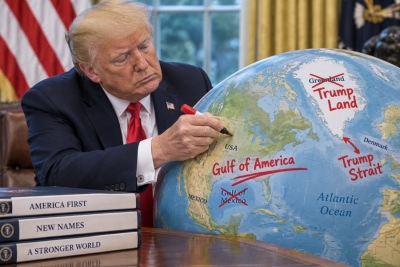
From renaming the Gulf of Mexico to trying to control Greenland and the provocative idea for a "Trump Strait" in the Strait of Hormuz, Donald Trump is attempting to symbolically expand American power far beyond sovereign US borders
Donald Trump, during his second term in the US presidency, has turned changing geographical names into a staple of American political rhetoric. From renaming the Gulf of Mexico to the "Gulf of America" and proposing "Lake America" instead of Lake Ontario, to the controversial idea of calling the Persian Gulf's Hormuz the "Trump Strait", these moves go beyond a simple change of words on a map. They are directly linked to the way Trump perceives power, influence, and the position of the US in the world. In the history of international relations, names have always been part of the battle for identity, historical narrative, and power. However, when an American president attempts to link his country's name or even his personal name to regions lying outside Washington's sovereignty, the issue escapes the level of a mere symbolic gesture. The deeper question is whether this is simply a political show or part of a broader strategy seeking to redefine the concept of American geopolitical influence and power on the planet.
Naming as a tool of power
Changing geographical names in international politics is not merely replacing a few words on a map. Names carry historical, political, and identity meanings, and states often attempt to utilize them to establish their own perception of a region or an international dispute. Viewed through this lens, Trump's moves cannot be attributed exclusively to personal promotion or his desire to leave his name in history. Behind these actions lies an effort to transform political power into symbolic power. That is, using language and political narrative to cultivate the impression that the US can not only influence global developments, but can even dictate the way they are described. Changing the Gulf of Mexico to the "Gulf of America" serves as a prime example. Even if the new name is adopted in official American documents, that alone does not create American sovereignty or ownership over that specific geographical area. The political message, however, is clear: Trump is attempting to link a national name to a geographical space and symbolically reinforce the "America First" narrative.
From the Gulf of Mexico to the "Trump Strait"
The same logic takes on even more complex dimensions in the idea of naming the Strait of Hormuz the "Trump Strait". Unlike other cases, the Strait of Hormuz is not an area at the center of a simple historical or identity dispute. It is a strategically vital international maritime passage upon which a significant portion of global energy security depends, and where the interests of regional countries intersect with the confrontation between Iran and the US. Therefore, changing the name of such a spot is not just a title change. It represents an effort to project a claim of geopolitical influence through language and symbolism. However, herein lies the primary limitation of this strategy: the distance between the name and actual strategic power.
The map does not change with a word alone
A state can alter the language it uses in its own media or internal documents. It cannot, however, turn a name into political reality without other factors, such as international acceptance and the actual capacity to shift the balance of power. From this perspective, Trump's obsession with names forms part of a broader approach in which controlling the narrative and symbols becomes an instrument of exercising power. The logic is clear: before reality changes on the ground, an attempt is made to change the perception of power in the public's mind.
Trump attempts to redraw the geography of American influence
Trump's recent moves cannot be examined in isolation from his overall perception of the position of the US in the world. A perception in which the boundaries between influence, ownership, and the right to shape developments appear to grow increasingly blurred. Within this framework, name changes form part of an effort to redefine the relationship of the US with its surrounding space as well as with regions lying outside its direct sovereignty. The Trump administration's "America First" policy is no longer restricted to trade, immigration, or security. It has also shifted into the realm of political geography. Pressure for greater control over Greenland, references to Panama and the Panama Canal, statements regarding Canada, and the attempt to link the American name with various geographical areas fit into a common framework. This framework is built on pursuing increased American spatial control or influence over strategic global locations.
Washington's new language of power
The difference from traditional American policy of previous decades lies primarily in the mode of expression and the tools employed. In the past, Washington sought to consolidate its position through alliances, international organizations, military presence, and economic influence. Trump conveys much of this message through a far more direct language of power. In this logic, capturing symbols, altering terminology, and formulating grand geopolitical claims constitute part of a political demonstration of strength. This approach, however, faces a fundamental contradiction.
Influence does not mean sovereignty
Great powers can influence international developments to a large extent. Political influence, however, does not automatically equate to sovereignty, nor does it grant a country the right to unilaterally alter geographical reality. Reactions from Canada over Lake Ontario, opposition from certain nations to renaming the Gulf of Mexico, and Iran's particularly sensitive stance regarding the Strait of Hormuz—given its historical weight—demonstrate that geography remains the product of complex balances between different sovereign states. In reality, the core issue of Trump's policy is not merely about names. It is the attempt to send the message that the US remains the force that dictates the rules of the global system. Yet as the gap between political claims and the ability to cause actual shifts in power grows, symbolic gestures risk turning into tests of the real limits of American global hegemony.
The "normalization" of the land-grab logic
Trump's latest moves in geography are not simply a matter of naming or political rhetoric. At a deeper level, they connect to an effort to redefine the relationship between powerful states and the sovereignty of others. When the US President speaks of changing borders, controlling foreign territories, or linking the American name to regions outside US domain, the issue goes beyond symbolic politics. It transforms into a challenge against the very principle of respect for state territorial integrity and sovereignty. Such logic blurs the distinction between power and right. That is, it creates the perception that a state, simply because it possesses superior economic and military power, can deem itself entitled to redefine the geography of other nations or impose its will upon them. This exact logic weakens the principle prohibiting the alteration of borders and sovereign rights through pressure or coercion—a principle that assumed central importance in the international system following World War II.
From Panama and Canada to Greenland
Pressure on countries like Panama and Canada, references to Denmark concerning Greenland, and claims surrounding other strategic areas paint a picture of foreign policy where American interests appear to take precedence over established international norms. This approach places even Washington's allies in a difficult position. Nations that for decades viewed the US as their strategic partner now find themselves facing a powerful player that appears to challenge the boundaries between influence and national state sovereignty.
The "Trump Strait" and the battle for Hormuz
In the case of the Strait of Hormuz, the matter becomes even more delicate. An international maritime passage vital to global energy security is transformed into an arena for personal and political displays of strength. The proposal for a "Trump Strait", in a region where Iran possesses significant geopolitical weight, is not merely a symbolic provocation directed at Tehran. It serves as an indication of the drive to convert a political claim of power into political reality through language, symbols, and narrative. However, according to analysis, despite roughly six months having passed since the outbreak of hostilities, Trump has still not managed to prove in practice that this specific symbolic claim can be converted into actual Middle East hegemony.
The big gamble for the US
Ultimately, the greatest challenge of this policy may concern the US itself. As the distance grows between the projected image of strength and international acceptance of American leadership, so does the risk that symbolic moves produce the exact opposite effect. Great powers acquire lasting influence when other players, even when disagreeing with them, recognize the legitimacy of their role. Yet transforming power into an instrument for changing names, exerting pressure on sovereign states, and unilaterally redrawing the geographical narrative may lead not to the consolidation of American supremacy, but to the strengthening of resistance against it. The real question, therefore, is not whether Trump can change a name on an American map. It is whether he can change the very reality of global power. And there, a new map is not drawn with words.
www.bankingnews.gr




Readers’ Comments