

A new wave of nervousness is beginning to shape Wall Street, as leading strategists warn that the time may have arrived for investors to adopt a more defensive posture. The S&P 500 has navigated a rather disappointing quarter, posting gains of just over 1%, and as summer comes to a close, concerns regarding the trajectory of the markets are mounting. Both JPMorgan and Citadel Securities have temporarily adopted a more cautious stance, though without concluding that the bull market has reached its end. JPMorgan's market intelligence team, led by Andrew Tyler, announced Monday that it is shifting to a "tactically cautious/neutral stance," while Citadel Securities' head of equity and derivatives strategy, Scott Rubner, estimates that "near-term asymmetry has shifted."
September is traditionally a difficult month
JPMorgan and Citadel Securities emphasize, as other analysts have noted, that September is historically one of the most challenging months for equity markets. The landscape becomes even more complex ahead of the US midterm elections. However, according to analysts, this heightened caution is not driven solely by calendar seasonality.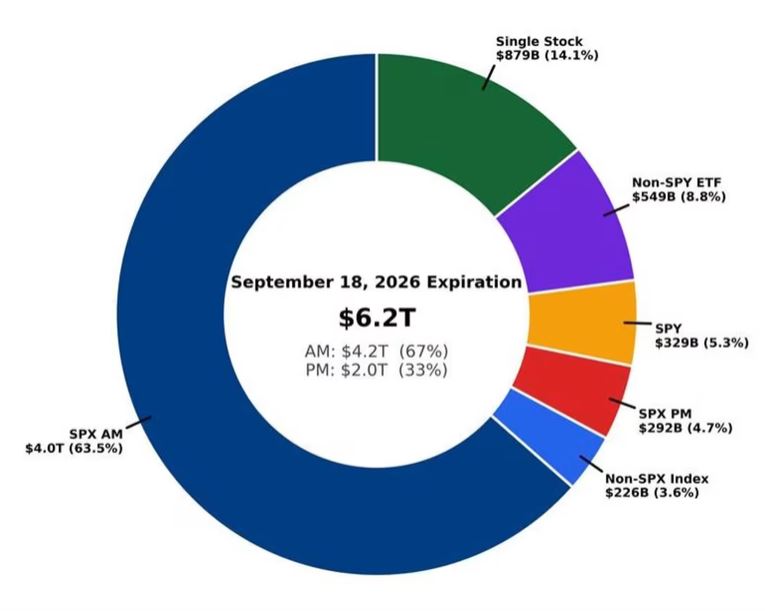
JPMorgan: Bull market is not over, but risks are rising
Andrew Tyler and his team point out that equity bull markets typically end for one of two reasons: a rate-hiking cycle or a recession. The prospect of a recession currently appears relatively distant. However, following Kevin Warsh's speech at Jackson Hole, the probability of a rate hike in September can no longer be ruled out. Indeed, according to JPMorgan, subsequent rate hikes cannot be excluded either. At the same time, current investor positioning fails to provide a clear signal regarding market direction, while an increase in credit market issuances is anticipated following Labor Day. Risks also include potential momentum unwinding and the possibility that semiconductor stocks and other artificial intelligence plays may fail to sustain their upward trajectory. A critical test will come with Broadcom's financial results, expected this week.
Citadel: Downside protection is now cheap
Scott Rubner of Citadel Securities identifies a different set of risks. Among other factors, he highlights the temporary deceleration of the corporate earnings season, the typically subdued activity of retail investors during September, and the pre-earnings blackout period during which corporations restrict or freeze stock buyback programs. Meanwhile, the 100 largest pension funds show a funding ratio of 112%, the highest level since 2001. According to Rubner, this could lead them to rebalance their portfolios by selling equities and purchasing bonds toward the end of the quarter. Another catalyst for potential turbulence is the expiration of US options with a total nominal value of $9.6 trillion through September 18. On September 18 alone, options valued at approximately $6.2 trillion are set to expire.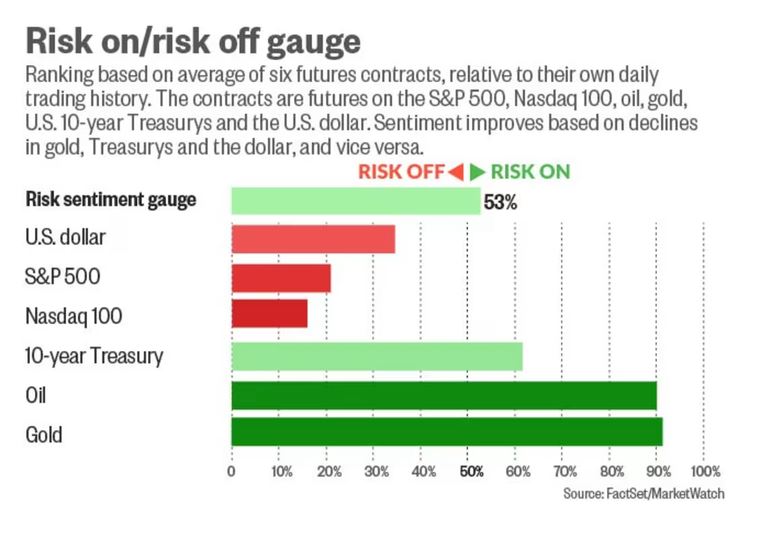
"Cheap" insurance against an S&P 500 decline
Rubner estimates that the cost of hedging against a market downturn is currently at exceptionally low levels. According to his calculations, demand for downside protection sits at just the 1st percentile for the entire year. Notably, a one-month put option on the S&P 500 with a strike price roughly 3% below current market levels fell on Friday to its lowest level since December 2024. Citadel's assessment is that investors can consequently acquire relatively inexpensive insurance against a potential market correction. Beyond purchasing equity hedges, Rubner suggests evaluating treasury bonds, which may offer a superior hedging opportunity.
JPMorgan's playbook: Nasdaq 100 over Russell 2000
JPMorgan proposes a different strategy centered primarily on sector and style rotations. Its analysts express a preference for:
-
Long positions in the Nasdaq 100 versus short positions in the Russell 2000
-
Magnificent Seven and software over semiconductor and memory chip equities
-
Large bank stocks, supported by economic growth prospects
-
Consumer stocks, provided energy prices move lower JPMorgan also estimates that healthcare stocks tend to be the top-performing defensive sector heading into US midterm elections. For additional risk mitigation, JPMorgan recommends short positions in credit ETFs and purchasing products that offer exposure to equity volatility.
Key market performance metrics
The S&P 500 trades at 7,686.14 points, reflecting a 5-day gain of 0.43%, a 1-month gain of 1.13%, and a year-to-date return of 12.28%. The Nasdaq Composite stands at 26,370.89 points, up 1.50% over five days, 1.76% over one month, and 13.46% year-to-date. The yield on the 10-year US Treasury stands at 4.792%, while gold prices reach $4,415.30. Crude oil moves at $87.92, registering an 8.40% gain over five days and a 17.01% surge over the past month.
Geopolitical risks also in focus
Market sentiment is further weighed down by geopolitical developments. Reports indicate that two crude supertankers were reportedly struck by projectiles in the Strait of Hormuz. This development carries significant weight for international energy markets, as any severe disruption to oil transit through the Strait could trigger a renewed surge in prices.
Economic data and corporate earnings under scrutiny
On the macroeconomic front, investors are awaiting the manufacturing index from the Institute for Supply Management (ISM), along with upcoming job openings data. Simultaneously, corporate earnings reports remain firmly under the microscope.
Bond market sends warning signal
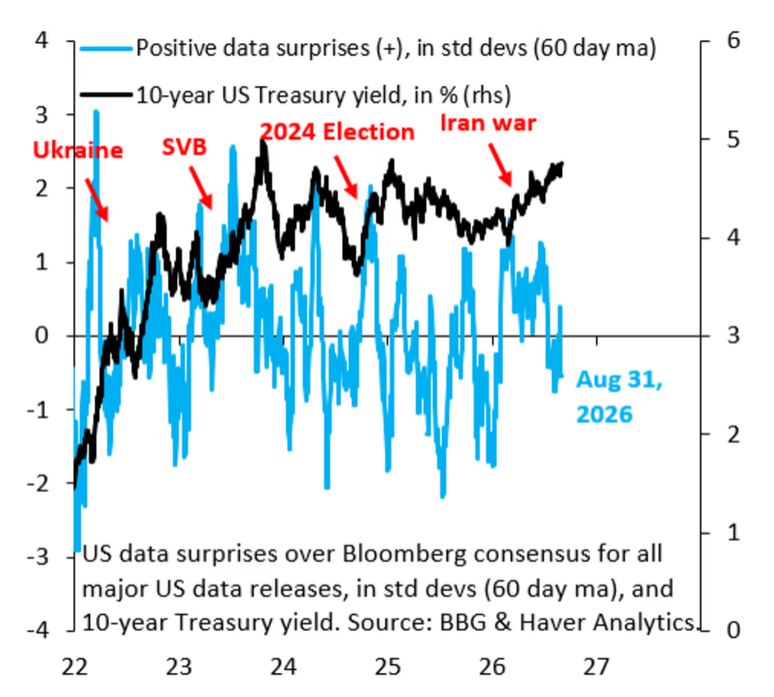
Analysis by Robin Brooks, former chief FX strategist at Goldman Sachs and current fellow at the Brookings Institution, commands particular attention. Brooks compares the weighted average of economic surprises in the US against the yield of the 10-year US Treasury. His conclusion is that economic data would justify lower yields rather than higher ones. Normally, weaker economic figures should exert downward pressure on the 10-year yield as markets revise their inflation expectations and growth outlook downward. However, the inverse is occurring: the 10-year yield is rising despite soft economic data. For Brooks, this signals that underlying demand for US sovereign debt is weaker than it initially appears.
The message for investors
Wall Street is not yet in a state of panic, but the environment is shifting. JPMorgan and Citadel Securities are not projecting the end of the bull market, but they foresee heightened short-term risks and advise greater caution. For market participants, the message is twofold: evaluate portfolio protection while it remains relatively cheap, and rotate into sectors and assets capable of enduring an environment marked by elevated interest rates, costlier energy, and increased volatility. September, after all, has only just begun.
www.bankingnews.gr












Readers’ Comments