

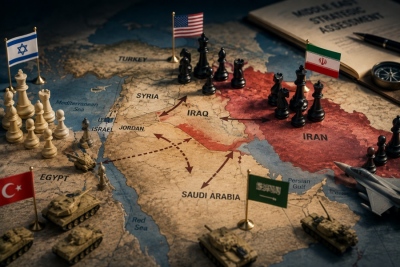
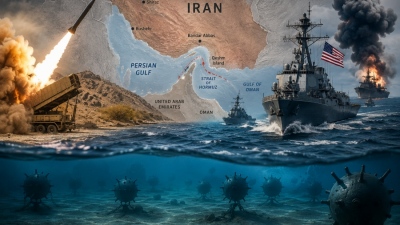
While US President Trump had flagged a destruction-scale attack in Hormuz, the planet remains on standby. However, a political bomb exploded in Washington as the US Secretary of the Army submitted his resignation. At the same time, it was revealed that US Strategic Petroleum Reserves dropped to low levels not seen since 1982. In Hormuz, Iranian forces seized the Sidr, a giant Saudi Arabian tanker, while an incident occurred in the Indian Ocean. It should be noted that the Sidr tanker was initially attacked with three missiles. Iran warns that if the US attacks again, retaliatory measures will have no limits. Additionally, the Iranian side emphasized that the US will either implement the 14-point Memorandum of Understanding, or the war will continue to the bitter end. The US finds itself in a military stalemate, while Iran, despite holding out militarily, is suffering economically as inflation has skyrocketed to 300%.
New development: US Secretary of the Army Daniel Driscoll submits resignation
US Secretary of the Army Daniel Driscoll submitted his resignation to President Trump following months of tension with Secretary of Defense Pete Hegseth, reports the Wall Street Journal. According to the report, Daniel Driscoll will step down from the Pentagon in the coming days. NBC had previously reported that Daniel Driscoll expected to resign as early as September. The Wall Street Journal, citing sources, reported that he could depart before the end of the year amid disagreements with Pete Hegseth. As the report noted, the relationship between Pete Hegseth and Daniel Driscoll, which many initially viewed as strained, ultimately escalated into an open conflict. The Hill mentioned Pentagon spokesman Sean Parnell as a potential successor.
Masoud Pezeshkian (President of Iran): We will "respond" if the US honors the memorandum of understanding
Iran will respond immediately if the US fulfills its commitments under the interim agreement signed in June, declared Iranian President Masoud Pezeshkian. The statements were made at the Shanghai Cooperation Organisation summit in Bishkek, Kyrgyzstan, according to the ISNA news agency. "Approximately three months of negotiations, mediated by the two friendly and brotherly countries of Pakistan and Qatar, ultimately led to an agreement on June 18, 2026, known as the 'Islamabad Memorandum of Understanding.' However, US commitment to a text bearing the signature of their own president lasted less than two weeks, after which backing down and breaching commitments began, continuing to this day. It goes without saying that violations of American commitments were met with a corresponding response from Iran.However, I state clearly that if the US returns to its commitments under said Memorandum of Understanding, the Islamic Republic of Iran will respond immediately. Unlike the US, my country has an outstanding track record of abiding by international commitments and agreements, and has always acted according to the principles of international law," emphasized Pezeshkian.
The Memorandum of Understanding aimed to facilitate peace negotiations and included provisions for reopening the Strait of Hormuz, which has turned into one of the main flashpoints of the war. Furthermore, the Iranian president argued that "the Islamic Republic of Iran, relying on the high capabilities of its brave and dedicated armed forces and the overwhelming support of its people, inflicted heavy strategic defeats on the US and the occupying regime, achieving major victories."
Iran seizes Saudi Arabia's giant tanker Sidr carrying 2 million barrels in Hormuz – Something happened in the Indian Ocean
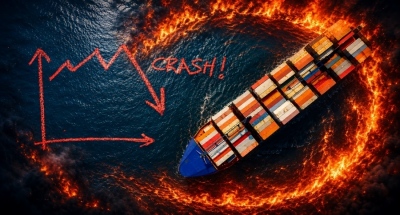
Iran fired three missiles from Sirik in the Hormozgan province toward the Strait of Hormuz, striking a Saudi supertanker off the coast of Oman. Simultaneously, Iran seized the Saudi Arabian tanker. An Iranian vessel was also targeted by American aircraft. Specifically, an Iranian vessel that disobeyed a US order was targeted by American aircraft. The United Kingdom Maritime Trade Operations (UKMTO) announced on Tuesday morning, September 1, 2026, that an oil tanker was targeted by three unidentified projectiles while exiting the Strait of Hormuz in waters 31 kilometers near the Al-Khashab area in northern Oman. The giant Saudi oil tanker Sidr was immobilized while crossing the southern corridor of the Strait of Hormuz. The Sidr tanker has a capacity to transport 2 million barrels of oil and, as it passed through the Strait of Hormuz, suddenly activated its automatic identification system. Additionally, the UKMTO reported receiving a report of an incident involving an oil tanker and military personnel in the Indian Ocean.
Dramatic decline in oil flows through Hormuz
The combined average oil flow through the Strait of Hormuz, Oman, and Fujairah routes over the past 28 days, according to TankerTrackers, was 6.92 million barrels per day, of which slightly less than 4.5 million barrels per day passed directly through the Strait of Hormuz itself. "This figure does not include oil exports from Saudi Arabia's west coast; other tracking sources estimate exports from that route at approximately 3 million barrels per day—a figure that stood at roughly 5 million barrels per day prior to the Ansar Allah siege in Yemen." Before the war, total oil exports from the region averaged around 23 million barrels per day. Today, export flows are roughly 11 to 12 million barrels per day below pre-war levels.
Vance: We see a significant increase in Venezuelan oil production to 1.25 million barrels per day, 500,000 barrels head to the US
US Vice President Vance stated that Venezuelan oil production is currently increasing. "We are seeing a significant increase in Venezuelan oil production right now," Vance stated. "I think it is wrong to ask, 'When will we see an increase in production... because we are seeing an increase in production right now.'" Oil production in Venezuela has reached approximately 1.25 million barrels per day, up from about 870,000 barrels per day in January. More than 500,000 barrels per day of Venezuelan oil are now heading to US refineries. However, Venezuelan oil output remains far below its historical peak of 3.45 million barrels per day in 1997. The country's production had dropped to about 2.3 million barrels per day by 2016, before sweeping economic and oil sanctions by the US further restricted state oil company PDVSA's access to key markets, financial resources, and vital diluents. By 2020, coinciding with the COVID-19 pandemic, Venezuelan oil production had plummeted to roughly 390,000 barrels per day, 88% below its historical high.
Shock revelation: US strategic petroleum reserves hit lowest level since 1982
The US Strategic Petroleum Reserve (SPR) dropped again last week by 3.1 million barrels to 286.6 million barrels, its lowest level since 1982. The decline comes as Washington continues to draw from its emergency reserves amid the war with Iran. The US ultimately plans to release 172 million barrels of SPR reserves, and under the current plan, roughly 39 million barrels remain. The released crude will be loaned to companies, which must return it in the future along with an additional quantity of oil. The US Department of Energy notes that the reserve can technically and operationally continue operating with as few as 70 million barrels remaining. However, Siddharth Misra, a associate professor of petroleum engineering at Texas A&M University, told Reuters that the practical minimum reserve level is closer to 250 million barrels, warning that a drop below that threshold would place America's aging storage infrastructure in a "risk zone."
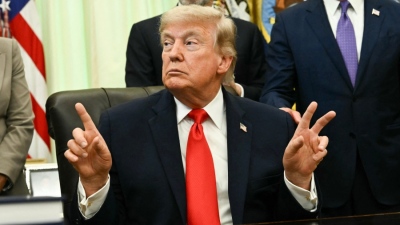
Trump: Stop asking stupid questions, I will not nuke Iran – The Iranians are crazy
US President Trump declared that the use of nuclear weapons against Iran is off the table, claiming specifically that "their navy is gone." "Their air force is gone. Their reconnaissance and surveillance assets are virtually gone. They are a failed state. They have 350% inflation. They have no money. That doesn't mean we won't attack them. We'll see what happens. We have the Strait of Hormuz in very good shape. On average, 30 ships pass through it every night. Iran will never acquire a nuclear weapon. That is the whole story. It isn't about any of the other issues. It's about us as a country, and the world, not allowing Iran to get a nuclear weapon.
If Iran had a nuclear weapon, Israel would have been destroyed. There would be no Israelis right now. They would have attacked our cities at some point because they are sick, crazy people." "Have you ruled out the use of nuclear weapons against Iran?" a reporter asked. "I would never say that, but the answer is yes." "I defeated them. And then I have to use nuclear weapons on top of that? What a stupid question!" Trump has mentioned defeating Iran 37 times, though he likely does not believe it himself, as real ground events tell a very different story...
www.bankingnews.gr



Readers’ Comments