

How can a country subject to US sanctions for over four decades still find dollars and other foreign currencies? The answer does not lie in a single mechanism. Over the years, Iran has developed a complex, multi-layered system that allows Tehran to convert its export revenues into currencies and assets it can use, even when direct access to the international banking system is restricted. Oil, non-oil exports, Chinese yuan, currency exchange houses, trade intermediaries, regional markets, gold, and cryptocurrencies form the key links in this chain. The result is a paradoxical situation: Iran has significantly reduced its reliance on Western banks without shedding its need for US dollars.
Oil remains the foundation
The heart of the system continues to be crude oil. Despite sanctions, Iran has managed to maintain substantial crude exports, with China standing as by far its most vital customer. Chinese purchases absorb the vast majority of seaborne Iranian oil exports, often routed through an intricate web of front companies, dark fleet vessels, and intermediate destinations. China's significance is twofold. First, it offers Iran a massive market for its energy resources. Second, transactions can be settled in yuan, minimizing the need to utilize the US dollar and, crucially, bypassing banks under the purview of US financial sanctions. Thus, Iran can sell oil to China and collect yuan, which can then be deployed to purchase Chinese manufactured goods or converted, through secondary channels, into other currencies and liquid assets. However, this mechanism carries a steep cost. Buyers of Iranian oil typically demand steep price discounts compared to international benchmarks, while shipping, insurance, and trade financing are considerably more expensive and complex. In other words, sanctions have not stopped the flow of oil export revenues entirely, but they have sharply reduced the net value Iran extracts from every barrel.
The yuan does not replace the US dollar
The adoption of the Chinese currency has grown significantly, but this does not mean the US dollar has lost its relevance. The yuan acts primarily as an intermediary tool. Iran can use it for commercial trade with China, circumventing direct reliance on US currency reserves. Yet, the Iranian economy still requires US dollars for vital imports, international clearing, domestic savings, and regional market settlements. This is precisely where the next tier of the system steps in: currency exchange houses and specialized financial intermediaries.
Iran's shadow banking system
Given that many Iranian financial institutions are barred from operating normally within the global banking architecture, a major share of transactions shifts to a parallel network. This shadow banking network involves currency exchange houses, trading companies, capital management firms, and other intermediaries with a heavy presence in financial hubs such as the United Arab Emirates, Hong Kong, and Singapore. Several of these networks have been targeted by the US Department of the Treasury, which has repeatedly stated that they serve to move Iranian financial assets outside official banking channels. The operational logic is relatively simple: an Iranian firm conducts a transaction with a foreign commercial partner, while payment settlement is executed through a chain of third-country companies and bank accounts. Money does not need to travel in the manner of a standard bank transfer. This structure is precisely what renders these networks so difficult to track and completely neutralize.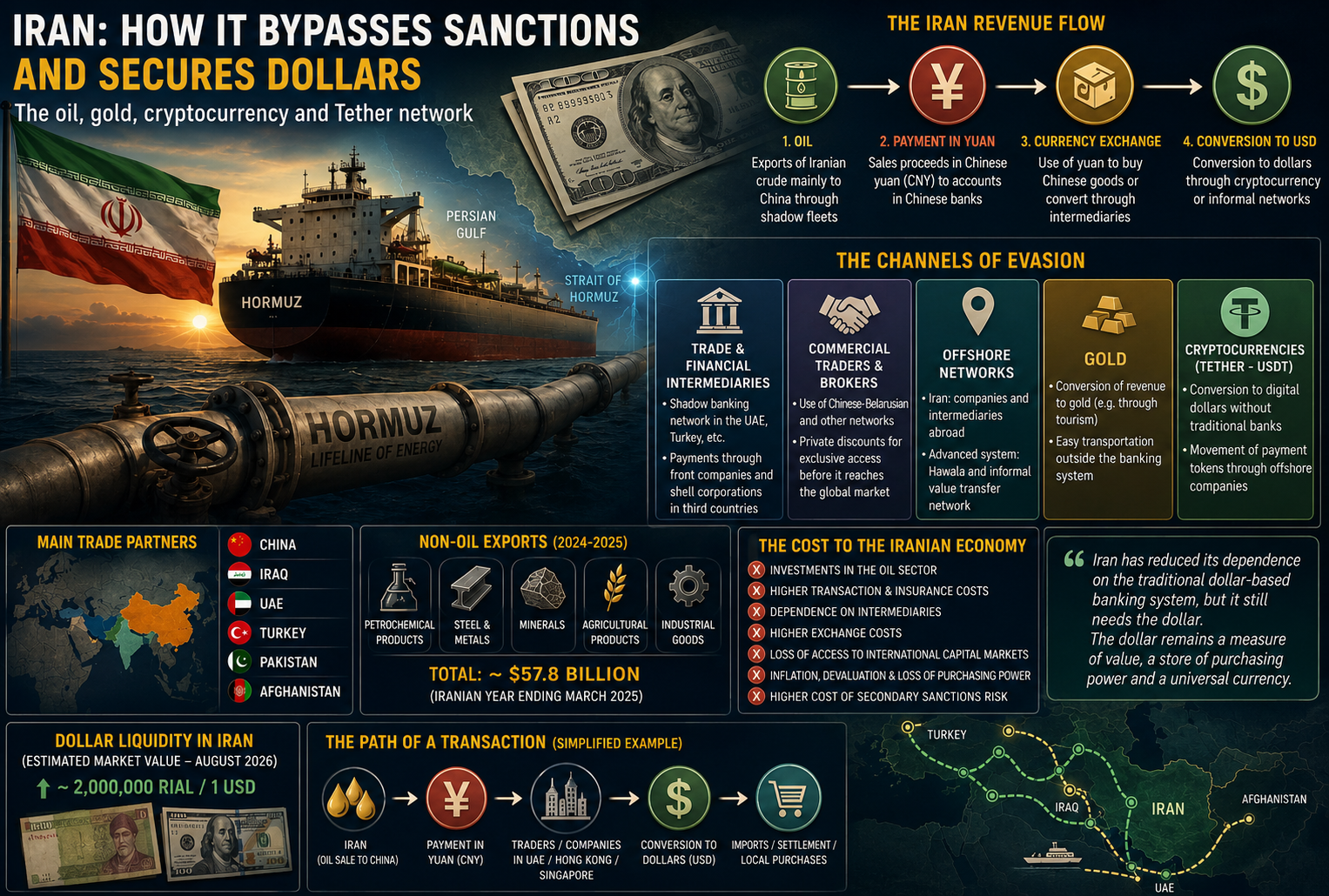
Non-oil export revenues
Iran possesses another major source of foreign exchange that is frequently overshadowed by crude oil: non-oil exports. Petrochemicals, steel, industrial metals, minerals, agricultural produce, and manufactured goods yield tens of billions of dollars annually. For the Iranian fiscal year ending in March 2025, non-oil exports were estimated at approximately $57.8 billion. Primary trading partners include China, Iraq, the United Arab Emirates, Turkey, Pakistan, and Afghanistan. The challenge is that these revenues do not always return smoothly to the domestic economy. The government has established mechanisms mandating exporters to repatriate their foreign currency earnings and allocate them for approved imports. However, the existence of multiple exchange rates and the massive gap between the official and unofficial rate of the rial create strong incentives to operate through parallel markets.
Iraq, Afghanistan, and the traditional hawala system
Neighboring countries represent another vital piece of the broader puzzle. Iraq is one of Iran's largest trading partners and simultaneously functions as a critical regional hub for foreign currency movements. Washington has repeatedly imposed sanctions on Iraqi banks and financial entities deemed to be facilitating illicit capital transfers or transactions benefiting Iran. Afghanistan presents a different operational environment. There, the deeply rooted hawala system—an informal money transfer network relying on brokers and balance offsets rather than traditional wire transfers—offers an additional channel. This does not imply that all dollars circulating in Iraq or Afghanistan flow directly to Iran, but it illustrates the supreme importance of regional trade hubs outside the formal banking system for Tehran.
Tether's digital dollar
In recent years, a new technological link has joined the chain: cryptocurrencies. Tether (USDT), a stablecoin pegged to the value of the US dollar, plays a particularly prominent role. For a sanctioned nation, its utility is obvious. Monetary value can be transferred digitally across borders without requiring a conventional account at a US financial institution. US authorities have asserted that Iranian networks leverage cryptocurrency transactions to transfer and conceal revenue streams. However, USDT is not a risk-free sanctuary. The issuing company can, under specific circumstances and following legal or regulatory demands, freeze tokens held at specific addresses. Thus, even the "digital dollar" fails to offer absolute immunity from sanctions enforcement.
Gold remains a timeless asset
Long before the advent of digital assets, there was physical gold. During prior periods of severe sanctions pressure, Iran utilized gold to convert financial claims into a tangible asset that can be transported and stored outside the banking system. Turkey played a notable role in this process historically, as a portion of Iranian energy export yields was converted into Turkish liras and subsequently into physical gold bullion. This strategy highlights a fundamental reality of Iran's economic behavior. Tehran does not always need to convert its revenues immediately into physical US dollars. It is often sufficient to convert them into a liquid asset that can later be exchanged for dollars or used directly to purchase foreign goods.
The true economic cost of sanctions
None of this implies that economic sanctions have failed. On the contrary, the reality that Iran must rely on such an intricate web is itself proof of their coercive power. Every additional layer introduces friction and expense. Oil is sold at a discount, logistics are complicated, insurance costs skyrocket, intermediaries charge hefty commissions, and foreign exchange conversions incur heavy fees. Furthermore, corporate entities participating in these transactions face the constant threat of secondary US sanctions, and the more layers involved, the higher the risk that assets could be frozen or seized. Sanctions have not completely severed Iran from global commerce, but they have drastically raised the cost of its participation.
The dollar remains at the center of global finance
Perhaps the greatest irony is that Iran's extensive de-dollarization campaign has not eliminated the fundamental importance of the US dollar. Iran may sell its oil in yuan, use dirhams in the United Arab Emirates, move value via physical gold or crypto assets, and process trades through regional networks. Yet, the US dollar remains the ultimate benchmark of economic value. Domestic market dynamics confirm this reality. In late August 2026, the dollar's exchange rate in Iran's unofficial market hovered around 2 million rials, underscoring the US currency's role as the primary reference point for domestic pricing and consumer purchasing power. The overarching takeaway is far more nuanced than simply stating "Iran uses fewer dollars." The reality is that Iran has managed to reduce its dependence on the dollar-denominated banking system without being able to uncouple itself from the US dollar itself. The dollar may have been displaced from the initial stage of a transaction, but it frequently remains at the finish line—as a measure of value, a store of purchasing power, and the supreme currency against which all other global financial assets are ultimately measured. This is the core of the Iranian economic model under sanctions: not the complete elimination of the dollar, but the construction of enough alternative routes to reach it whenever necessary.
www.bankingnews.gr









Readers’ Comments