

Washington gains the primary say over Caracas reserves
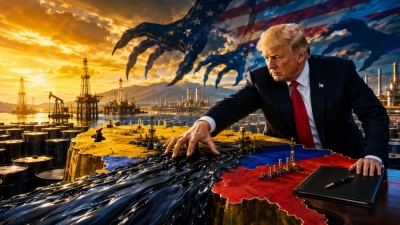
Donald Trump announced the reaching of an agreement for the development of 17 strategic fields with proven reserves of around 65 billion barrels. The American president stated that the US side secured majority control of these resources, describing the deal as the largest oil agreement in world history, taking place at zero cost to American taxpayers. For her part, interim president Delcy Rodriguez confirmed the deal, noting that the relevant projects foresee investments exceeding $100 billion and are expected to yield more than $209 billion in tax revenues for the state. "Under my direction," Trump stressed, "Secretary of State Rubio and the Secretary of Defense, in close cooperation with the highly respected interim president of Venezuela, Delcy Rodriguez, and through partnerships with the private sector, have secured majority ownership for the US in more than 65 billion barrels of proven oil in Venezuela, at no cost to American taxpayers. This historic agreement will more than double America's oil reserves, dramatically increase our oil supply, and long-term, significantly lower gasoline prices for all Americans, while helping Venezuela continue its path toward exceptional success and great prosperity. This agreement will further strengthen the growing relationship between Venezuela and the United States. Thank you for your attention to this unprecedented matter."
Centennial exploitation rights and channeling of produced oil to US military needs
Under the agreement, the exploitation of the 17 oil fields is granted to a new private company for a period of 100 years. The US will receive 55% of the "effective volume" of production, a percentage resulting from equity participation and the right to purchase part of the extracted oil at cost price. The oil acquired under these terms is intended to strengthen the US Strategic Petroleum Reserve and meet the operational needs of the US armed forces.
The change in the political landscape and the adaptation of the institutional framework to foreign corporate demands
This development became possible following the dramatic turn in Venezuela's political affairs on January 3, when US military forces arrested President Nicolas Maduro and his wife Cilia Flores, transferring them to the US to face federal charges that he does not recognize. Following his removal, appointed Delcy Rodriguez assumed the presidency, while the Trump administration immediately pushed for the return of American businesses to the country. Concurrently, authorities in Caracas proceeded with a sweeping overhaul of oil legislation, allowing private and foreign corporate groups to sign new contracts, autonomously sell extracted oil, and manage their revenues, while Washington eased restrictions in the sector.
Possible OPEC exit and tremors in international energy balances... major geopolitical realignment
As part of realigning relations with the US, Venezuela is seriously considering a withdrawal from OPEC, a topic discussed in contacts with American officials. Any implementation of this scenario would mark a historic turning point, as the country has been a founding member of the organization since 1960, along with Iran, Iraq, Kuwait, and Saudi Arabia. Such an exit would make Venezuela the first founding state to leave the organization, weakening the bloc of traditional oil producers. Venezuela's looming departure from OPEC following the deal with Washington does not merely represent a shift in balances within an international organization, but completely redraws the global energy map. The exit of a nation holding the largest proven crude reserves on the planet effectively cancels the cartel's ability to control global supply.
Winners and losers
Winners include the US and Western oil majors because they gain long-term access to giant deposits, replenish their strategic reserves, and weaken OPEC influence on international prices. Theoretically, based on international analysis, consumers are also among the winners because increasing production without quota restrictions puts downward pressureon crude prices, offering relief at the pump. Losers undoubtedly include Saudi Arabia, Russia, and OPEC+ because they lose the monopolistic capacity to regulate supply and maintain artificially high oil prices through production cuts, alongside OPEC unity which now faces an existential crisis, as following the UAE and Venezuela, an uncontrolled price war threatens member states.
1. The strategic prevalence of the US
For Washington, the agreement with Caracas and the leasing of oil fields represent a major geopolitical triumph. American oil companies assume control over vast infrastructure, while the US refining system secures access to cheap crude oil. Simultaneously, American strategic reserves are replenished without being squeezed by decisions originating from Riyadh or Moscow.
2. The weakening of the Saudi Arabia - Russia axis
OPEC+, under the leadership of Saudi Arabia and in alliance with Russia, relied on member cohesion to enforce production cuts and maintain oil prices at elevated levels. With Venezuela gaining independence from the cartel and the prior exit of the UAE, this strategy collapses. If cartel members begin producing uncontrollably to maintain their market shares, the cartel risks transforming into a decorative organization lacking real power.
3. What this means for fuel prices and the pump
For consumers globally, releasing Venezuela's production from OPEC quota constraints constitutes a positive development. Funneling millions of additional barrels into the market creates conditions of oversupply. This is expected to cap or significantly reduce international crude oil prices, translating into lower gasoline and diesel prices at filling stations.
4. Will OPEC collapse?
Expert analyst Igor Yushkov points out that the risk of OPEC collapse is real, as dissatisfaction over production quotasaccumulates dangerously. He estimates that cartel members will not necessarily announce an abrupt dissolution, but will follow a strategy of gradual and uncontrolled quota increases, effectively rendering the organization's restrictions completely useless.
www.bankingnews.gr






Readers’ Comments