

Nobody needs to hack your phone.
You do not need to click a suspicious link. You do not even need to be the target of an investigation.
It is enough to simply be in the wrong place.
Your phone is constantly searching for the best available network.
Somewhere nearby, however, there may be a «tower» that is not a tower.
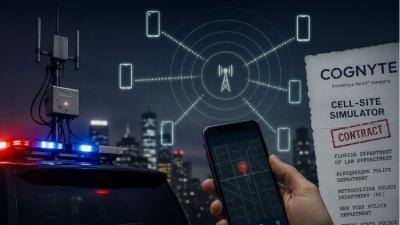
An American police device mimics a cellular base station, broadcasts the appropriate signal, and surrounding mobile phones begin communicating with it.
The suspect, the passerby, the driver stopped at a red light, the journalist, the protester, someone exiting a doctor's office: all can instantly enter the same digital net.
This is the true power of Cell-Site Simulators, or IMSI catchers, as they are also known.
And this precise technology is gaining fresh momentum across the US as state and local police departments turn to Israeli company Cognyte.
The issue is not merely that law enforcement acquired yet another tool.
It is that the very concept of surveillance is changing.
From Edward Snowden to the invisible tower
In 2013, the disclosures of Edward Snowden made millions of Americans realize that digital surveillance no longer belonged strictly to spy movies.
Since then, the battle for privacy entered everyday life.
Users of Ring video doorbells pushed back against the ease with which camera footage could reach authorities.
Flock cameras, which automatically read license plates, came under fire from advocacy groups arguing that a vast record of movements is being created for individuals suspected of no crime.
Yet another technology has remained far quieter.
Cell-Site Simulators do not merely record what passes in front of a lens.
They interpose themselves directly into the connection between the phone and the telecommunications network.
They impersonate legitimate base stations and compel nearby devices to connect.
In this way, they can capture device identifiers and SIM details while assisting in the precise geolocation of a handset.
The problem lies in the words «nearby devices».
To locate one phone, the technology sweeps up many.
And a citizen with zero connection to the investigation suddenly ends up inside the same electronic dragnet as the person hunted by police.
Cognyte: From the Israeli intelligence industry to American policing
Cognyte did not appear out of nowhere.
Its roots lie in Verint Technologies, from which the cyber intelligence and security business was spun off to create the independent company.
Israel has established itself over years as a global hub for intelligence technologies, cybersecurity, and surveillance.
A decisive role in this ecosystem has been played by the renowned Unit 8200, the signals and electronic intelligence unit of the Israeli military, whose veterans have subsequently migrated to dozens of private technology firms.
This industry produced impressive products.
It also generated formidable controversies.
In 2018, an investigation by Haaretz linked Verint Technologies equipment to surveillance operations in authoritarian or repressive environments.
According to allegations, similar tools had been deployed in Azerbaijan and Indonesia against citizens and minorities, in South Sudan to monitor regime opponents, and in Bahrain amidst an environment of widespread activist suppression.
Cognyte later faced fresh allegations.
Documents released by a human rights group in Myanmar indicated that FalcoNet technology had been sold to the country's armed forces prior to the military coup.
This development carries particular weight because electronic surveillance in Myanmar subsequently became part of a regime accused of torture, arbitrary detention, and extrajudicial executions.
This does not mean technology is automatically responsible for how a state uses it.
It means something else: when such a powerful tool passes from country to country and from intelligence agencies to police precincts, the actual product is not just hardware.
It is the capability of authority that accompanies it.

Your phone does not know the tower belongs to the police
The operating principle is almost deceptively simple.
The phone is designed to continuously seek a network.
An active Cell-Site Simulator presents itself as an attractive base station and induces devices in the vicinity to communicate with it.
In doing so, it can harvest identity and location data from multiple phones simultaneously.
Certain more advanced systems can, under specific technical conditions, support even more intrusive capabilities. Crucially, however, even their basic function is not inherently restricted to a single phone from the outset.
The technology first casts the net.
Then it searches for the fish it wants.
And as devices become smaller and more portable, the last visible footprint of surveillance disappears. Such a system can operate from a vehicle, a portable unit, or equipment carried by personnel.
Surveillance no longer requires a room filled with monitors and antennas.
It can simply drive down the street.

From Florida to New York
The concern is not theoretical.
In recent years, Cognyte has visibly broadened its footprint in the American law enforcement market.
Authorities in Florida acquired company equipment in connection with operations linked to migration flows from Haiti.
In Albuquerque, police selected Cognyte for a Cell-Site Simulator system.
The Baltimore police department also has a documented relationship with the company, followed by new contracts with major agencies.
In late 2025, agreements emerged with police departments in Washington and New York.
In March 2026, a contract followed with authorities in Texas.

The Fourth Amendment against the algorithm
Chip Gibbons, from Defending Rights and Dissent, places the issue at the heart of the American Constitution: in the Fourth Amendment and the protection against unreasonable searches and seizures.
The problem is the mass scope.
A traditional warrant has a specific target.
A technology that gathers data from devices merely situated near the target reverses that logic.
You do not start with the suspect to find their data.
You start with everyone's data to find the suspect.
This is the essence of a digital dragnet.
And therein lies the deepest political question: does technology allow authorities to do at scale what no one would deem acceptable if conducted door-to-door?
And then comes artificial intelligence
If Cell-Site Simulators represent the net, artificial intelligence can become the mechanism deciding what is worth catching.
Cognyte also markets NEXYTE, an analytics and intelligence fusion platform.
Its premise reflects exactly what is currently transforming modern policing: disparate data sources converge on a single screen, correlate, and produce connections that a human analyst would require far more time to identify.
Investigative files, public postings, social networks, personal relationships, behavioral indicators.
The system presentation even introduces the concept of a «threat score».
And here the issue extends beyond «where a phone is located».
It crosses into «what a person signifies».
In platform demonstrations, even an Instagram post featuring luxury perfume can form part of an algorithmic narrative assessing a suspect's financial profile.
The issue is not that such data can never hold investigative value.
The issue is the illusion that because a computer connected dots, those dots necessarily construct the truth.

From Pegasus to the new surveillance market
Cognyte does not exist alone in this ecosystem.
Cellebrite has become globally known for mobile forensics extraction technologies.
NSO Group found itself at the center of an international scandal over Pegasus and zero-click intrusion capabilities on smartphones.
Israel has built one of the most advanced surveillance technology sectors in the world.
The question, however, is not whether the technology is Israeli.
An American, French, or Chinese device with identical capabilities would raise the exact same democratic concerns.
The critical matter is what a democracy purchases when it acquires such a system.
Does it merely buy a tool?
Or does it buy alongside it an entirely new philosophy of policing?
When anyone can be tracked, everyone becomes a suspect
The defining battle of the coming decade may not be over whether surveillance will exist. That battle has already been lost.
It will be over whether surveillance will have limits.
www.bankingnews.gr












Readers’ Comments