

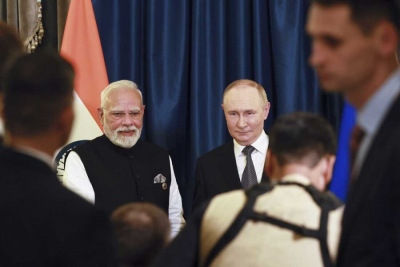
Moscow and New Delhi have initiated a series of contacts ahead of the SCO and BRICS summits. On August 24, Vladimir Putin welcomed Indian Foreign Minister Subrahmanyam Jaishankar at the Kremlin. Over the coming weeks, the Russian president is expected to meet twice with Indian Prime Minister Narendra Modi. Despite external pressures, both sides have managed to further strengthen the already significant volume of bilateral trade. Russia also intends to help ensure the stability of India's agricultural sector, with Putin pledging to increase fertilizer supplies. Experts assess that energy cooperation, particularly Russian oil supplies, remains at the core of India-Russia relations, despite growing pressure from the West.
Two Putin-Modi meetings on the horizon
The upcoming meetings with Modi were one of the main reasons for the Indian minister's visit to Moscow, political scientist Tatiana Kosacheva told Izvestia. As the host of the BRICS summit, India also wishes to discuss creating the proper conditions so that the Russian side can participate as comfortably as possible, while simultaneously avoiding the risk of a further escalation of tensions with its Western partners, the expert noted. New Delhi is facing significant Western pressure, particularly from the United States, due to its close ties with Moscow.
Oil keeps Moscow and New Delhi united
At the same time, India is the world's third-largest importer and consumer of oil. It covers more than 88% of its petroleum needs through imports, while Russia currently remains one of the country's most critical crude oil suppliers. Russian oil deliveries were likely the primary topic of behind-the-closed-doors talks, particularly amid ongoing drone attacks targeting Russian refineries, political scientists assess. Tatiana Shaumyan, head of the Center for Indian Studies at the Institute of Oriental Studies of the Russian Academy of Sciences, told Izvestia that energy resources represent one of the primary pillars of the bilateral agenda. India currently faces a massive demand for oil, making energy security a top priority. Furthermore, cooperation is not limited to direct supplies, but also extends to joint extraction and the refining of energy resources.
"It is impossible to disrupt these relations"
"It is impossible to disrupt these ties. Any attacks on infrastructure are obstacles that can be overcome. Those carrying out these actions [the drone attacks] seek to damage our relations. Our task, as well as India's, is on the contrary to strengthen cooperation in this strategic sector," Shaumyan told the newspaper. The message is clear: attacks on Russian energy infrastructure do not appear to have altered New Delhi's strategic approach toward Moscow.
India seeks more Russian investments
New Delhi continues to seek an increase in Russian investment in India while attempting to address the growing imbalance in bilateral trade. According to agreements reached between the leaders of the two countries, the volume of bilateral trade is expected to reach $100 billion by 2030, writes Kommersant. However, according to the publication, the fact that commercial and economic ties remain heavily concentrated on Indian purchases of Russian energy resources leaves the bilateral relationship particularly vulnerable to external pressures.
The Trump ultimatum and the high risk
The critical question, according to Kommersant, is precisely how India will navigate between its need for Russian energy resources and its need to avoid punitive US measures. Recently, US President Donald Trump threatened to impose a secondary tariff of 100% on products from countries that continue to purchase Russian oil, natural gas, and uranium. Such a move would constitute a direct threat to India's economic security and energy stability. New Delhi thus faces a particularly difficult geopolitical dilemma: to maintain its strategic energy relationship with Russia by defying pressure from Washington, or to yield under the threat of US sanctions. So far, India's actions indicate that it chooses not to abandon Moscow.
www.bankingnews.gr





Readers’ Comments