

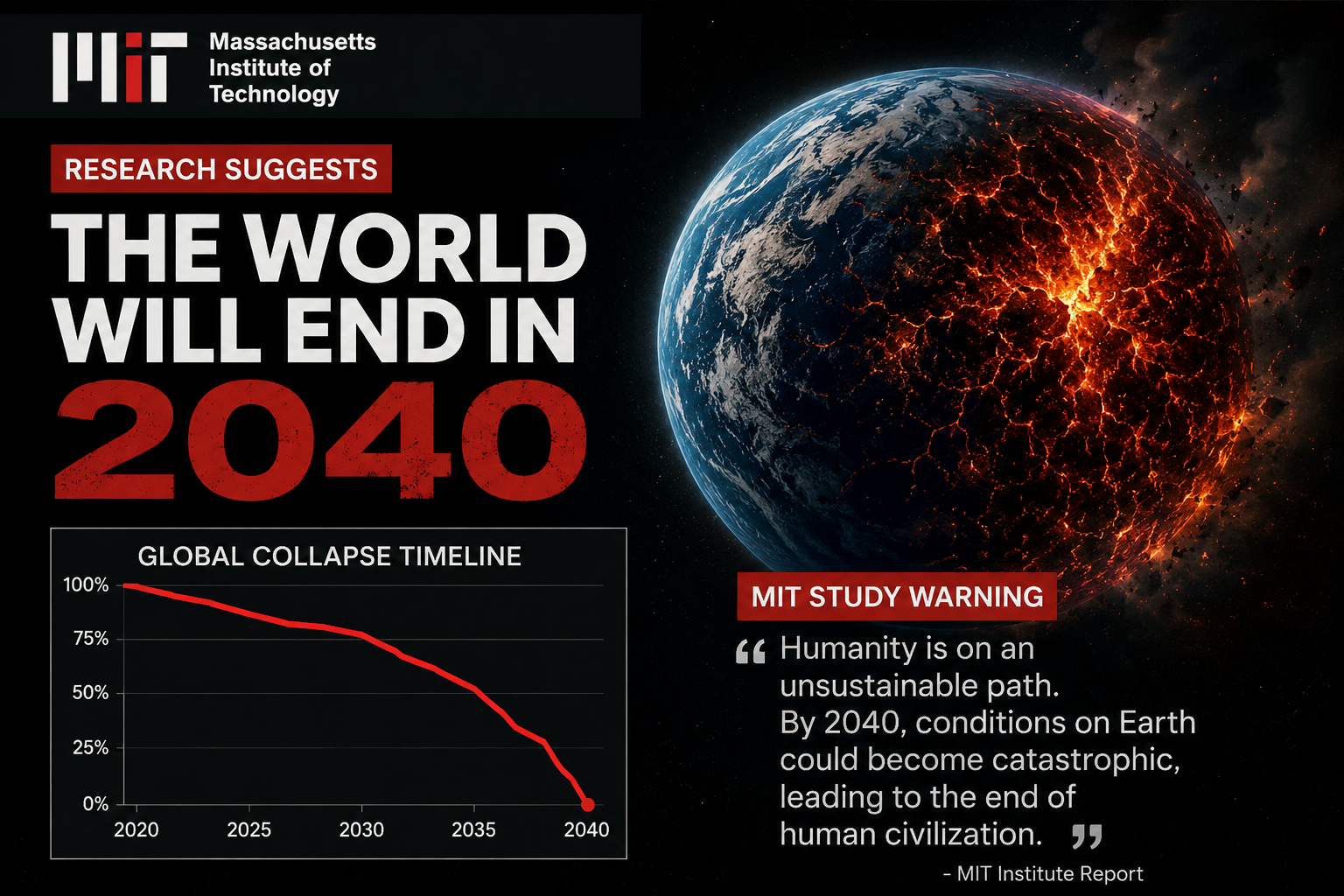
Fifty-four years ago, a team of researchers from MIT fed data on population growth, resource consumption, and pollution levels into a computer roughly the size of a shipping container. The machine processed the data and arrived at a trajectory leading to steep decline.
The 1972 report «Limits to Growth» predicted that, without drastic course corrections, industrial civilization would hit hard boundaries by the middle of the century.
At the time, critics dismissed the findings as Malthusian paranoia, citing the Green Revolution and technological optimism as proof that human ingenuity would always overcome scarcity.
According to the text, they were wrong.
A reassessment published by KPMG in January 2026 reportedly confirms the original trajectory of the MIT model: the world is not merely heading toward a collapse in 2040, but is already 18 months ahead of the worst-case scenario.
The report examined 30 key indicators, including arable land depletion, groundwater extraction, atmospheric carbon concentrations, and debt-to-GDP ratios across OECD countries.
According to the analysis, 27 of these indicators have outpaced the 1972 projections.
The remaining three, global maritime trade volume, semiconductor manufacturing, and satellite launches, may mask underlying vulnerability, as they measure activity rather than resilience.
The conclusion is particularly grim: the «business as usual» path now leads to systemic rupture between 2032 and 2038, while cascading failures could begin becoming evident as early as late 2027.
Numbers do not care about human optimism
Mathematics does not care about human optimism.
Exponential curves have the property of appearing flat right up until the moment they turn vertical.
The MIT model tracked five variables: population, food production, industrial output, pollution, and non-renewable resource depletion.
In 2026, global population stands at 8.2 billion people, having grown by 1 billion in just 12 years.
Food production plateaued in 2023 despite increased fertilizer use, a sign of diminishing returns from agricultural intensification.
Industrial output continues to climb, but the energy return on investment, the amount of usable energy extracted relative to the energy required to extract it, has fallen below the critical 15:1 threshold for most fossil fuel sources.
Pollution, measured by particulate matter, ocean plastic density, and atmospheric methane, exceeds the model’s «pollution crisis» scenario by 40%.
The curves converge toward a point where resource scarcity and toxicity reinforce each other.
The nine fractures already running through the foundation
Financial architecture does not collapse with a dramatic bang.
Instead, it dissolves slowly and almost invisibly, like limestone under acid rain, until the ground suddenly gives way beneath one’s feet.
Global debt reached 307 trillion dollars in early 2026, an amount equivalent to 333% of global GDP.
This is not a number that can be «solved» through growth. The exit is devaluation, default, or dissolution.
Central banks in 37 countries are currently testing central bank digital currencies (CBDCs), programmable money that can come with expiration dates and usage restrictions.
The Bank for International Settlements openly discusses «financial repression» as a necessary tool for managing sovereign debt.
In simple terms, the article argues, citizens’ savings could be used to keep institutions solvent, without citizens having any real room to react, since money will be code rather than cash.
The banking crisis never ended
The banking crisis of 2023 never truly ended, but was merely placed in a kind of artificial coma.
Regional banks in the US continue to lose deposits as savers turn to money market funds and US Treasury bonds.
Commercial real estate, particularly office towers built in the 1980s and 1990s, trades at levels roughly 60% below 2019 valuations.
Pension funds that invested in these «stable» assets face, according to the text, the risk of insolvency by 2028.
The derivatives market, that opaque web of interconnected obligations, now carries a notional value exceeding 1 quadrillion dollars.
When, not if, a major counterparty collapses, the deleveraging process will not be orderly. It will turn into a stampede toward «exits» that may no longer exist.
The climate is not changing, it is destabilizing
Climate systems are not merely shifting. According to the article, they are destabilizing.
The summer of 2026 broke records set just months earlier.
Phoenix recorded 31 consecutive days with temperatures above 115°F, roughly 46°C.
The wet-bulb temperature in Mumbai exceeded 35°C for six hours on August 3, 2026, surpassing the threshold of human survivability without air conditioning.
The minimum sea ice extent in the Arctic in September may set a new historic low, while some models suggest the first «blue ocean event», an ice-free Arctic, could occur as early as 2027.
In Siberia, the permafrost is not merely melting, it is exploding.
Methane craters up to half a kilometer in diameter have appeared on the Yamal peninsula, releasing ancient greenhouse gases at rates that, according to the text, could render reductions in anthropogenic emissions futile.
Water is being weaponized
Water is not just growing scarcer. It is turning into a weapon.
The Colorado River, which irrigates about 15% of American agricultural output, has reached critically low levels, triggering mandatory cuts under negotiations for the 2026 Compact.
Farmers in Arizona have already begun uprooting orchards that took decades to grow.
The Ogallala aquifer, beneath the American breadbasket, is declining by an average of two feet per year and will not recharge on a human timescale.
In India, groundwater beneath the Punjab region, the country’s breadbasket, will be economically inaccessible by 2028.
Pakistan and India have exchanged fire three times this year along the Line of Control over water rights in the Indus river basin.
The first water war of the 21st century, the article claims, is not coming. It has already begun, simply masked as a dispute over territorial sovereignty.
Migration turns into a torrent
Migratory flows have turned from trickles into torrents.
The UN estimates that 1.2 billion people currently live in areas that could become uninhabitable over the next two decades due to extreme heat, drought, or sea-level rise.
In 2026 alone, 340,000 people crossed the Darién Gap between Colombia and Panama heading north.
These are not, according to the article, merely economic migrants seeking opportunity, but climate refugees fleeing regions where agriculture is collapsing.
The Sahel region of Africa is emptying toward Europe at three times the rate seen during the 2015 crisis.
In Bangladesh, where 160 million people live on a delta sinking roughly one centimeter per year while sea levels rise three times faster, authorities are weighing «managed retreat» plans that could relocate 20 million citizens by 2030.
Borders are closing. Camps are swelling. And humanitarian infrastructure is under pressure that appears, according to the text, mathematically impossible to manage.
Food: The planet walks a tightrope
Food systems operate on such razor-thin margins that they resemble a tightrope.
The world holds roughly 70 days of grain reserves.
When exports from Ukraine were disrupted in 2022, wheat prices spiked by 40%.
When the Mississippi River dropped to historic lows in 2023, barge freight was stalled for months.
These, the article argues, were warning tremors, not anomalies.
In 2026, rice prices hit a 14-year high due to El Niño-induced droughts across Southeast Asia.
The Green Revolution that fueled the population explosion was built on fossil fuel inputs: natural gas for fertilizers, diesel for tractors, and petroleum for pesticides.
As energy costs rise, food costs inevitably follow.
The bread riots that began in Sri Lanka in 2022 and spread to Pakistan, Peru, and Kenya were, according to the text, merely a preview.
Microbes evolve faster than our defenses
Antibiotic resistance currently causes 1.27 million deaths annually, a figure projected to reach 10 million by 2035.
Gonorrhea, tuberculosis, and staph infections are exhibiting strains resistant to known pharmaceutical treatments.
Entering a post-antibiotic era could mean that surgery reverts to a lethal gamble, childbirth becomes far more hazardous, and minor cuts can prove fatal once again.
Meanwhile, zoonotic spillover events from animals to humans have tripled since 2010.
H5N1 avian influenza has, according to the text, achieved mammal-to-mammal transmission in dairy cattle herds across the American Midwest.
Virologists place the probability of efficient human-to-human transmission over the next 18 months at 40%.
Should this occur, the mortality rate could surpass that of the 1918 Spanish Flu.
Demographic inversion at nightmare speed
Global fertility has dropped to 2.3 children per woman, hovering barely above the replacement rate.
In South Korea it sits at 0.72, in Italy at 1.24, and in China at 1.09.
The inverted population pyramid, few young people supporting large elderly cohorts, creates massive fiscal deficits.
Japan currently spends 40% of its national budget on elder care and debt servicing. By 2030, that figure will reach 60%.
Pension systems are not merely underfunded. They are, as argued, un-fundable.
At the same time, youth unemployment in the developing world has reached 40% in regions where 70% of the population is under 30.
The combination of idle young men and resource scarcity has historically been the precursor to war.
Social cohesion dissolves
Social cohesion is fraying.
Political polarization has reached levels where 70% of Americans view members of the opposing political party as an existential threat.
Trust in institutions, including media, government, universities, and medicine, has fallen below 20% across Western democracies.
Conspiracy theories spread faster than facts because they offer a coherent narrative in a world of chaotic complexity.
When official accounts lose credibility, citizens construct their own realities.
The result is a society unable to agree even on baseline facts, rendering collective problem-solving nearly impossible.
The public square has degraded into a battleground of competing realities.
The mechanics of cascading collapse
These nine factors do not operate in isolation.
They interlock and feed into one another with terrifying efficiency.
Climate stress drives migration. Migration drives political backlash and border militarization.
Resource nationalism disrupts trade. Trade disruption creates economic shocks. Economic shocks lead to currency crises.
Currency crises prevent food and energy imports.
Food and energy shortages trigger civil unrest. Unrest further paralyzes supply chains.
Feedback loops are not linear. They are exponential.
The European energy crisis of 2022 serves as a prime case study.
Sanctions on Russian natural gas drove up prices. Soaring prices forced industrial shutdowns. Shutdowns cut fertilizer production. Reduced fertilizer lowered crop yields. Lower yields drove food prices higher.
The disruption moved from pipelines to city squares in six months.
Now, imagine that same chain reaction unfolding simultaneously across water, food, energy, and financial systems.
Models show that when three critical systems fail, the remaining seven follow in months, not years.
Resilience sacrificed on the altar of efficiency
The term «resilience» has, according to the text, been co-opted by corporate consultants to market digital solutions.
True resilience, however, is biological, not digital.
It is possessing diverse seed varieties, not running cloud backups.
It is knowing manual trades, not storing files on servers.
It is trust among neighbors, not verification via blockchain.
Industrial civilization optimized everything for maximum efficiency at the expense of redundancy.
It created «lean» systems, like a razor blade: sharp and efficient, but brittle under load.
What the breaking point will actually look like
Collapse will not arrive in cinematic fashion.
There will be no single day when the president declares martial law while cities burn.
The decline will be gradual, personal, and unevenly distributed.
It will begin the day your debit card fails at the supermarket, not because your account is empty, but because the payment processor went down.
It will be the week the pharmacy cannot refill your prescription because a supply chain broke in an industrial zone you have never heard of.
It will be the month your tap water runs brown, and then stops entirely.
The power grid pushed to its limits
Infrastructure does not fail all at once initially. It fails piecemeal.
The electrical grid, one of the greatest engineering feats of the 20th century, operates with less than 3% reserve capacity in most developed nations.
During the heatwave of August 2026, rolling blackouts hit 40 million Americans.
Hospitals ran on backup generators. Traffic signals went dark. Refrigerators warmed. Food spoiled.
These were not conditions in a developing nation, but in suburbs of Dallas and Sacramento.
When the grid goes down entirely, and the text notes the probability of a major continental outage by 2030 stands at 60%, recovery will not be quick.
High-voltage transformers take 18 months to build. Transmission lines require specialized cable-laying vessels.
And the institutional knowledge to repair these systems sits with an aging cohort of engineers lacking adequate replacements.
Water crisis and the return of epidemics
Water scarcity does not mean every tap runs dry simultaneously.
It means the price of water triples.
It means municipal service is rationed to four hours a day.
It means private wells become targets.
It means the wealthy install reverse osmosis filtration while the poor wait in lines with plastic jugs.
It means hospitals cancel elective surgeries because they cannot sterilize instruments.
It means sewer systems back up for lack of flushing pressure.
And it means cholera and typhoid return to cities that had not seen them in a century.
Food shortages will not start with empty shelves
Food scarcity will not look like empty supermarket shelves at first.
It will look like fresh produce being replaced by processed carbohydrates.
«Meatless Mondays» turning into meatless weeks.
Portion sizes shrinking while prices remain flat.
Imports, coffee, chocolate, bananas, disappearing and being replaced by local substitutes.
Weight loss being framed by doctors as healthy dietary trends rather than caloric deficits.
And suburban victory gardens returning, not as hobbies, but as survival necessities.
Crime will not go Mad Max, it will metastasize
Crime will not explode in cinematic fashion.
It will metastasize.
Petty theft will become normalized as police stop responding to non-violent calls.
Home break-ins will rise as desperation outstrips legal deterrents.
Organized looting of freight trains and delivery trucks will become so routine that insurers stop underwriting cargo in transit.
Neighborhoods once considered progressive will form private patrols.
The state will not vanish. It will fracture into private security, gang rule, and mob justice.
The state will retain the capacity for overwhelming force, but lose the ability to maintain everyday order.
Healthcare will decay incrementally
Disease will not spread like a medieval plague, but turn into a permanent grind.
Hospitals will operate at 140% capacity year-round.
Elective procedures will be postponed indefinitely.
Cancer treatments will be rationed by age.
Antibiotics will be reserved for those who can pay black-market rates.
Common infections will kill because medications no longer work.
Mental health crises will climb as chronic stress becomes the baseline emotional state.
The healthcare system will not fail overnight. It will erode incrementally, losing another fraction of its capacity each year.
Economic collapse and the «digital cage»
Economic collapse will not necessarily look like the hyperinflation of Weimar Germany, with wheelbarrows of paper currency.
It will look more like the cashless society envisioned by technocrats, but as a prison rather than a convenience.
CBDCs will be marketed as «financial inclusion» tools and could turn into mechanisms of social control.
Your money may expire if not spent within 30 days.
Purchases may be restricted based on your «carbon score».
Accounts may be frozen for speech violations or exceeding travel allowances.
The wealthy will move assets into land, precious metals, and hard cryptocurrencies, while the general public holds programmable digital tokens degraded by algorithm.
The stock market will not necessarily crash. It could be «temporarily» halted to prevent panic selling, then reopened under capital controls.
Survival is not just about stockpiles
Preparation is not paranoia when the threat is mathematical.
However, the lone-wolf survivalist hoarding canned food and building bunkers misses the mark.
Three months of stored food will not carry you through a decade of decline.
The lone wolf dies. The pack survives.
The critical asset is not ammunition or freeze-dried meals. It is social capital.
Trust is the currency that holds value when fiat fails.
Skills are the assets that appreciate when markets crash.
Water and food: Self-reliance becomes critical capital
Water security means more than storing bottled jugs.
It means knowing how to harvest rainwater, tap shallow aquifers, and build solar stills.
It means knowing your local watershed, the upstream sources, and the downstream contaminants.
It means community-scale infrastructure, cisterns, sand filters, gravity-fed lines, that works when municipal power fails.
Food security means regenerative agriculture, not industrial farming.
It means learning to grow calories, not aesthetic crops for social media.
It means heirloom open-pollinated seeds, not hybrid varieties that require annual repurchasing.
It means composting, foraging, root-cellaring, and fermentation.
It means small livestock, rabbits, chickens, goats, converting inedible biomass into protein.
And it means knowing your neighbors’ skills and trading labor for produce.
Energy and medicine: Returning to foundational skills
Energy security requires redundancy.
Solar panels with battery banks for when the grid fails.
Wood stoves for when gas lines freeze.
Manual tools for when electric ones have no juice.
The ability to repair rather than replace.
The skill to maintain engines, wire circuits, and fabricate solutions from scrap.
Medical security means returning to foundational skills: setting bones, suturing wounds, identifying medicinal plants.
It also means understanding hygiene, proper latrine construction, water purification, and waste disposal, to prevent disease rather than treating it after the fact.
Security will be collective or non-existent
Security means community defense, not personal armories.
A fortress mentality invites a siege.
Mutual aid pacts, neighborhood patrols, and communication networks that function when cellular towers drop could prove vital.
De-escalation skills will matter, as every gunshot invites retaliation.
The wisdom to share surplus may prove more important than hoarding it, since stockpiling attracts theft.
Psychological resilience may prove the rarest asset of all.
The capacity to adapt to a lower standard of living without despair.
The ability to find purpose beyond consumption and status.
The flexibility to abandon plans when reality shifts.
The emotional stability to witness suffering without becoming callous or crumbling.
And the moral grounding to retain ethical principles when legal enforcement dissolves.
The horizon toward which the world is heading
The 2040 projection, according to the article, was not wrong. It was conservative.
The KPMG reassessment argues we are not watching a cliff edge, but a steepening slope that began around 2020 and accelerates each year.
Collapse is not an event waiting in the future.
It is a process we are already living through.
The question is not whether we will live to see civilizational decline.
The question is where on the curve we will stand when our personal timeline intersects the systemic breakdown.
The Roman Empire did not fall in a day. It experienced centuries of decline during which life went on, markets traded, and culture existed, right up until systems stopped functioning.
The Maya did not disappear. They abandoned their cities when the agricultural base could no longer support population density.
The Late Bronze Age collapse, around 1177 BC, saw interconnected societies fail within decades due to climate shifts, seismic events, and invasions.
The survivors were those who decentralized, maintained oral traditions when writing disappeared, and pivoted from complexity to resilience.
The next 15 years will not resemble the last
The world stands at an identical inflection point.
The next 15 years will not look like the last 15.
Assumptions of perpetual progress, technological salvation, and endless growth on a finite planet are colliding with physical reality.
The hardship will be distributed unevenly, as it always is.
The wealthy will buy islands, citizenships, and private security details.
The poor will suffer first and worst.
The middle class will discover that degrees, certifications, and retirement accounts are abstractions that evaporate when supporting infrastructure fails.
Yet, according to the article, there is also a paradoxical liberation in the dark.
When the crushing weight of maintaining industrial civilization becomes unsustainable, room opens for other ways of living.
Not a utopia.
Certainly hardship.
But also proximity, craft, meaning, and connection, things the digital age promised but failed to deliver.
The future is not uniformly bleak. It is complex, diverse, and still undetermined.
The MIT model presented a choice in 1972.
According to the article, humanity made its choice, through action and inaction.
Now it must face the consequences.
The 2040 horizon approaches not as prophecy, but as the arithmetic consequence of numbers.
Those who see what is coming and prepare body, mind, and community will not escape the storm.
They may, however, build a sturdy enough vessel to reach the other side.
www.bankingnews.gr






Readers’ Comments