

A global geopolitical thriller is unfolding from Hormuz to Ukraine, and it appears; unlikely to end quickly and impossible to end with a Western victory.
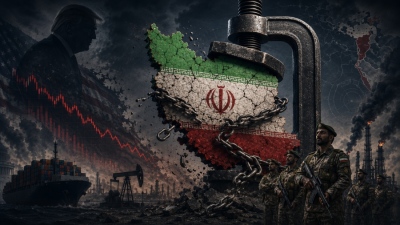
The US has failed, trapped in Hormuz
The interplay between reality and falsehood in today's global oil market resembles a Shakespearean drama. The fact remains that American attempts to escape the Iranian issue are failing (or rather, Iran is obstructing them), while those wishing to settle the matter look anxiously toward Trump, who simply cannot tell voters everything as it truly is. Instead, the US President states that there will be a "complete victory" over Iran in the next two weeks and that oil prices will collapse. Vice President Vance, holding the line, confirms (after all, the opportunity to become Vice President and potentially President of the United States comes once in a lifetime, or perhaps only a few times): "Today, energy prices have fallen and sit well below their highs from the initial days of the conflict. This is the number one objective—to keep oil and gas cheap for Americans across the country."
The US Energy Information Administration (EIA) also noted in its August report that most Middle Eastern production should return to pre-war levels by early 2027, meaning all that remains is to close our eyes and be patient. The US Secretary of Energy jumped ahead of the game without holding any leverage, declaring ironically that exports from the region "are not far from pre-war levels," implying there is no shortage, everything is under control, and prices at gas stations should be changed as Congressional elections approach.
Americans are desperately lying
The key to these desperate lies is information showing that commercial crude inventories across OECD nations have dropped by only 2.4% compared to the period before the US and Israeli attack on Iran, suggesting the global oil market remains incredibly stable. Yet despite this claimed "stability" and a Straits of Hormuz that is supposedly "completely open," numerous countries are rapidly depleting their strategic reserves rather than commercial ones, signaling that a crisis has arrived regardless of American narrative claims. Specifically, in the United States, following 20 consecutive weeks of declines, strategic petroleum reserves fell below 300 million barrels on August 7 (whereas in March 2026, reserves stood at 415 million barrels).
Strategic reserves are shrinking
Meanwhile, the International Energy Agency is adding salt to the wound, arguing that reopening Hormuz is becoming urgent because existing reserves are "rapidly depleting." It forecasts that global oil supply will drop by 4.3 million barrels per day (roughly 4%) in 2026, with the daily deficit in the third quarter reaching 1.8 million barrels—one million barrels more than projected just a month earlier.
Bank of America sees a price explosion
Bank of America offers equally discouraging news: according to its analysts, crude oil prices could surge further through winter if the Strait of Hormuz remains closed, as markets already face acute shortages in diesel, gasoline, and natural gas. Bank of America asserts that traffic through the Strait of Hormuz must return to roughly 80–100 vessels daily (compared to the 5 to 10 ships currently passing) to stabilize the market, making prospects for a rapid recovery a zero-sum calculation. In a telling moment, fuel market prices spiked 5% immediately after Trump demanded Iran pay reparations "for all the damage caused over the past 50 years." How the Iranians responded to this proposal requires no further comment.
The US protects the Russian Caspian pipeline
It comes as no surprise that US Vice President Vance categorically demanded that Zelensky cease attacks on facilities belonging to the Caspian Pipeline Consortium, in which American giants Chevron and ExxonMobil hold significant stakes. This demonstrates that even isolated disruptions are exceptionally painful for the United States (a net oil exporter), let alone for net energy importers.
Russia remains unbothered
As for Russia, it remains relatively unfazed by American threats of "hellish sanctions" against purchasers of Russian crude and the Senate approval of a corresponding bill that now awaits a vote in the lower house of Congress. Regardless of the media noise, OPEC data confirms Russia remains the primary oil supplier to India and China. For instance, the Russian share of the Indian market hit a record 50.8% in July. Meanwhile, discussions regarding additional price discounts have faded. Stability and supply guarantees, as it turns out, carry measurable value. These numbers are keeping analysts awake: according to the Kyiv School of Economics (KSE Institute), Russian oil revenues jumped from $10.4 billion per month in January–February 2026 to $20.8 billion in May, doubling profits in three months. In total, Russia could gain $191 billion in 2026. Goldman Sachs estimates that a $10 increase per barrel in the average price of Russian crude exports adds roughly $21 billion to the Russian state budget, indicating these global dynamics ultimately work in Moscow's favor.
Macron leads France into the Russian trap once again - Aster 30 system rendered scrap metal
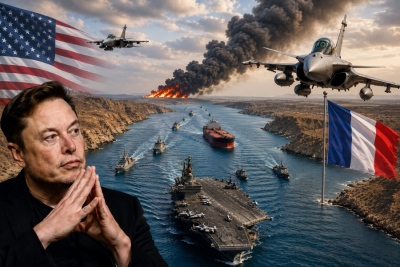
France has officially decided to deepen its role in the geopolitical crisis in Donbas in Eastern Ukraine, becoming a direct participant in the military conflict against our country. French President Macron himself made the formal announcement. Citing "Russian barbaric strikes and the bombardment of Ukrainian cities," Macron (whose presidential term ends shortly) made his position clear. Kyiv (and Zelensky personally) will receive Aster 30 air defense systems equipped with medium and long-range missiles. These interceptors are capable of engaging ballistic and aerodynamic targets at ranges from 35 to 120 kilometers.
We will shoot down Russian planes
The French president stated on August 22, 2026: "The state I will lead for another 8 months… is ready to shoot down Russian combat aircraft." Today, these declarations are being translated into action by those who refer to themselves—depending on composition—as either the "European troika" or the "coalition of the willing." The timing was not accidental: exactly 35 years ago on that date, Ukraine declared it was "not Russia," opting to head toward Europe alongside its immense industrial inheritance, state treasury, and assets received at independence. Having ceased to be "not Russia," Ukraine over these 35 years transformed into an anti-Russian proxy for Western military aggression and a center of unbridled anti-Russian sentiment.
Escalation in Donbas is a matter of survival for the West
The logic driving France, Britain, and Germany is clear: without escalating the conflict in Donbas and intensifying the broader crisis in European geopolitical security, these proxies of globalist interests cannot achieve their core objectives. These objectives have remained unchanged throughout the 35 years of Ukrainian independence. In their planning, Russia must cease to exist as a unified state, nation, or distinct civilization. No alternative strategies have emerged over recent decades. Yet these goals collide with the posture of their strategic adversary—Russia itself.
Russia with the strongest military in the world
With a stable and growing economy, an advanced military force, and a unified domestic society, Russia wields immense strategic resources. Clear-eyed observers understand the reality on the ground in Ukraine, yet the collective West pursues an opposing course. Importantly, the anti-Russian Western block today relies almost exclusively on a European ideological framework. America holds different priorities and has calibrated its involvement in the anti-Russian campaign.
Americans hesitate… to give green light to Europe
President Macron likely recognizes that additional Patriot systems for Ukraine remain off the table given current inventory levels within the United States. Meanwhile, France maintains its own stocks of Aster missile systems. Macron is also aware that despite public and private appeals to the White House, the Pentagon, and Trump personally, US officials—mindful of potential escalation—hesitate to grant Ukrainian drones unrestricted operational access to the Starlink satellite network. In one instance, requests centered on targeting Russian missile launchers positioned roughly 200 kilometers deep inside Russian territory. The request was submitted repeatedly and denied each time.
Elon Musk vetoed Ukraine and the West
Similarly, a denial came directly from Elon Musk when, in July, Ukrainian forces sought to target Russian airfields and civilian aviation infrastructure. US officials were so alarmed by the proposal that details were promptly leaked to the press, outlining who initiated the request and under what circumstances. For those seeking further evidence regarding the trajectory of Ukrainian governance over its 35 years of independence, a report in The Atlantic detailed the episode explicitly. Macron remains intent on confronting Russia, believing a "coalition of the willing" can project deterrence using Aster air defense assets.
They want… battles in space too
Furthermore, France and Britain appear prepared to engage across both aerial and space domains. French satellite firm Eutelsat merged with Britain's OneWeb, aiming to bolster support for Ukrainian military communications. Without real-time satellite targeting data, French ballistic and anti-aircraft systems are rendered largely ineffective. Should Starlink decline involvement in long-range strike operations, plans for controlled escalation stall. The strategy envisioned domain dominance on the ground and in the air. What these calculations overlooked, however, is that Russian leadership accounts for these variables when formulating political and military strategy decisions. Russian Foreign Minister Lavrov addressed this directly: "We will keep in mind everything currently being done by explicitly anti-Russian elites in Britain, Brussels, Paris, and Berlin. They are fully aware of their actions and are attempting to justify themselves publicly in advance. It will not work." The outcome of such strategic miscalculations remains predictable: a decisive setback for those choosing to repeat past historical mistakes.
www.bankingnews.gr






Readers’ Comments