

Foreign investors are reducing their exposure to short-term US government debt, at a time when stablecoins are emerging as a potential new and powerful buyer of American debt. In June, foreign investors sold $29 billion worth of T-Bills, while Tether alone holds nearly $115 billion in direct US Treasury bonds.
Foreigners step away from T-Bills
The trend had already emerged in May, when foreign investors sold $43.5 billion in short-term US Treasury bonds. In June, sales of another $29 billion followed. Over a two-month period, foreign holdings in T-Bills fell by a total of roughly $72.5 billion, raising questions about who will absorb the demand for American debt. However, this picture does not mean that foreign investors are abandoning the US market. On the contrary, June recorded net foreign capital inflows reaching $133.5 billion. Capital is simply being redirected into different investment vehicles. Foreign investors purchased $181.4 billion in US equities and just $6.8 billion in long-term Treasuries. In contrast, they were net sellers of T-Bills. Foreign holdings in these short-term government securities declined from approximately $1.43 trillion in May to $1.40 trillion in June debt holdings. The takeaway for Washington is clear: buyers of American debt are not disappearing, but the composition of overall demand for debt is shifting.
Tether has already loaded up on US debt
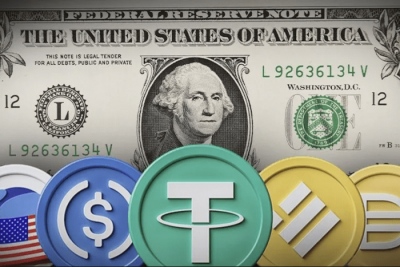
This is precisely where stablecoins enter the picture. Their operational structure creates a natural link to US government bonds. When a user hands one dollar to a stablecoin issuer, they receive a corresponding digital token. The issuer, in turn, must maintain sufficiently liquid assets to refund users who request redemptions. Short-term US government securities are ideal for this purpose. Tether serves as a prime example. At the end of the second quarter, the issuer of USDT stated that it held $114.96 billion directly in US T-Bills. At the same time, it held an additional $25.62 billion in short-term repurchase agreements (repos). The scale is striking: the $29 billion in T-Bills sold by foreign investors in June alone corresponds to roughly one-quarter of Tether's direct Treasury bill portfolio.
Circle moves in the same direction
A similar logic applies to Circle's USDC. A large portion of the stablecoin's reserves is managed through the Circle Reserve Fund, which is overseen by BlackRock. This specific fund invests in cash, short-term US government bonds, and repos backed by those same Treasury securities. Thus, a dollar entering a stablecoin ecosystem can ultimately wind up financing US national debt, without the user ever buying a US Treasury bond directly. This exact dynamic is particularly appealing to Washington policymakers.
Stablecoins have not filled the gap yet
However, it would be premature to claim that stablecoins have already replaced foreign bond investors. There is currently no indication that Tether, Circle, or any other stablecoin issuer directly bought the $29 billion in T-Bills sold by foreign central banks and investors in June. After all, the total supply of stablecoins grew very modestly during that same period. At the end of the second quarter, Tether had 184.6 billion USDT in circulation, just 446 million more than the previous quarter. Overall, the stablecoin market cap stood at approximately $302 billion on August 21. These figures are not large enough to account for $29 billion in T-Bill purchases.
Washington's big bet is on tomorrow
The true bet for the US government therefore lies in the future. The GENIUS Act requires regulated stablecoins to maintain liquid reserves, placing cash, short-term T-Bills, and repos backed by government debt at the center of the new crypto regulatory framework. The US Department of the Treasury has already published new rules for implementing legislation regarding digital assets and stablecoin issuers. The logic is straightforward: the more digital dollars circulate, the larger the reserves issuers will need to build. A significant share of those reserves will flow directly into US Treasury debt. So, while foreign investors dumped $29 billion in T-Bills in June, stablecoins have not yet filled the gap. Washington, however, is already clearing the path for them to do so tomorrow.
www.bankingnews.gr









Readers’ Comments