

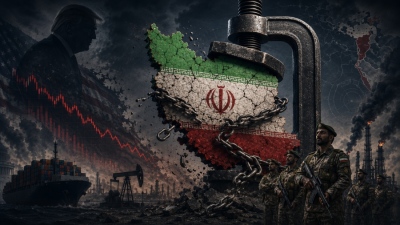
The failed adventure of the Americans in Hormuz and the wider Persian Gulf has entered a new, highly dangerous phase. While the economic war launched by the US begins today, August 24, 2026, reports are simultaneously increasing that the US military is preparing to launch military missile strikes against Iran, potentially within the week. It is obvious that the US is ramping up pressure, but Iran refuses to bend, emphasizing that it will seize all tankers in Hormuz that do not obey Iranian orders while warning the US that it has prepared new weapons and will attack American targets with overwhelming force.
News Nation: US will attack Iran again within the week with missiles
The American media outlet News Nation revealed that the US plans to launch military strikes on Iran within the week, while failed former US Vice President Mike Pence stressed that the US and Israel must take action once again to "finish the job."
Mike Pence (former US Vice President): US and Israel finish the job
Former US Vice President Mike Pence claimed: "The time will come for Trump and Israel to take action again to 'finish the job.'" At the same time, Iranian sources state that "the probability of a new military conflict breaking out in the coming days is extremely high. Any country that collaborates with Trump to pressure and starve the Iranian people will be severely punished."
Atlantic: Trump no longer wants to deal with Hormuz – Iran the new dominant power in the region...
The Atlantic notes in an article: "Today, Iran finds itself in a completely different situation. It has directly confronted the global superpower and Israel, weathered their heavy attacks involving their most advanced weaponry, and survived this confrontation in the best possible manner." As a result, Iran, with the help of the United States, has entirely restructured the power architecture in the Middle East and the Persian Gulf. From now on, the dominant force in the region will be Iran, not the United States or Israel. Neighboring countries are already adapting to this new reality, and powers situated further away will follow suit.
US: The largest economic attack in history against Iran launched today 24/8 - Judgment Day has arrived
Continuing recent rhetoric and uttering nonsense, the US Secretary of the Treasury stated: "Iran's day of economic judgment has arrived." The US Treasury Secretary declared: Countries that link their fate to Iran will face the closure of all avenues to sustainable prosperity. "Any nation serving as an economic lifeline for a regime on the brink of collapse should expect to contribute to that regime's isolation." The US Treasury Secretary also emphasized: "Starting this morning, August 24, we are unleashing the most expansive and formidable economic offensive in history against Iran." He further noted that "Trump will respond swiftly and decisively to any military action directed against our forces or Gulf partner nations."
Mike Johnson (US): Conflict with Iran will soon enter a new phase
Mike Johnson, Speaker of the US House of Representatives, claimed he expects the conflict with Iran to enter a new phase shortly and believes allies will assist the US in ending the conflict. Mike Johnson claimed in an interview with Fox News: "I think we will enter a new phase very soon." He also asserted that oil continues to flow through the Strait of Hormuz. "You cannot trust the Iranians on the other side of the table," he claimed. "That is the challenge." Asked whether Republicans could maintain control of the House of Representatives if the war in Iran continues until November, he replied: "Absolutely."
Mohsen Rezaei (Iran): The US asked for a ceasefire... not Iran – Not a drop of oil will pass through Hormuz
If the economic war continues, not a single drop of oil will pass through the Strait of Hormuz, emphasized the Secretary of Iran's Supreme National Security Council, Mohsen Rezaei. America believed it could finish the job within three days to six weeks. The Secretary of the Supreme National Security Council wrote in a message: "If the economic war continues, not a single drop of oil will be exported through Hormuz or from anywhere in the Persian Gulf." Iran was not weakened and did not request negotiations. On the contrary, it was America that requested a ceasefire. We reached a consensus document during negotiations, but the opposing side could not tolerate this agreement and breached it. The armed forces also stood firm, and through their operations, they exposed the vulnerabilities of the US military to the entire world—a military that has spent over a trillion dollars. America entered the arena with its full force, believing it could finish the task within three days to six weeks.
Iran: We will seize all vessels violating Iranian rules in Hormuz
The Persian Gulf Straits Authority (PGSA), Iran's regulatory body for the Strait of Hormuz, announced that vessels violating Iranian protocols in the strategic waterway will face operational restrictions on future voyages, including fines, detention, or vessel confiscation. In a statement published on its official X account, the authority warned shipowners and cargo owners moving vessels to and from the Persian Gulf to review the Non-Compliant Vessel (NCV) list prior to chartering to avoid potential complications.
Effective immediately, the authority stated, any vessel cooperating with ships included on the list—including ship-to-ship (STS) transfers or transshipments—will also be added to the blacklisted fleet. The announcement comes amid elevated tensions in the Strait of Hormuz, a vital choke point for global energy transit through which approximately one-fifth of the world's oil supply passes. Iran has warned that it will not tolerate any infringement on its sovereignty over the strategic passage, stating that traffic through the Hormuz waterway will not return to normal unless the United States ends its war and blockade against the country.
Mohsen Farkhani (Iranian analyst): US sanctions and blockade measures an "act of war" for Iran
Tehran considers the sanctions and blockade measures imposed by Washington to be acts of war rather than mere economic pressure, argues Mohsen Farkhani, a Tehran-based international relations researcher. "These sanctions are a war in themselves, and the blockade imposed on Iran is likewise part of this war," he told Al Jazeera. "Therefore, both the blockade and the sanctions constitute forms of war and demand a response from Iran," the analyst underscored. "China, Turkey, and other nations will not sever their ties with Iran," stated Farkhani, regardless of whether Tehran were to view countries such as the UAE, Turkey, Iraq, Pakistan, or China as adversaries should they restrict commercial ties under US pressure.
He added that the UAE's decision to curb trade with Iran was made "solely due to US pressure. Otherwise, we have been neighbors since time immemorial, and I do not believe it is possible to completely sever ties with Iran, given our deep-rooted relations." Tehran has so far exercised restraint, he noted. "Iran has consistently demonstrated caution in formulating its positions and ensuring they align with international resolutions."
www.bankingnews.gr






Readers’ Comments