

Who is the new enemy of Israeli Prime Minister Benjamin Netanyahu: Turkey or the domestic crisis inside Israel ahead of elections?
Israel is an intruder state, a cancer that kills indiscriminately and expands by stealing the land of other nations...
The fresh tension between Israel and Turkey over Syria constitutes, on one hand, a cover for the continuation of Israel’s occupation of Syrian territory, and on the other, a test for the credibility of regional alliances and the necessity of establishing local and independent security.
In recent days, tension between the Zionist regime and Turkey has entered a new and unprecedented stage.
A tension considered one of the most intense political confrontations between the two sides following the Israeli move to recognize the Armenian genocide.
Israeli airstrikes on the Abu al-Dhuhur military base in northwestern Syria, under claims of opposing the expansion of Turkey’s military presence, have led to an escalation of these disputes.
Israel destabilizes the region, not Turkey
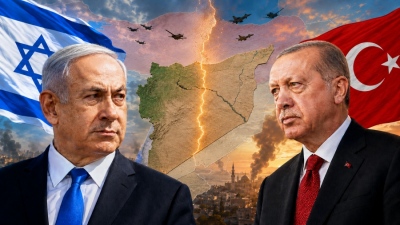
Following statements by Turkish President Recep Tayyip Erdogan, the office of Benjamin Netanyahu issued a harsh statement, accusing Ankara of attempting to destabilize the region.
An accusation that Turkey considered devoid of historical truth and political seriousness.
At the same time, Turkey has also pursued the legal process of requesting that Interpol arrest Benjamin Netanyahu.
Fabricating war scenarios with Turkey in Syria...
In this context, Yechiel Leiter, the ambassador of Israel to the United States, claimed that Israel has received intelligence indicating the intention of Turkey to significantly expand its military presence in Syria.
Israel Katz, Defense Minister of the Israeli regime, also accused Recep Tayyip Erdogan of dragging Turkey into «dangerous adventures in Syria».
More than a simple bilateral dispute, these positions are an indication of competition over the future of security in Syria and the equations of power in the region.
Syria as a pretext for expanding Israeli occupation
The Israeli regime attempts to frame its actions in Syria as countering Turkish militarism.
However, the reality on the ground is completely different.
The attack on the Abu al-Dhuhur base, the advance toward Tel al-Daryat, the raid in the Quneitra regions, and previous actions, including the consolidation of its control over the occupied Golan Heights, the expansion of its presence in the countryside of Damascus, and dominance over the strategic heights of Jabal al-Sheikh, represent a series of actions whose occupying character cannot be justified by security claims.
The Israelis are fabricating an enemy
It appears that highlighting the name of Turkey, in part within Israeli calculations, serves a function beyond a security dispute and could provide cover for expanding the scope of occupation in Syria.
A course that ultimately leads toward approaching the borders of Iraq as part of the regime’s expansionist plans.
Therefore, the core issue is not the presence of Turkey, but the continued occupation by a regime that does not consider geographical borders an obstacle to its expansionist project.
Netanyahu and the need for a new enemy
Ahead of elections in Israel, the situation for Benjamin Netanyahu appears more difficult than ever.
The failure to achieve many of the stated objectives of the wars, from Gaza to Iran, the intensification of economic and social crises, the erosion of military capability, growing domestic pressures, and the spread of global disgust regarding the regime’s performance have severely challenged his political standing.
Under such conditions, when the capacity to launch a new war is in doubt, creating a crisis does not necessarily mean starting an outright war.
Sometimes, simply generating a security atmosphere, highlighting an external threat, and reproducing a sense of insecurity can become tools to bolster extremist currents and pave the way for the political survival of Benjamin Netanyahu.
Permanent hostility is part of this mechanism.
Trilateral agreement: A test for regional security
The moves of the Israeli regime against Syria and Turkey have now put the trilateral security agreement between Saudi Arabia, Turkey, and Pakistan to a serious test.
One of the main pillars of this agreement is mutual support against military threats.
It remains to be seen to what extent this commitment against a real threat to one of the members will translate into practical action.
A refusal by Saudi Arabia and Pakistan to effectively back Turkey could seriously question the credibility of this coalition and the claim of establishing new security mechanisms in the region.
Security acquires meaning when, at a moment of crisis, it moves beyond the level of a declaration.
On the other hand, Western conduct once again exposed the contradiction between rhetoric and action.
European nations have largely restricted themselves to condemning Israel over settlements and have failed to respond appropriately to the occupation and the regime’s threats against Syria and Turkey.
During his visit to Turkey, Donald Trump, while raising the issue of support and sales of the F-35, ultimately demanded that tensions must not lead to military action against American interests in Syria and the region.
An approach indicating that the priority is preserving the interests of Washington rather than regional security.
Recent developments demonstrated once more that the West is neither a savior nor a messenger of peace, but in many cases part of the crisis... because within the framework of «Israel First», the security of other nations in the region is marginalized.
From this perspective, the intensification of occupation in Syria and the threat toward Turkey underline once again the accuracy of Iran’s warnings regarding the threatening nature of the Israeli regime to the security of the entire region.
In such circumstances, the way forward is not for countries to rely on the promises of extra-regional powers, but rather to move toward local, independent security grounded in internal strength.
The region can break free from the cycle of crisis when its nations do not tie their security to the will of foreign actors, do not accommodate the military presence of foreigners, and adopt an independent, coordinated stance against occupation and aggression.
The experience of Iran in relying on local defense capabilities and the smart management of regional strategic assets indicates that independent security is not a distant ideal, but an achievable way out.
www.bankingnews.gr




Readers’ Comments