

"Were children the product?" – The allegation hitting Meta's core
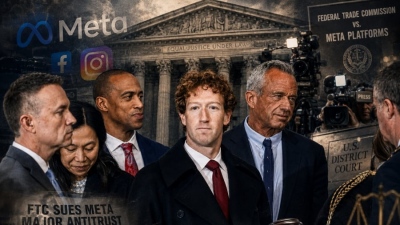
The four states leading the trial—California, Colorado, Kentucky, and New Jersey—contend that Meta utilized product design across Facebook and Instagram to artificially extend time spent on the apps by younger users. The prosecutors' core argument posits that extended platform engagement directly generates more user data, creating expanded opportunities for targeted ad placements. California Deputy Attorney General Megan O'Neill outlined the state's case during opening statements, describing a monetization strategy structured around locking users inside applications, harvesting personal information, and obscuring potential harms from the public. States maintain that elements such as endless scrolling, push notifications, public like counts, and automated recommendation engines are not neutral utility tools. According to the prosecution, these features represent components of an engineered system calibrated to make leaving the app extraordinarily difficult for adolescent users.
Endless scroll, likes, and notifications targeted – Can the mechanics of "keep scrolling" be dismantled?
This issue marks the potentially historic turning point of the litigation. Historically, numerous lawsuits directed at technology platforms focused primarily on user-generated content published by third parties. This lawsuit digs much deeper. It directly targets underlying product design. The states are requesting structural modifications to features like infinite scrolling, like buttons, and minor interaction rules, meaning the judge could order major operational changesalongside monetary penalties if Meta is found liable. This structural threat presents a far greater risk to Meta than a standard civil fine. A monetary penalty represents a single operational cost. An enforced algorithmic overhaul could disrupt the entire economic engine driving the company.
The multi-billion dollar algorithm – Where Meta's real fear lies
Facebook and Instagram function fundamentally as massive programmatic advertising engines. Their enterprise valuation relies on keeping users active, mapping personal interests, and serving content designed to maximize user response metrics. Heightened engagement directly translates into increased capacity for ad impressions. Consequently, legal mandates targeting algorithmic mechanisms could carry vastly greater consequences than headline-grabbing financial claims. Reports from The Guardian emphasize that structural alterations to content recommendation engines could severely depress user engagement, directly eroding advertising revenue. If implemented at scale, the proceeding ceases to be an isolated legal liability matter. It becomes a fundamental threat to the company's core monetization framework.
$200 billion on the table – Meta warns of an astronomical $1.4 trillion scenario
The financial metrics surrounding the trial are staggering. According to courtroom statements, state attorneys general have discussed potential penalty models approaching the $200 billion mark. Meta, meanwhile, argued in court filings that a specific statutory calculation model could theoretically push liability up to $1.4 trillion, roughly matching the firm's total market capitalization, though the presiding judge deemed this estimate exaggerated. Thus, the $1.4 trillion figure does not represent an awarded sum or a formal claim by the states. It represents an extreme economic projection cited by Meta regarding potential statutory civil penalties. Yet even the approximately $200 billion cited by states positions this proceeding among the largest corporate liability trials in decades.
"They knew and failed to stop it" – The explosive charge over internal research
Another severe charge asserts that Meta cannot credibly claim ignorance regarding platform risks. Prosecutors plan to present internal research documents, internal communications, and employee testimony that they argue show corporate leadership was fully aware of negative experiences among teen users. California explicitly alleges that executives understood how specific features promoted compulsive usage while simultaneously marketing the platforms as safe environments for young audiences. This dimension drives frequent comparisons between this litigation and historic lawsuits against the tobacco industry. The central legal question remains identical: What did executive leadership know about the risks of their product, and how did those insights compare to public corporate messaging?
Children under 13 – The case's second bombshell
The trial extends beyond allegations of addictive product design. All 29 participating states have filed claims against Meta alleging systematic violations of the federal Children's Online Privacy Protection Act (COPPA). Regulators claim Meta collected and monetized personal data belonging to children under 13 without obtaining verifiable parental consent. In June, US District Judge Yvonne Gonzalez Rogers rejected Meta's attempt to dismiss the core of the lawsuit, clearing state claims regarding deceptive practices and COPPA violations to proceed to trial. Age verification represents a notoriously complex technical challenge. Meta maintains that social platforms face massive hurdles identifying users who misrepresent their birth dates, warning that overly intrusive identity checks introduce severe new privacy risks.
Meta's defense counterattack: "Evidence is presented selectively"
Meta lead defense attorney Paul Schmidt rejected the narrative put forward by state prosecutors. The defense team argues that internal documents and employee communications are being presented entirely out of context to manufacture a false narrative of deliberate harm toward child users. Schmidt further argued that the relationship between social media exposure and youth mental health is vastly more complex than prosecutors claim, asserting no direct causal link connects app usage to specific psychological disorders. The company emphasizes extensive investments in safety infrastructure, robust parental controls, automated notification limits, and dedicated safety settings for teen accounts. Meta maintains that its long-term commercial interest relies entirely on providing users with safe, positive digital experiences.
Section 230 and free speech – Major legal shield fails to block trial
Meta has historically relied on Section 230 protections—the US legal provision offering broad immunity to online platforms for third-party content—in similar legal disputes. However, this case introduces a critical distinction. States are not merely arguing that third parties posted harmful content on the platform. They contend that Meta directly engineered specific features in a manner that was inherently harmful or deceptive to end users. California officials noted that Meta's efforts to dismiss the case using Section 230 arguments failed to prevent the lawsuit from moving forward to a federal trial. This legal distinction could set a major precedent not just for Meta, but for dozens of ongoing cases against other tech platforms.
Key witness Arturo Bejar – The former Meta insider testifying against the company
The prosecution's primary witness is a former company insider possessing direct knowledge of internal operations. Arturo Bejar worked at Meta from 2009 to 2015 and returned as an independent consultant between 2019 and 2021. On August 19, he continued his testimony before the federal court in Oakland. Bejar asserts that he repeatedly warned senior executives about harm experienced by young users, testifying that internal safety systems prioritized formal rules over preventing real-world psychological impact. His testimony is considered pivotal because it directly connects public state allegations with Meta's internal operations. Meta attempted to block or restrict his testimony citing disputes over deleted Signal messages, but the presiding judge rejected the defense motion.
Mark Zuckerberg and Adam Mosseri under the legal microscope
The trial is projected to last roughly six weeks, with expected courtroom testimony from top executives including Meta founder and CEO Mark Zuckerberg and Instagram head Adam Mosseri. Their personal testimonies carry immense legal significance. Prosecutors are not merely attempting to show that technical features operated defectively. They are working to establish what executive leadership knew, when they knew it, and how they acted regarding youth safety. This elevates the proceeding from a technical debate over algorithms into a high-profile battle over corporate executive fiduciary duty.
The first warning bell already rang: $6 million penalty for addictive design
Meta enters this federal proceeding carrying recent legal precedents. In March 2026, a Los Angeles jury found Meta and YouTube liable in a landmark case involving a young plaintiff who alleged childhood platform addiction caused severe mental health issues. The jury awarded $6 million in total damages, assigning 70% of the financial liability to Meta and the remainder to YouTube's parent company. The verdict carried immense symbolic weight across the tech industry. It marked one of the first instances of a jury accepting the legal theory that social media product design could constitute a primary cause of personal harm.
The $942 million hit in New Mexico – And this time it wasn't just about money
An even larger legal blow followed shortly after in state proceedings. In New Mexico, Meta faced combined financial liabilities totaling $942 million after a jury awarded $375 million and a state judge added $567 million toward a youth mental health intervention fund. Meta has stated its intention to appeal. However, the true bombshell involved the sweeping court-ordered operational mandates. The ruling required strict age verification, daily usage caps for minors, push notification blackouts during night and school hours, and expanded parental controls. While the judge declined to enforce algorithm changes, the ruling demonstrated how deeply courts might intervene in platform feature design.
The comparison terrifying Silicon Valley: Is Meta the new Big Tobacco?
The most intense historical parallel drawn by legal experts compares this litigation to state actions against major cigarette manufacturers. During the 1990s, US state attorneys general launched coordinated lawsuits against Big Tobacco over public health costs and deceptive product marketing. The landmark 1998 Master Settlement Agreement forced major tobacco firms to pay hundreds of billions while accepting strict operational controls on advertising and youth marketing. The parallels to today's social media litigation are striking. That historical battle focused on products prosecutors proved were addictive alongside industry executives who concealed internal risk assessments. Today, the legal battleground has shifted from cigarettes to digital mobile screens.
Big Tobacco: The warning that even a historic defeat does not kill a giant
Yet the tobacco comparison offers another perspective for corporate analysts. Cigarette manufacturers did not vanish following their historic legal defeats. Despite massive financial settlements, severe marketing limits, and heavy regulation, tobacco companies remained highly profitable multinational corporations. Analysis from The Guardian notes the global tobacco market remains close to $1 trillion, with major industry players maintaining strong margins decades after their legal battles. In separate federal proceedings, initial government claims of $289 billion were dramatically scaled back prior to final judgment. Companies adapted to strict marketing rules while continuing standard business operations. This outcome represents a highly plausible long-term operational scenario for Big Tech. Not corporate dissolution—but mandatory submission to new regulatory frameworks.
"The end of social media as we know it?" – The phrase sparking industry concern
Forrester analyst Kate Winick described the lawsuit as a proceeding that could potentially mark the end of social media "as we know it"—not because Facebook or Instagram will shut down overnight, but because an adverse ruling could trigger a long-term decline in usage if core engagement features are restricted. While dramatic, the quote highlights a fundamental legal question. What happens if courts order structural changes such as: restricting infinite scroll mechanisms, hiding public like counts for underage users, disabling notification systems during overnight hours, mandating strict identity verification, and forcing algorithms to deemphasize pure engagement metrics? Such mandates would not merely alter a teenager's experience on Instagram. They would dismantle the economic foundation supporting the entire attention economy.
Europe opens a parallel front – Regulatory pressure becomes global
This legal battle is not isolated to the United States. The European Union has aggressively implemented strict child protection requirements under its landmark Digital Services Act, establishing formal enforcement guidelines targeting addictive platform design. This dual pressure creates immense operational complexity. If US courts mandate structural design changes while European regulators enforce parallel technical rules, Meta faces a global operational shift. Maintaining separate technical architectures across California, New Mexico, and Europe would prove engineeringly impractical. Consequently, localized court mandates could quickly transform into global platform design overhauls.
Jury won't decide alone – The judge holds the ultimate key
An important procedural detail is frequently overlooked in media coverage. The eight jurors empaneled in this federal proceeding will issue a purely advisory verdict regarding technical claims. The ultimate legal determination of liability and injunctive relief rests with US District Judge Yvonne Gonzalez Rogers. This distinction means the lawsuit's outcome will proceed differently than standard jury trials where jury verdicts directly dictate final outcomes. The presiding judge must weigh complex evidence alongside technical legal frameworks governing constitutional speech, privacy rights, product design, and corporate liability.
The real $200 billion question: Can a court order overcome the algorithm?
Meta maintains vast financial reserves capable of absorbing substantial legal judgments. Even a historic monetary fine does not automatically threaten the company's solvency. The true structural threat lies elsewhere. If judiciary rulings reclassify engagement-focused design as inherently dangerous product defect, the social media industry faces an entirely new epoch of legal exposure. Future lawsuits would no longer focus on user content moderation choices. They would target why algorithms serve specific content, how frequently it is displayed, and what technical choices were engineered to maximize screen time. That represents a completely different legal landscape.
The "tobacco" of a new era or an overreaching lawsuit? The battle begins
For state prosecutors, the case represents an essential defense of youth mental health against software engineered to exploit child psychology. For Meta, the lawsuit represents an overreaching effort to assign complex societal and mental health issues to digital tech platforms. Both parties recognize the trial's outcome will extend far beyond the federal courtroom in Oakland. Meta already faces thousands of parallel lawsuits brought by school districts, municipalities, and personal injury plaintiffs regarding youth addiction. A decisive victory for the states could trigger an unprecedented wave of new litigation. A victory for Meta could establish a strong legal barrier protecting platform design choices from product liability.
The landmark trial: More than Meta's wallet at stake
Headline claims of $200 billion capture public attention. Projections of $1.4 trillion generate sensational headlines. Yet neither figure captures the true historical importance of this proceeding. The central conflict asks whether judicial authorities can legally compel one of the world's most powerful tech conglomerates to stop engineering features targeted at capturing youth attention. In the 1990s, American courts forced Big Tobacco to alter how it advertised and distributed its products. Three decades later, Silicon Valley faces an identical legal reckoning. Not over tobacco. Not over cigarettes. Reckoning over likes, notifications, infinite scrolling, and engagement algorithms engineered to maximize user retention. If the 29 states prevail, Meta's greatest loss won't be a multi-billion dollar penalty. It will be the loss of its legal right to design Facebook and Instagram without judicial oversight.
www.bankingnews.gr












Readers’ Comments