

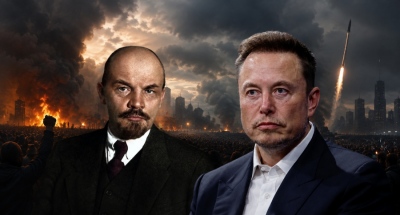
Vladimir Lenin wrote that a revolutionary situation breaks out when those «below» do not want, and those «above» cannot, live as before.
Today, the ballooning of oligarchs like Elon Musk, through unchecked «shadow» money and the erosion of democracy, brings humanity to a breaking point of social and climate explosion.
Specifically, according to Ann Pettifor, director of policy research at Policy Research in Macroeconomics (PRIME), Elon Musk may not know it, but he owes a great deal to the Geneva School.
This now largely forgotten group, combining the Austrian School's emphasis on free markets with German liberalism, developed during the 1930s the theory that paved the way for greater private control over the creation, pricing, distribution, and marketing of money.
This is the intellectual foundation upon which oligarchs like Musk build their fortresses of wealth and power today, at the expense of democracy.
The Geneva School's contribution to the erosion of democracy was not accidental. As Quinn Slobodian of Boston University has observed, its core members, among them Ludwig von Mises, Friedrich von Hayek, and Lionel Robbins, shared a view later embraced by Milton Friedman of the Chicago School: that democracy constituted a «potential threat to the functioning of the market order», not least because it legitimized demands for redistribution.
These neoliberal economists therefore pushed for «safeguards» against the disruptive power of democracy.
They wanted states, laws, and institutions redesigned to minimize public, democratic power over the economy, with the aim of protecting and «encasing» private market power.
And, to a significant extent, they succeeded.
Today, the global financial system is larger than ever and many of its segments (especially the so-called «shadow banking system», which consists of non-bank financial intermediaries such as hedge funds and private credit firms) operate largely beyond state oversight and regulation.
In Frankfurt, London, New York, Shanghai, and Singapore, private actors possess the power and freedom to shape vast speculative markets in money, energy, healthcare, food, education, and housing, a kind of global casino where, as in all casinos, the «house» wins in the end.
This system is, by design, removed from public accountability and essentially unchecked.
And the consequences were predictable: extreme concentration of private wealth, growing control of political influence by wealthy individuals, the degradation of the public sphere, the rise of political extremism, and, with the SpaceX IPO of Musk, the (brief) emergence of the world's first trillionaire.
Why money is not a commodity
As Pettifor notes, at the heart of this system lies a distorted and archaic conception of money as a scarce commodity.
In 1695, John Locke argued that money could be stabilized by linking it to a physical commodity such as silver or gold, an arrangement that, as Stefan Eich of Georgetown University explains, effectively precluded discretionary political intervention in money.
Centuries later, proponents of the Geneva School adopted this idea of «depoliticized» money. In his 1976 monograph Denationalisation of Money, Hayek argued that the state monopoly on money should be abolished.
Unemployment, he maintained, did not arise from market failures, but from the fact that «governments prevent enterprise from providing a good money».
Inflation persisted because the state intervened in the valuation of currency and because money was prevented «from being regulated by the market process itself».
Nothing, he concluded, should stand in the way of developing a private market for the creation, supply, pricing, and distribution of money.
Democracies were particularly problematic.
«Good money, like good law, must operate regardless of the effects that the decisions of the issuer will have on known groups or individuals», he wrote.
While a «benevolent dictator might conceivably ignore these effects», democratic governments, which «depend on a coalition of special interests», can «under no circumstances do so».
Of course, Hayek's vision of money as a commodity that must be depoliticized was fundamentally political.
Today, its resonance remains much stronger than is generally recognized, and extends far beyond cryptomania.
If money is regarded as a commodity like timber or platinum, then it is only a short logical step to believing that money can be bought and sold in private markets.
But money is not a commodity.
It is a social construct.
It is a promise of payment, and the credibility of that promise rests on and is secured by laws, regulations, and public institutions.
Money is, at its core, a credit system (such systems have existed for millennia and allow societies to achieve more than they ever could through a barter economy).
As Benjamin Braun of the London School of Economics and Political Science and Daniela Gabor of SOAS University of London explain, there are two primary forms of credit money: central bank liabilities (reserves and cash) and commercial bank liabilities (deposits).
The «moneyness» of these liabilities ultimately depends on the legal rights and financial backstops provided by the state, including direct access to lender-of-last-resort liquidity.
Modern representatives of the Geneva School distort this arrangement, enabling and encouraging privately organized, market-based money creation and pricing (interest rates).
While the central bank has direct control over the «policy rate», market interest rates are, by design, beyond its regulatory oversight.
This private power to determine the «price» of money increases real interest rates and yields and encourages private money markets to apply the principles of usury in order to generate credit that extracts wealth and inflates debt.
Such «easy» money creation, combined with high real interest rates, inevitably raises the cost of private borrowing.
Furthermore, the global shift toward inflation targeting during the 1990s led central banks to prioritize creditor interests in their interest rate decisions.
Partly as a result of this easy yet costly money creation, public and private debt has skyrocketed, reaching an astonishing $251 trillion in 2024, corresponding to 235% of global GDP, up from around 100% in the 1960s.
Private debt alone stands at 143% of global GDP.
Publicly gives, privately takes
According to Pettifor, Hayek's monetary vision finds its fullest expression in the largely unregulated global money market.
As Paul McCulley of Cornell Law School, former managing director of PIMCO, pointed out in 2009, this «shadow banking» system has contributed to «an explosive growth in leverage and liquidity risk outside the oversight of the Federal Reserve».
And this market continues to grow. In 2024 it grew by 9.4% (twice the rate of the regulated banking sector), reaching $256.8 trillion, or 51% of global financial assets.
As Braun and Gabor also show, when private financial actors innovate, they create «shadow money», financial liabilities that perform near-monetary functions within the financial system, but without ex-ante state backing.
Prior to the global financial crisis of 2008, both Bear Stearns and Lehman Brothers created shadow money to fund their rapidly ballooning balance sheets.
Yet, Braun and Gabor explain, the creation of new money depends on the daily valuation of the collateral against which new credit is extended.
When the private valuation of collateral collapsed, shadow banks collapsed along with it.
Musk has raised billions of dollars in loans from Wall Street and shadow banks over the past year to finance the growth of SpaceX, which Nir Kaissar of Bloomberg describes as an «empire-building project with no profits, no dividends paid, and controlled by a single individual» and as the «ultimate definition of a junk stock».
Although many were willing to extend these loans, they demanded high real interest rates.
Unlike credit rating agencies, the private bond market assesses a company's value based on the additional yield it must pay over comparable-maturity US Treasuries.
The bonds issued by SpaceX trade at an average spread of 1.62 percentage points across all maturities. This is higher than the average spread of 1.55 percentage points for BB-rated «junk» bonds.
As the credit market knows, low-rated bonds carry a far higher probability of default.
That is why many institutional investors, such as pension funds, insurance companies, and sovereign accounts, typically do not hold junk-rated bonds at all. When Musk's other company, Tesla, came close to bankruptcy during the 2017–19 period, its bonds traded as low as around 80 cents on the dollar.
One would expect that, at a minimum, these private credit markets would be subject to the same discipline as other capitalist enterprises, namely being rewarded or penalized for taking risks, and not benefiting from public policies and resources.
In reality, in order to mitigate crisis risks, these private markets remain tethered to state-backed central banks.
Monetary authorities' actions, from quantitative easing (QE) to interest rate cuts, provide periodic boosts to shadow banking leverage, as Gabor and Cornel Ban of the Copenhagen Business School have shown.
Following the global financial crisis, the European Central Bank sought particularly to protect the securitization market by providing collateral, implementing quantitative easing, and lobbying the European Commission and national governments for regulatory relief.
The ECB also managed to derail a European Commission proposal for a financial transaction tax, including repo transactions of shadow banks.
The surplus amassed by a small but growing number of plutocrats is further augmented by tax breaks and public subsidies, such as those for fossil fuels.
Partly due to the allocation of public financial resources, the total wealth of American billionaires increased by $2.071 trillion (70.3%) during the COVID-19 pandemic, from March 2020 to October 2021, reaching $5.02 trillion.
The wealth of the country's five richest individuals at the time (Jeff Bezos, Bill Gates, Mark Zuckerberg, Larry Page, and Musk) surged by 123% over the same period.
This trend has accelerated even further since. According to Jasper Boll of the Paris School of Economics and Emmanuel Saez and Gabriel Zucman of the University of California, Berkeley, the wealth of 250 billionaires in California increased by 144% over the 2023–25 period, reaching more than $2 trillion (nearly half of California's annual GDP) at the end of last year.
By May 2026, it had grown by an additional 12.5%, reaching $2.31 trillion.
Musk is not included in that list, having left California for Texas, a state with no income tax.
Nevertheless, after receiving tens of billions of dollars in subsidies and contracts from the US government, his net worth reached over $1.4 trillion, though today it hovers around $800 billion.
Imperialist appetites
In their 2020 book Trade Wars Are Class Wars, financial writer Matthew C. Klein and Michael Pettis of Peking University argue that rising inequality within countries intensifies international trade conflicts.
Falling wages and real incomes reduce the purchasing power of workers while increasing the level of savings.
The wealthy absorb a large portion of these savings.
Yet, much like those who profited from 19th-century imperialism, today's richest individuals cannot consume all the wealth they possess.
There is a limit to the number of superyachts, private jets, rocket ships, luxury bunkers, and mega-mansions they can purchase, let alone non-luxury goods.
When businesses cannot sell their products, they accumulate increasingly large surpluses, a recipe for recession unless foreign markets are found to absorb a country's excess production and savings.
In the 19th century, these conditions contributed to imperialism, centered on countries such as Brazil, India, and South Africa.
In the 21st century, they helped drive hyper-globalization, as the wealthy seek foreign markets not only to absorb the mounting surpluses they control, but also to expand them further, for example by offshoring production to China and South Asia.
Silicon Valley billionaires and private equity investors in the US have also identified opportunities in Western and Eastern Europe, as well as in Latin America, particularly in the housing, energy, healthcare, and transportation markets.
Globalization enabled rapid growth for many developing nations, with 800 million people lifted out of poverty in China alone. Yet it also fueled trade imbalances, leading to political tensions between surplus and deficit nations.
And while hyper-globalization catered to the needs of capital, it disregarded the welfare of labor.
Workers in America's so-called Rust Belt, for instance, suffered decades of erosion of their livelihoods before turning to a populist political movement that promised to reverse their fortunes.
They are not alone. In countries as diverse as Brazil, Russia, Italy, and India, millions of voters backed authoritarian right-wing leaders (men and women) who promised to take back control of their economies and protect jobs from the international economic system.
Yet these «saviors» often make matters worse.
Nowhere is this more evident than in the United States, where President Donald Trump promised to protect Americans by restricting immigration and erecting tariff walls against markets in Mexico, China, and even Canada.
At the same time, his administration slashed taxes for the wealthy and curtailed regulations governing their speculative and extractive activities. As the ultra-rich gain control of ever-larger surpluses of unutilized savings, their appetite for investment and speculation in foreign markets grows, just as right-wing populism increases domestically.
The combination of extreme domestic inequality and global trade and financial imbalances has created what Wolfgang Streeck, former director of the Max Planck Institute for the Study of Societies in Cologne, calls a «revolutionary situation».
Such a situation arises, as Vladimir Lenin put it, «when the “lower classes” do not want to live in the old way and the “upper classes” cannot carry on in the old way».
Yet a 21st-century revolution would differ from all previous ones for one reason: humanity faces the existential threat of climate breakdown and biodiversity collapse.
The global economic system falls short of what people are entitled to and what the planet needs to sustain the human life-support system.
While the financial system creates unprecedented wealth for plutocrats like Musk, it also generates shocking levels of precarity and distress, with economic inequality translating directly into political inequality. Moreover, it is dangerously overleveraged and prone to recurring financial crises.
Given these dangers, nothing short of a radical restructuring of the economy and the financial system is required.
The world needs systemic change. We must begin by rejecting the deeply flawed theory of money that underpins the current regime, the economist concludes.
www.bankingnews.gr









Readers’ Comments