

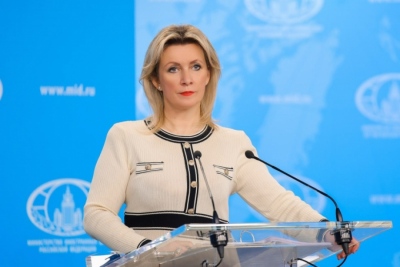
A new clear message on how Moscow envisions the end of the war in Ukraine was delivered by Maria Zakharova, asserting that a temporary ceasefire cannot by itself bring genuine and lasting peace.
The spokeswoman for the Russian Foreign Ministry reiterated that, according to the Russian stance, any final settlement must address what Moscow terms the «root causes» of the Ukrainian crisis.
And behind this formulation lie some of the most difficult questions of the entire conflict:
Ukraine's future relationship with NATO, European security architecture, and the status of Russian-speaking populations.
This position is not new. Russia has repeatedly stated that it considers Ukraine's potential accession to NATO unacceptable and demands broader commitments regarding Alliance expansion. Ukraine and NATO reject the argument that Moscow can hold a veto over Kyiv's security choices.
Zakharova's phrase setting Moscow's bar
Maria Zakharova was unequivocal: «A viable, long-term resolution of the Ukrainian crisis is possible only if its root cause is eliminated».
With this specific phrasing, Russian diplomacy attempts to make clear that it does not consider a mere cessation of hostilities sufficient.
For Moscow, an agreement that would temporarily silence the guns while leaving major strategic questions open could simply postpone the next conflict by a few years.
A similar stance was presented by Russian Deputy Foreign Minister Sergey Ryabkov, stating that Russia seeks a long-term settlement rather than a brief truce that could be followed by a new round of war.
NATO back at the center of the conflict
The first and foremost issue raised by Zakharova is NATO's eastward expansion.
Moscow has argued for years that the prospect of Ukraine joining the Alliance creates an immediate threat to Russian security.
The Russian government's position has hardened further.
Zakharova had previously stated that a simple delay or postponement of Ukrainian accession is insufficient for Russia. Moscow wants NATO to officially renounce the commitment of the 2008 Bucharest Summit, under which Ukraine and Georgia would eventually become members of the Alliance.
In other words, Russia is not merely demanding:
«Ukraine must not enter NATO now».
It is demanding something far deeper:
institutionally closing the Alliance's door to Kyiv.
And precisely there lies one of the largest obstacles to any peace agreement.
Kyiv rejects a Russian veto
The Ukrainian position stands on the opposite side.
Kyiv has repeatedly maintained that Russia cannot dictate which international alliances Ukraine joins.
At the same time, the Ukrainian leadership considers that without robust, concrete security guarantees, any peace could prove fleeting.
NATO also continues to defend its «open door» policy and rejects the demand that Russia gain a de facto veto over Alliance enlargement.
Thus emerges the major impasse:
Moscow insists that Ukrainian neutrality form a core pillar of peace, while Kyiv views strong Western security guarantees as essential protection against renewed warfare.
Russia's second major demand
Maria Zakharova also raised the issue of the rights of Russians and Russian-speaking residents in regions remaining under Kyiv's control.
Moscow maintains that a final agreement must include guarantees for their language, culture, and civil rights.
The Russian Foreign Ministry has repeatedly highlighted this specific topic as one of the essential conditions for a long-term settlement.
The Ukrainian side, however, rejects many of the Russian allegations regarding systematic persecution of Russian speakers, viewing them as political arguments used by Moscow to justify its actions. This dispute represents another issue that cannot easily be resolved through a simple military ceasefire.
Why Moscow rejects a «quick» truce
Zakharova's message carries another significant dimension.
The Russian leadership fears, or at least publicly states it fears, that a temporary ceasefire without a comprehensive settlement would afford Kyiv time to regroup forces, rearm, and resume the conflict later.
Vladimir Putin has previously linked acceptance of a ceasefire to questions over whether rearmament or mobilization in Ukraine would continue during its duration.
For Moscow, therefore, the discussion is not merely:
«When does the firing stop?»
It is:
«What changes strategically so that it does not resume?»
Sergey Lavrov escalates rhetoric
At the same time, Russian Foreign Minister Sergey Lavrov launched fresh heavy accusations against Kyiv.
According to the Russian side, Ukrainian officials have been seen publicly celebrating following attacks that Moscow characterizes as terrorist acts against Russian civilians.
www.bankingnews.gr


Readers’ Comments