

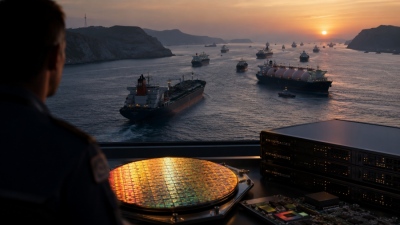
In a recent shift in tactical planning, some vessels do not remain "invisible" for merely a few hours, but for days or even over a week, reappearing in entirely different locations. Their tracks vanish, while it remains uncertain whether they carry their original cargo, transferred it ship-to-ship, or returned to the Persian Gulf for a new load. A recent example of this trend was the supertanker Romania Prosperity. The vessel disappeared from waters off Fujairah, in the Gulf of Oman, in late July and reappeared in the same region 10 days later. Observers were unable to verify if it retained its original crude cargo or conducted a ship-to-ship transfer before returning to the Persian Gulf to receive new cargo. Another Very Large Crude Carrier, the Alexandros (owned by George Prokopiou's Dynacom), vanished while unladen in the northern Red Sea mid-last month, only to surface last week near India partially loaded. Simultaneously, the supertanker Kuwait Prosperity disappeared laden with crude oil in the Persian Gulf in early July, before emerging 10 days later near Indonesian waters.
The profit outweighs the risk
Vessels switch off their location transponders primarily to conceal their positions and evade potential attacks from Iran, with shipowners willing to assume the risk of transporting cargo through dangerous sea passages due to the high profitability offered by these operations. In recent weeks, the state oil company of the United Arab Emirates has even begun transporting Iraqi oil through Hormuz. These "dark" transits, combined with other disruptions in the freight market, "indicate that the VLCC market has adapted to a different operational environment," stated Maria Bertzeletou, senior market analyst at Signal Ocean. "Confirmed tanker transits have shifted toward stealth operations." The practice of tankers turning off their tracking systems has fluctuated alongside shifts in US-Iran tensions. A temporary peace agreement that took effect in June resulted in more vessels broadcasting their location normally during transit. However, after Tehran resumed attacks against shipping, dark transits rose once again. Most recently, the practice spread further following the mid-July announcement by the Iranian-backed Houthi armed group enforcing a blockade on Saudi oil in the Red Sea.
62% of tankers cross in secret
According to Signal Ocean, roughly 62% of oil and petroleum product tankers crossed the Strait of Hormuz without transmitting their tracking position between July 14—when the US reinstated the naval blockade on Iran—and early August. The corresponding figure prior to this period stood at approximately 50%. Signal Ocean data does not indicate the exact duration for which vessels keep their transponders deactivated.
Tanker struck by drone while exiting Hormuz
Meanwhile, the United Kingdom Maritime Trade Operations (UKMTO) announced on Friday (8/14/2026) that it received a report of a tanker struck by a drone while exiting the Strait of Hormuz. The vessel sustained minor damage, and no casualties were reported. At the same time, the United Arab Emirates strongly condemned an Iranian drone strike targeting two vessels linked to the Abu Dhabi National Oil Company (ADNOC). It remains unclear whether the UKMTO report references the same incident. The UAE called for an immediate cessation of attacks and the full reopening of the Strait of Hormuz.
www.bankingnews.gr









Readers’ Comments