

The first visit
Vladimir Putin landed on Iturup on August 13, as part of a broader tour of the Russian Far East. The visit is considered historic, as it marked the first time Putin personally visited the disputed Kurils during his long tenure in power. The Russian president visited the Yasny fish processing complex, where he inspected the facilities and sampled local products. Concurrently, he toured the island's social infrastructure, including hospital and school facilities, and met with local officials. At his side, among others, was the governor of the Sakhalin region, Valery Limarenko. The image the Kremlin sought to project was clear: the Russian president was not visiting a "grey zone," but a region that Moscow considers an integral part of the Russian Federation.
A "bomb" in Tokyo
Japan's reaction did not take a single minute to arrive. Foreign Minister Toshimitsu Motegi summoned Russian Ambassador Nikolay Nozdrev and expressed an official protest over Putin's presence on Iturup. The Japanese government reiterated its claim to Iturup/Etorofu, Kunashir/Kunashiri, Shikotan, and Habomai, which in Tokyo are called the "Northern Territories." Russia has controlled the islands since the end of World War II and rejects the Japanese claim. Sanae Takaichi raised the tone even further, calling Putin's visit unacceptable and warning that it places additional strain on the already extremely difficult relations between Moscow and Tokyo.
80 years without a peace treaty
Behind the new clash lies one of the longest-standing territorial disputes in the world. The Soviet Union occupied the islands at the end of World War II in 1945. Japan has never recognized Russian sovereignty over the four southernmost islands, and this disagreement has prevented Moscow and Tokyo from signing a comprehensive post-war peace treaty. For decades, the two sides attempted periodically to find a compromise. Today, however, relations stand at a very different point. Japanese participation in sanctions against Russia following the 2022 invasion of Ukraine, along with the overall deterioration of Russia–West relations, has nearly frozen the previous diplomatic process. And Vladimir Putin's arrival on Iturup appears to widen the divide even further.
The Putin message
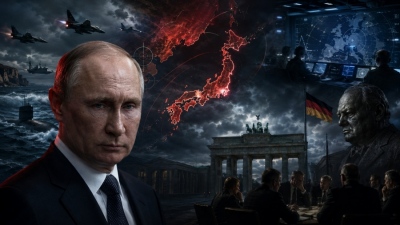
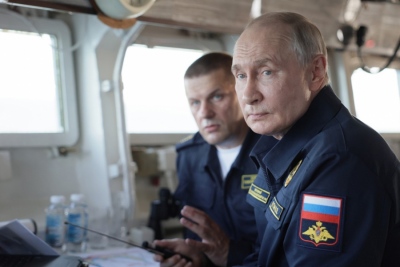
Moscow has left no room for doubt regarding how it views the matter. For the Russian government, Russia's sovereignty over the islands is an outcome of World War II and is not subject to question. Thus, Putin's visit can be interpreted as an exceptionally strong political message, though this does not imply any new official Russian decision regarding the status of the islands. The message on a political level is hard to ignore: The Russian president went personally to Iturup and appeared there as a head of state inspecting infrastructure, economic activities, and daily life in a region Moscow considers its own. The intervention by Dmitry Medvedev was equally harsh. Responding to Japan's reaction, the former president of Russia and current deputy chairman of the Security Council of Russia reiterated that the Kurils are considered Russian territory by Moscow. His intervention demonstrated that the Russian leadership does not view the visit as a simple domestic trip. On the contrary, the move assumes the character of a declaration of sovereignty aimed primarily at Tokyo. The geopolitical dimension becomes even more pronounced when connecting the visit to Iturup with the remainder of Vladimir Putin's itinerary in the Russian Far East. Prior to his arrival in the Kurils, the Russian president visited Sakhalin and observed activities of the Russian Pacific Fleet, including a presence aboard the missile cruiser Varyag. The temporal proximity of these two events—military activity in the Pacific followed by a visit to an island claimed by Japan—inevitably takes on powerful symbolism. And this is precisely what leads analysts to see a far broader message behind Putin's trip.
Tokyo and the US are watching...
The geographic position of the islands transforms the region into a key node in the strategic balance of the North Pacific. Japan is a close ally of the United States. At the same time, Russia has reinforced its strategic and military cooperation with China, while the growing collaboration among Moscow, Beijing, and Pyongyang is monitored with increasing anxiety by Tokyo. The Kurils also possess military significance for Russia, and in recent years Moscow has strengthened its military presence in the area. Thus, the Kuril issue ceases to be merely an old Russian-Japanese territorial dispute. It is now integrated into the grand geopolitical chessboard of the Pacific.
The second message
Russian analysts speaking to NEWS.ru consider that the visit contained a second message: that Russia intends to further reinforce its presence in the Asia–Pacific region. Moscow's rapprochement with Beijing, joint military activities, and the shift of a large portion of Russian economic ties toward Asia turn the Russian Far East into a region of ever-increasing strategic importance. For Moscow, Sakhalin, the Kurils, and the Pacific coast no longer represent merely a remote periphery. They constitute a gateway to Asia. Political scientist Georgy Fedorov estimated that the Russian Far East is acquiring critical importance because it borders China, Japan, and the wider Pacific expanse. A similar position was expressed by Vitaly Tretyakov, who linked Russia's growing attention in the region to the shift of a larger share of economic activity toward Asia. These assessments do not constitute official Russian government policy in themselves. They capture, however, a perspective gaining ground in Moscow: The Far East is not Russia's periphery—it is now one of the most critical fronts of its economic and geopolitical future. Putin's visit can hardly upend the regional balance on its own. However, it can make any attempt at rapprochement between Russia and Japan even more difficult. Tokyo now faces a Russia that appears determined to demonstrate its sovereignty over the islands in practice. Moscow, on the other hand, sees a Japan increasingly integrated into the US security strategy in the region, having taken a clear stance against Russia post-2022. And situated between them are four small island clusters that for eight decades have prevented two major powers from definitively settling their accounts from World War II.
www.bankingnews.gr





Readers’ Comments