

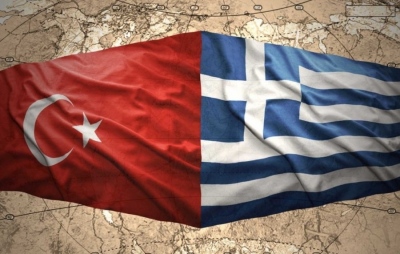
Especially according to the Turkish journalist, Greece constitutes Turkey's "bad neighbor" to the west, while Turkey historically remains at the center of Greek foreign policy. Consequently, news and reports concerning Turkey appear almost daily in the Greek media. Turkey's population is approximately nine times larger than that of Greece, while its productive capacity is roughly 5.5 times greater. In 2025, Turkey's GDP was projected to reach approximately $1.6 trillion, compared to around $280 billion for Greece's economy.
Greece's annual productive capacity corresponds roughly to the level of Turkey's annual exports. At the same time, due to competition with Turkey, Greece is forced to allocate a significant portion of its limited financial resources toward defense spending and armaments. Greece has a population of approximately ten million residents. The low birth rate, around 1.4%, results in the gradual aging of the population, posing a serious demographic challenge. Various minority and ethnic communities reside in the country, including Turks, Slav-Macedonians, Albanians, and Roma. Concurrently, Greece hosts a significant number of migrants from Africa and the Middle East, as well as from neighboring countries. All these factors compose a complex and sensitive demographic reality. As Necat Eslen notes, the cultural and psychological foundations of Greek-Turkish relations have historically been influenced by the concept of the Megali Idea.
Although the Megali Idea is not expressed today in the same form as in the past, its ideological footprint remains noticeable in certain aspects of the Greek state mechanism and public life. Religion and religious figures play an important role within this framework. In Greece, religion is not exclusively a matter of individual faith and conscience, but also constitutes an important sociopolitical factor that can influence balances in both domestic and foreign policy. Within this context, the Ecumenical Patriarchate in Fener, Istanbul acquires special significance, situated at the intersection of religion, politics, and the historical legacy of the Megali Idea. Greek positions regarding maritime jurisdiction and the delineation of maritime zones in the Aegean and Eastern Mediterranean, as well as Greece's policy on the Cyprus issue, can be viewed by some analysts as modern expressions or extensions of the historical Megali Idea.
Anti-Turkish sentiment
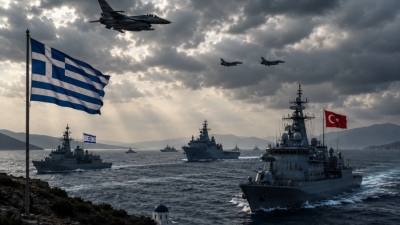
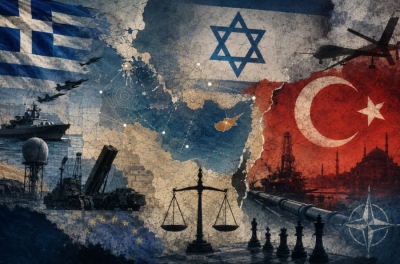
Regardless of which government is in power in Greece, says Necat Eslen, the country's foreign policy is significantly influenced by anti-Turkish sentiment. Historical references, the need to strengthen national unity internally, and particularly political calculations during periods of crisis contribute to shaping a policy that is often based on confrontation with Turkey. Ottoman rule, the catastrophic outcome of the Greek campaign in Asia Minor after World War I, and the historical trauma and collective memory associated with the Turkish military intervention in Cyprus in 1974 constitute major sources of this sentiment. During times of economic crisis and social issues, politicians can exploit anti-Turkish sentiment—even by projecting threats attributed to Turkey—to influence public opinion. This perception is reproduced across broader social strata, including through education and media. According to the Greek position, the Aegean constitutes an overwhelmingly Greek maritime space. Greece seeks to exercise rights over the entire continental shelf it considers its own, maintains the right to extend its territorial waters up to 12 nautical miles, and has reinforced its military presence on Aegean islands, despite Turkish objections and relevant international treaties. Despite possessing thousands of islands and islets in the Aegean, Greece has also been involved in disputes regarding sovereignty over small islets located near the Turkish coast. At the same time, it demands the withdrawal of Turkish troops from Cyprus—which it characterizes as an occupying force—as well as the termination of Turkey's guarantee system. It also supports a federal solution for the Cyprus problem and seeks more active involvement from the European Union in the process. In the Eastern Mediterranean, Greece projects positions on maritime zones and the continental shelf that Turkey considers maximalist. The differing interpretations between the two countries regarding the Law of the Sea, the continental shelf, and the maritime boundary delimitation constitute one of the primary sources of tension in Greek-Turkish relations. Greece's effort to strengthen its position and power through cooperation with major powers is a key feature of its foreign policy toward Turkey. In recent years, Greece has developed closer strategic relations and alliances with the US, France, and Israel, while simultaneously seeking to leverage its NATO membership and, in particular, its status as a European Union member state as factors to enhance its standing vis-à-vis Turkey. From the Turkish perspective, this strategy creates the perception that Greece is attempting to offset its geopolitical power through the support of strong allies, rather than seeking a direct and comprehensive settlement of bilateral disputes.
Geography is destiny
Geography is destiny, writes the Cumhurriyet journalist. Turkey and Greece are obligated to coexist in the same geographic region and, as neighboring countries, will continue to share common interests as well as common challenges. For this reason, Greek politicians should distance themselves from external guardianship, domestic confrontational rhetoric, and maximalist claims, adopting a mutual benefit approach—a true win-win principle—that could contribute to shaping a lasting and stable peace. However, no political leader in Greece seems to readily possess the political capital or legitimacy required to revise previously declared positions and proceed with a meaningful compromise on issues such as the Aegean, the Eastern Mediterranean, and the Cyprus issue. Such a compromise could carry a significant political cost for any government, its party, and the personal political trajectory of the leader who undertook it. Consequently, expecting immediate and substantive results from negotiations between Greece and Turkey without first addressing the deeper political and social causes of the confrontation is extremely difficult. The inability of political leaderships to transcend internal political pressures, historical prejudices, and maximalist positions constitutes perhaps one of the most significant obstacles on the path to genuine Greek-Turkish reconciliation.
The threat
Due to its geographical and demographic peculiarities, Greece faces a series of strategic vulnerabilities in the security sector that could become targets of exploitation. Aegean islands, especially those located at a great distance from the mainland, exhibit increased sensitivity due to their geographical position and their dependence on long and vulnerable supply lines. Concurrently, energy interconnections and submarine communications cables serving these islands may prove vulnerable to asymmetric interference. At the same time, social groups that feel marginalized, as well as sections of the migrant population, may become vulnerable to social tensions and internal unrest. Domestically, critical infrastructure—such as major ports and automated energy distribution networks—could also become targets for cyberattacks or other forms of digital sabotage. In this volatile and constantly shifting geopolitical environment, characterized by uncertainty, continuous power rivalries, the search for new balances, and the emergence of new risks as well as opportunities, time may work to Turkey's advantage. Turkish interests in the Aegean, the Eastern Mediterranean, and Cyprus are considered of strategic importance and are therefore linked to the need to maintain strong deterrent capabilities. Within this framework, Turkish strategic thinking must factor in the capacity for asymmetric response as one of the elements that can contribute to balancing power and strengthening deterrence regarding the defense of Turkish interests in the Aegean, the Eastern Mediterranean, and Cyprus, concludes Necat Eslen.
www.bankingnews.gr



Readers’ Comments