

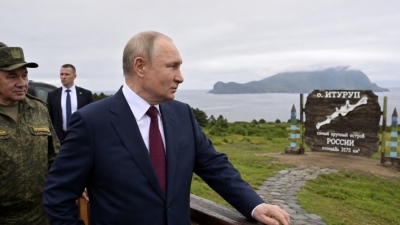
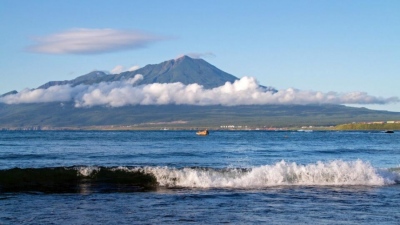
A new surge of tension in the already frozen relations between Moscow and Tokyo was caused by the visit of Vladimir Putin to Iturup, the largest of the four southern Kuril Islands controlled by Russia but claimed by Japan.
The visit on August 13 was Putin's first to the Kuril chain and carried a strong political and symbolic character. Japan reacted immediately, characterizing it as unacceptable and lodging a formal protest.
The island is called Iturup in Russia and Etorofu in Japan and sits at the center of a territorial dispute that remains unresolved since the end of World War II.
Outrage in Tokyo - Sanae Takaichi: «Absolutely unacceptable»
Prime Minister of Japan Sanae Takaichi reacted with uncharacteristically harsh language, declaring that the visit «hurts the feelings of the Japanese people» and is «absolutely unacceptable».
At the same time, Foreign Minister Toshimitsu Motegi reiterated Tokyo's official stance that the four islands constitute Japanese territory and announced a strong protest to the Russian side.
Sanae Takaichi is currently the Prime Minister of Japan, having initially assumed office in October 2025 and leading her second cabinet since February 2026.
Putin's message: «For Moscow the islands are Russian»
The presence of Vladimir Putin on Iturup can be interpreted as a particularly strong demonstration of Russian sovereignty in the region.
During his visit, the Russian President toured a fish processing plant, a hospital, and a school, and met with the Governor of Sakhalin, Valery Limarenko. Putin simultaneously reiterated the Russian position that the status of the islands was determined after World War II.
The trip took place immediately after his presence on Sakhalin, where he observed military activities of the Russian Pacific Fleet.
The dispute spanning over 80 years
The territorial issue constitutes one of the largest historical thorns in Russia–Japan relations.
The Soviet Union seized the four islands, Iturup/Etorofu, Kunashir/Kunashiri, Shikotan, and Habomai, in the final days of World War II. Japan continues to claim them as the «Northern Territories», while Russia administers them as part of the Sakhalin Oblast.
The dispute is the main reason why Moscow and Tokyo have not signed to this day a formal peace treaty definitively closing World War II issues.
Peace negotiations essentially frozen
For decades, different Japanese governments attempted to combine economic cooperation with Russia with progress on the territorial issue.
The situation changed radically following the Russian invasion of Ukraine in 2022, when Japan joined Western sanctions.
Moscow suspended negotiations for a peace treaty and in February 2026 the Kremlin declared that no active dialogue existed on the matter, characterizing bilateral relations as severely strained.
Nevertheless, official Japanese policy has not changed. The Foreign Ministry of Japan reiterated in February 2026 that the objective remains resolving the issue of the four islands and concluding a peace treaty.
Economy further complicates the game
Despite the deep political crisis, economic ties have not completely vanished.
Japanese companies still maintain significant interests in major energy projects in the Russian Far East. Mitsui and Mitsubishi, for example, retained stakes in Sakhalin-2, a project that remains important for Japan's energy security.
This shows that the picture is more complex than the view that one side «no longer needs» the other. Political confrontation is exceptionally intense, but specific energy ties continue to connect the two economies.
The Kurils acquire even greater strategic importance
Beyond history and national prestige, the islands hold immense geostrategic value.
They are located between Kamchatka and the northern Japanese island of Hokkaido, offering access to rich fishing grounds and natural resources. At the same time, their position renders them important for the Russian military presence in the Northwest Pacific.
Putin's visit takes place during a period in which Tokyo is increasingly concerned about military cooperation between Russia and China, as well as the general deterioration of the security environment around Japan.
Freezing any hope for compromise?
The visit to Iturup does not in itself alter the legal status of the dispute. But politically it sends a particularly clear message.
Russia shows that it treats the island as territory to which its president can travel and inspect state facilities without taking into account Tokyo's reactions.
Japan, on the other hand, insists that it does not intend to abandon its claim and characterizes the visit as a blow to prospects for improving relations.
A highly symbolic move that changes the climate
To argue that the visit «forces Japan to recognize the loss of the islands» would be premature: Tokyo has neither abandoned nor recognized Russian sovereignty over the four disputed islands.
What changes, however, is the political climate.
With Vladimir Putin stepping onto Iturup for the first time as president and Sanae Takaichi responding with open condemnation, the territorial dispute returns with force to the center of Russia–Japan relations.
And after more than eight decades without a definitive peace treaty, the distance between Moscow and Tokyo today appears wider rather than narrower.
www.bankingnews.gr





Readers’ Comments