

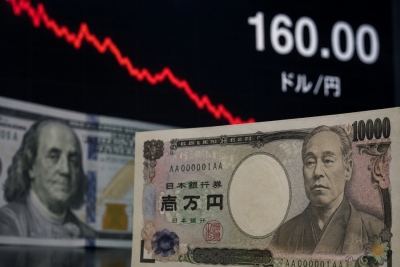
The Japanese yen has already erased about half of the gains it posted following the historic foreign exchange market intervention by the US and Japan less than two weeks ago, as fundamental forces driving the currency to multi-decade lows prove increasingly resilient against short-term measures. The Japanese currency is now trading above 159 yen per dollar, having strengthened toward 155 yen in the days following the intervention after previously surging past 163. "The intervention spooked the markets, but it didn't stop the laws of the financial market, which dictate that capital flows toward higher yields. As long as the cost of money in Japan remains lower than overseas returns, carry trades will return," stated Jesper Koll, expert director at Monex Group.
The yield gap remains the major headache
At the core of the problem lies the persistent yield gap between Japan and the US. Borrowing costs in Japan remain far lower than those in the US and other major markets, incentivizing investors to borrow cheaply in yen and deploy capital into higher-yielding assets elsewhere. This is the classic carry trade, which continues to act as a powerful force strengthening the US dollar against the yen. The economic environment has grown even tougher for the Japanese currency, as rising Treasury yields and elevated crude oil prices—a major strain for energy-dependent Japan—reignite macroeconomic tailwinds favoring the greenback.
Intervention curbed speculation, but failed to alter fundamentals
Jesper Koll estimates that the intervention succeeded in reining in excessive speculative positions and raising the risk profile for traders betting against the yen. However, it did not eliminate the core yield advantage that continues to support the dollar. "Spooking the markets is easy. Getting markets to follow requires changing incentives and building investor confidence," Koll noted. Echoing this sentiment, Masahiko Loo, senior fixed income and currency strategist at State Street Global Advisors, highlighted that the intervention effectively shifted market psychology and showcased an unusually high degree of bilateral coordination between the US and Japan. However, "what it has not yet achieved is eliminating the yield advantage supporting the dollar," he observed.
US 10-year yield at 4.686% versus 2.846% in Japan
The divergence in sovereign yields remains exceptionally wide. The benchmark 10-year US Treasury yield stands at 4.686%, compared to 2.846% for the equivalent 10-year Japanese government bond. This substantial spread provides global investors with a compelling incentive to hold US debt. "It is better understood as a success in curbing speculation rather than a success in altering economic fundamentals," Loo stated.
All eyes on the Bank of Japan
This shifts the market focus directly onto the Bank of Japan (BOJ), which has scheduled its upcoming monetary policy meeting for September. Koll of Monex argues that the primary shock for market participants was not the currency intervention itself, but rather the BOJ's reluctance to pursue more aggressive monetary tightening. This cautious stance raises questions over whether concerns surrounding the domestic banking system or Japan's massive public debt load are constraining policymakers' room to maneuver. Unless Japanese interest rates rise or American yields decline, investors maintain a strong financial incentive to export capital abroad.
"At least two more interest rate hikes are needed"
John Wood, chief investment officer for Asia at Lombard Odier, expects the recent intervention will likely deliver a "limited temporary impact." He argues that the BOJ may need to execute at least two additional rate hikes to meaningfully halt the underlying weakness of the Japanese currency.
Interest rates are not the only issue
However, interest rates may represent only one piece of a broader economic equation. Analysts at Crédit Agricole CIB contend that the root issue is an "investment power asymmetry" between the two economies. Massive US investments in artificial intelligence and other tech sectors continue to attract global capital, while Prime Minister Sanae Takaichi's planned public and private investment package has yet to fully materialize. "What is required to fix yen weakness is not interest rate increases, but an expansion of real investment," argues Crédit Agricole CIB. This assessment suggests that a lasting yen recovery ultimately requires Japanese domestic assets to become more attractive, ensuring local savings stay within Japan rather than seeking higher returns abroad.
160 turns into a policy red line
Under these market conditions, the joint intervention may function less as a mechanism to reverse the yen's decline and more as a speed bump against rapid currency depreciation. Loo of State Street considers the 160 yen per dollar level to have transformed into a "policy red line." This implies that a sudden, disorderly move above this threshold could trigger fresh forex intervention by Japanese monetary authorities. "I wouldn't rule out another intervention, particularly if the exchange rate move becomes sharp or erratic," Loo noted. However, he warned that while intervention can buy time, the real burden rests on the BOJ monetary policy normalization process, potentially as soon as September.
US-Japan shield against yen short positions
Washington and Tokyo have also sought to enhance the deterrent effect of their market actions by showcasing the availability of the Federal Reserve's repo facility for foreign and international monetary authorities. This liquidity mechanism provides dollar liquidity against US Treasury holdings, reducing Japan's need to outright sell its Treasury assets to fund foreign exchange interventions. US Treasury Secretary Scott Bessent has expressed clear support for reinforcing this backstop mechanism. This development potentially makes betting against the yen more costly for traders, though without eliminating the carry trade itself. As Jesper Koll summarized: "Spooking the markets is easy. Getting markets to follow requires changing incentives and building investor confidence."
www.bankingnews.gr












Readers’ Comments