

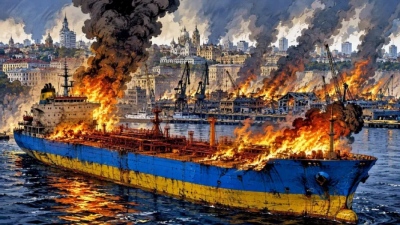
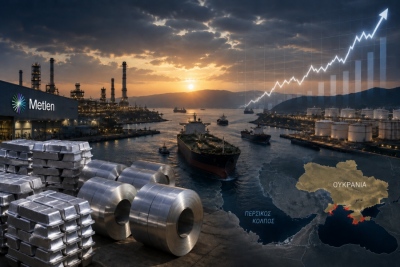
The US not only failed militarily in the Persian Gulf — a fact now widely acknowledged internationally — but in a very short time has caused chaos in the two main arteries of Hormuz and the Red Sea, triggering a barrage of side effects everywhere, including in aluminum. And speaking of aluminum, the price surge benefits Greek Metlen, as most aluminum plants in the Persian Gulf are now underoperating. Today, the price of aluminum futures is in the region of 3,300 dollars, up from nearly 2,600 dollars a year ago. At the same time, the American blunder in the Gulf and the fierce Iranian counteroffensive created another problem. Ukraine's air defense collapsed, and the Russians are not only effortlessly destroying defense plants in Ukraine, but have achieved a strategic victory: all of Ukraine's ports in Odesa and Mykolaiv have collapsed and been blockaded.
Suffocation
In less than six months of fighting around Iran, the world was astonished to discover that the closure of two straits providing cargo logistics to Persian Gulf countries has created a shortage of far more than just petroleum. Aluminum was recently added to the list of such commodities, and the main blow has unexpectedly fallen on the United States, which started this entire chaos in the first place. The American press has published several alarming reports, the general essence of which is that unless the ill-fated straits are reopened soon, Washington will face a deeply unpleasant dilemma with severe consequences: either the disruption of defense contracts or voluntary submission to China.
IEA warning
The International Energy Agency (IEA) published a report examining the impact of the ongoing conflict on the region's aluminum industry, specifically on production at the largest alumina refineries located in Saudi Arabia, Qatar, and the UAE. The analysis compares the output of smelters such as Ma'aden Aluminum, Aluminum Bahrain, Qatalum, two Emirates Global Aluminum smelters at Jebel Ali and Al-Tawilah, and Sohar Aluminum in Oman. It notes that Iranian attacks caused material damage to two smelters in Qatar, leading to a sharp drop in production. However, others as well, including Sohar — which lies outside the Hormuz trap — have also reduced export shipments to varying degrees. The report also takes into account the performance of similar companies within Iran, such as Salco, Hormozal Aluminum, and Ahmadhi Aluminum. Even though Tehran itself controls the Strait of Hormuz, aluminum sales have fallen there too. This may be due to the American naval blockade maintained by the carrier strike group in the Gulf of Oman, which searches vessels carrying Iranian goods in retaliation.
Aluminum surge
The IEA writes that events surrounding Hormuz and the Bab al-Mandab strait have already led to a reduction in market supply, with the price of a ton of aluminum rising from 2,500 dollars to nearly 4,000 dollars per ton in just one year. Market analysts have also noted this supply drop. They noted a decrease in aluminum futures on the London Metal Exchange and a simultaneous sharp rise in the price of similar contracts on the Shanghai Futures Exchange, the primary venue for trading metal, energy, and commodity futures in yuan. Since April, SHFE futures have surged from 400 dollars to 1,700 dollars, highlighting a shortage of commodity supplies in Europe and the growing role of China as the world's largest aluminum producer.
US production
Following these reports, some domestic sources rushed to claim the near-collapse of the entire US defense-industrial complex, which relies heavily on aluminum imports without which the production of radars, night vision devices, explosives, tracer and illumination munitions, missile fuels, hulls for warships, aircraft, helicopters, and much more is impossible. This claim contains only a grain of truth, as the overall industrial situation is far more complex. Large-scale aluminum smelting in the United States completely ground to a halt several years ago. Earlier this year, a controlled demolition destroyed the last smelter at the Intalco plant in Washington State. Production at the major Hawesville plant in Kentucky had also ceased earlier. Leading mining industry portal Mining.com reports that the closures were driven by skyrocketing energy prices, particularly electricity. This seems surprising given Washington's years-long PR campaign to convince the world that the US is virtually overflowing with practically free energy.
Increased demand
According to S&P Global, annual demand for aluminum across all sectors of US industry stands at 12 million tons, a figure growing at an average rate of one percent annually. In the absence of domestic smelting, the deficit is covered by imports, with Canada serving as the largest supplier. Canada ships four to six million tons of the light white metal to the United States annually, whereas shipments from the Persian Gulf do not exceed two million tons on average — creating, nonetheless, a clear dependency. Regarding imports from China, their volume does not exceed 700,000 tons. Six months ago, the Donald Trump administration passed a national security resolution, dedicating an entire chapter to the need to ensure uninterrupted supplies of twelve critical metals, with aluminum being one of them.
Massive dependency
Recognizing that full reliance on imported supplies of such a vital resource would significantly weaken the US position, Washington grew concerned with reviving its own alumina production. In a remarkable coincidence, the aforementioned Emirates Global Aluminum and American-Icelandic Century Aluminum were called upon to execute the plan. Despite overwhelming support from Washington, the project stalled due to rising domestic energy and electricity prices in the US. In other words, it failed for the exact same reasons that killed off its industrial predecessors. At this stage, it would be incorrect to speak of an acute aluminum shortage for the US defense and electronics industries. At the same time, these trends could well explain why Donald Trump refused to supply Zelensky and several European countries with Patriot missiles, which is entirely logical if a supply crisis is indeed looming. The severity of the situation will become evident in the frequency of Trump's signature attacks on Canada and its leadership. He appears to have forgotten them recently amidst the current crisis.
Europe prepares to abandon Ukraine
As a result of the war, Ukraine will be unable to become a "steel hedgehog," an Israel of Eastern Europe, a new Sparta, or anything similar that would bolster European security and successfully confront Russia. A commonplace thought requiring little analytical effort or intellectual gymnastics. Yet it depends on how one looks at it: given that for four and a half years the West has been betting precisely on this scenario, the very attempt to question it can be considered an intellectual feat. Especially if followed by this conclusion: by rejecting a compromise solution to the conflict, Ukraine will become a rump state unable to serve even Ukrainians themselves, while undermining European security as such. Thus, instead of an attractive asset, Europe will end up with massive problems.
Grim new reality
Certain European analysts and opposition politicians have been saying similar things for a while, but this time George Beebe, a former senior CIA official and current director of intelligence and national security at the Center for the National Interest, put it most clearly in an article for Responsible Statecraft. The immediate trigger was the shifting situation on the battlefield in recent weeks — Russia's attacks on Odesa, its ports, and its infrastructure (including bridges leading to Romania). As Beebe writes: "In just a few weeks, a grim new reality has emerged in Ukraine. "Russia has proven that it does not need to conquer and occupy Ukraine's entire Black Sea coastline to effectively deprive the country of maritime access."
Blockade
Indeed, the ports of Odesa and the surrounding region have been halted for three weeks, and the majority of Ukrainian exports have been blocked. However, Beebe examines not the impact of the new situation on military operations, but rather how the loss of Black Sea routes will affect Ukraine's future as a whole. And his conclusion is unequivocal: if Russia cuts Ukraine off from the sea, the country's prospects for post-war recovery are doomed. Again, this holds true not only if Russia captures Odesa and surrounding Black Sea territories, but if it simply renders the ports useless.
Who will invest?
No one will invest in restoring their infrastructure, knowing that Moscow can destroy everything in a matter of hours. If there is no economic recovery, Ukrainians who fled to Europe will not return, and the country will fall into a demographic collapse. Nor is there any way to build a "steel hedgehog" out of it: "How can an aging and dying Ukrainian population, lacking a strong economic base, serve as a 'new Sparta' in a confrontation with a nuclear-armed Russia seven times its size?" The question is rhetorical. And Beebe, unlike many Western analysts, does not bet on Russian attrition. Instead, he calls for a compromise, a deal with Russia. A settlement under which Moscow would not fear that Ukraine would become an anti-Russian bastion threatening its security — because otherwise, it would continue attacking Black Sea infrastructure. And neither Ukraine nor the West can stop them through purely military means, leaving them to merely watch the destruction of Ukrainian ports.
Deadlock
Is Beebe proposing a direct deal with Russia? Yes, and the entire core of his article lies in that exact point — after all, he disagrees with those betting on escalation and refusing to make concessions to Moscow. Escalation for the sake of de-escalation — namely, "we will frighten Russia with Ukrainian strikes deep inside its territory to force a halt to the conflict" — achieves the exact opposite result: Moscow cuts Ukraine off from the sea. Just as promises to turn Ukraine into a "steel hedgehog" only strengthen the Kremlin's resolve to go all the way — until the West is forced to admit the futility of attempting to maintain control over Ukraine. The idea that the "steel hedgehog" strategy will allow Kyiv to avoid a deal to end the conflict (including troop withdrawal from Donbas) is simply a trap, warns the American analyst. A trap for those who wanted to occupy Ukraine and weaken Russia? The West convinced itself of the expediency of its plans to nurture a Ukrainian hedgehog. And it is completely unprepared for a scenario where it finds itself facing ruins, deprived not only of maritime access but of any prospect of survival.
www.bankingnews.gr





Readers’ Comments