

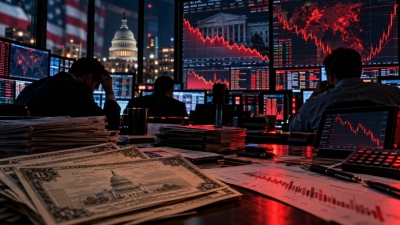
The global economy is exhausting its last munitions, as fictitious liquidity and oil stockpiles dry up dangerously.
The nightmare of geopolitical upheavals and sky-high debts brings markets to the edge of total paralysis.
Specifically, according to Mohamed El-Erian, for decades, businesses, investors, and policymakers operated based on the comforting assumption that the global economy relied on a relatively stable equilibrium.
Macroeconomic and financial disruptions were treated primarily as cyclical turbulences, which could be managed so that things returned to their course, always toward a predictable destination: that of per capita GDP growth within a continually globalizing economic and financial order.
However, this model is now challenged by geopolitical tensions, the weaponization of economic relations, the rapid advancement of new technologies, and other factors.
Navigating economies and markets through this storm is achievable, but it demands commitment to strengthening resilience, preserving alternative options, and demonstrating agility.
This will not happen automatically, because there is now uncertainty regarding the theoretical and practical end points of many ongoing structural changes: from productivity and economic growth to supply chains and equilibrium interest rates.
Furthermore, the broader architecture of trade and international payments is evolving rapidly, increasing operational complexity and planning uncertainty for many businesses.
The three risk areas
For those who consider this assessment exaggerated, it suffices to examine how our new reality has manifested this year across three areas.
First, geopolitical tensions feed new efforts to leverage and weaponize critical supplies.
The era of seamless post-Cold War globalization has given way to a struggle for political influence through existing interdependencies.
State and non-state actors have recognized the potential to exercise asymmetric power by restricting the physical arteries of global trade.
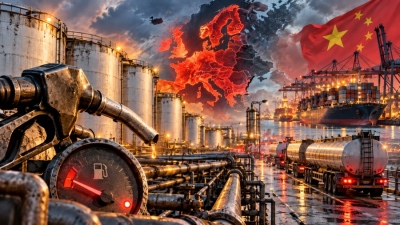
From disruptions in maritime transport in the Strait of Hormuz and the Red Sea to fierce competition over critical mineral supply chains, geography is systematically weaponized.
However, these strategies lack a clear end point.
No one knows where current geopolitical fragmentation will lead.
Some hope for what former UK Prime Minister Gordon Brown calls «soft, managed globalization», others fear an international order that has suffered irreparable rupture, while some still yearn for the old days of seamless globalization and the multilateral rule of law.
And yet, right now, shipping routes need to be reconfigured, while maritime risk premiums remain elevated.
Given that no major diplomatic agreement is in sight, multinational corporations will be forced to move even further away from efficient «just-in-time» supply chains and incorporate more costly «just-in-case» redundancies.
Second, the tools of economic policy that once supported the operation of the shared «hydraulic infrastructure» of a unified global economy are now being converted into weapons.
The increasingly unpredictable use of tariffs, sanctions, investment controls, and export bans radically alters how global capital is allocated and overturns the international financial order as we know it.
As national security concerns increasingly override economic and trade efficiency, there are no longer mutually agreed limits on the exercise of economic statecraft.
Here too, the destination or end point remains unclear, because what were once stable parameters of the system are now variables characterized by severe instability.
Third, markets are being asked to fund massive capital expenditures (capex) in the race to develop and deploy productivity-enhancing technologies.
Tech giants, as well as large non-tech enterprises, collectively commit hundreds of billions of dollars to data centers, computing power, and the development of artificial intelligence applications. Again, however, the destination, the point at which these unprecedented expenditures will translate into large, commercially exploitable productivity gains, remains unknown.
Due to the perceived «penalty» of lagging behind the competition, many corporate boards feel compelled to approve investments of unprecedented scale, without a clear path toward achieving adequate returns on invested capital.
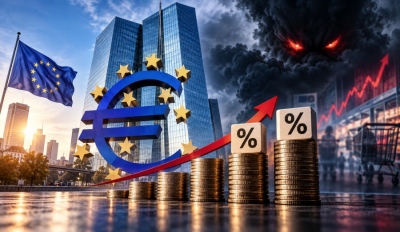
And because all these capital expenditures (capex) must be funded, the implications for debt markets are anything but reassuring.
How the system is protected
Indeed, the cost of capital is already facing upward pressure from competing funding demands in the private and public sectors, notes El-Erian, continuing:
«It is true that, despite uncertainty around major structural factors, the global economy and the bond market have so far managed to avoid the largest traps.
However, this is largely due to the fact that certain powerful buffers have acted defensively for the system».
The first is the dynamism of the American economy, which plays a central role in global growth and innovation, offsetting the structural stagnation of China and Europe.
The second factor was the availability of endogenous market liquidity. Despite monetary policy tightening after 2021, the financial system generated its own liquidity.
Large corporate cash reserves and new financial instruments maintained the flow of credit, while reinforcing the role of physical commodity stockpiles, primarily in energy markets, where strategic reserves and flexible refined product markets repeatedly absorbed supply shocks caused by geopolitical factors.
However, a critical distinction must be made between real, structural sources of resilience and more temporary forms of resilience based on physical and financial buffers that can be depleted.
Oil stockpiles have now fallen to levels not seen in decades, while abundant endogenous market liquidity cannot be taken for granted, as evidenced by the recent massive liquidation of positions by the overleveraged hedge fund Situational Awareness and the deleveraging of certain Korean exchange-traded funds (ETFs).
Sooner or later, fiscal policies lacking sufficient discipline and unbridled corporate capital expenditures will collide with rising debt, excessive financial leverage, and higher interest rates.
Without clearer end points, hopes for a return to the predictable world of the past must yield to the reality of difficult and volatile geoeconomic transitions.
Companies, governments, and investors can no longer formulate strategies based on single forecasts («baseline scenarios»).
Instead, the focus must shift to building even greater resilience, flexibility, and strategic options over the short term.
These are the strategic assets required to survive a difficult and concerning journey that could evolve in any direction.
As the safety buffers that hitherto protected the global economy dry up, everyone will need to build larger safety margins.
Volatility
The system is moving in part thanks to what will soon remain of borrowed liquidity and depleted physical stockpiles, as well as spending funded through fiscal deficits.
As this reality becomes increasingly obvious, coming months and years will be increasingly characterized by greater economic and financial volatility, as well as wider divergence in outcomes, as the gap between winners and losers widens both across and within sectors, countries, and financial assets.
We must accept that the absence of broadly accepted end points constitutes yet another version of the «new normal».
However destabilizing and disorienting this structural reality may appear, those who accept it will discover that it is precisely under these conditions that significant long-lasting advantages are created and great fortunes are forged.
Conversely, those who fail to demonstrate resilience, flexibility, and open-mindedness risk falling into a state of paralysis, which undermines economic prosperity both today and for many years to come, concludes the economist.
www.bankingnews.gr


Readers’ Comments