

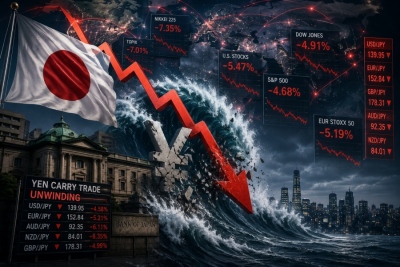
The unwinding of the famous yen carry trade is accelerating and developments in Japan are now causing serious concerns for the entire global financial system.
For years, investors could borrow yen at virtually zero cost and direct those funds into stocks, bonds, real estate, cryptocurrencies, and other financial assets around the world.
Cheap Japanese money constituted one of the driving forces of international markets and contributed to the creation of massive financial «bubbles».
Now, however, the process is reversing.
Interest rates in Japan are rising, the yen is retreating, and investors are called upon to close positions that for decades were considered extremely lucrative.
Japan and the US intervened to support the yen
The fall of the yen last week was so sharp that the US Department of the Treasury reportedly proceeded with an emergency intervention.
This constitutes an extremely unusual development.
The coordinated intervention of the Japanese Ministry of Finance and the US Treasury to support the yen delivered a powerful shock to international markets.
The move was characterized by Jesper Koll, executive expert director of Monex Group, as a substantial «weaponization» of the yen aimed at market deterrence.
As he argued, the intervention surpassed the boundaries of conventional foreign exchange market management, as Japan and the USA used their public balance sheets in a coordinated manner to influence investor psychology.
The intervention did not last for long
The problem is that the intervention failed to halt the decline for a prolonged period.
The yen continues to retreat against the dollar, while yields on Japanese government bonds are moving sharply upward.
And herein lies the core of the crisis.
The yen carry trade is beginning to collapse right before investors' eyes.
The question now is whether the US Treasury will need to allocate additional billions to artificially support the Japanese currency.
Even if this occurs, however, the effectiveness of such an intervention may prove limited.
The 30-year big «gamble» backfires
The logic of the carry trade was simple.
Investors borrowed yen at an extremely low interest rate and used the capital to invest in higher-yielding assets across the globe.
As long as Japanese interest rates remained near zero, the model functioned.
Now, however, the Bank of Japan is raising interest rates.
Even an interest rate around 3% would be exceptionally high for an economy accustomed to two decades of zero cost of money.
When the cost of borrowing in yen rises, the carry trade ceases to be so attractive.
And then investors must do something that could prove catastrophic for markets: sell assets to repay their yen-denominated loans.
Jim Rickards: «This is the biggest story in the world»
Eight-time best-selling author on financial and market topics Jim Rickards warns that the unwinding of the yen carry trade is equivalent to «economic nuclear war».
As he explains, this model constituted one of the primary engines of global economic growth for more than three decades.
For years, investors could borrow yen at zero or near-zero interest rates and allocate capital to markets worldwide.
The problem arises when Japanese interest rates rise.
Then the equation changes.
The borrower must accumulate dollars, convert them to yen, and repay the original loan.
What happens, though, if banks stop lending?
Then investors have no choice but to sell assets.
And when many investors do the same simultaneously, the fall in prices triggers new sales, creating a vicious cycle.
«There is nothing bigger», argues Rickards, characterizing the development as «the biggest story in the world».
The domino effect could hit the entire planet
The dangerous element is that the problem is not limited to Japan.
If the carry trade unwinds abruptly, investors will have to liquidate positions in international markets to raise liquidity.
Stocks, bonds, commodities, real estate, and cryptocurrencies could come under pressure.
The greater the leverage, the greater the need for forced sales.
And when forced sales become generalized, the market can turn into an avalanche.
The derivatives «bomb» hits Wall Street
In the USA, alarming signs are already appearing.
Massive derivative losses have caused a collapse in the stock of UWM Holdings, parent company of United Wholesale Mortgage, the largest mortgage lender in the USA.
UWM Holdings dropped by another 35%, reaching the range of $1.20 per share.
The company had originated approximately $40 billion in mortgage loans in the second quarter of 2026.
This is therefore not a small or peripheral financial firm.
UWM went public in January 2021 via a SPAC merger, obtaining a valuation of approximately $16 billion at the time.
The collapse of its stock is yet another indication of the pressure exerted on overleveraged positions.
Cryptocurrencies in the crosshairs as well
Concurrently, forced liquidations are recorded in heavily leveraged positions within the cryptocurrency market.
The pattern is familiar:
Price fall → margin calls → forced sales → further drop → new liquidations.
If the same phenomenon is transferred on a larger scale to international markets, the consequences could be exceptionally severe.
The US economy is already under pressure
For American households, economic conditions are already difficult.
The size of the US labor force has shrunk by more than one million workers within a year, while the cost of living continues to exert heavy pressure on households.
In an environment of renewed financial turmoil, these pressures could intensify.
And the major problem is that the global economy is already facing a second major threat: the energy crisis.
Hormuz: Oil could become the second «black swan»
The reopening of the Strait of Hormuz could provide significant relief to international markets.
However, prospects for an agreement between the USA and Iran appear extremely difficult.
Tehran demands, among other things, the termination of the war and aggression against Iran and its allies, the lifting of the naval blockade, the withdrawal of US military forces from the region, the payment of reparations for military operations, the lifting of sanctions, and the release of frozen Iranian assets.
It is exceptionally difficult for such a package to be accepted by Donald Trump.
In fact, the American president responded to Iranian demands by asking Tehran to pay compensation.
US strategic petroleum reserves are emptying
At the same time, the oil market faces a dangerous paradox.
Prices are falling in the hope that a solution to the crisis will eventually be found, while commercial and strategic stockpiles are declining at historic rates.
American reserves in the Strategic Petroleum Reserve (SPR) dropped below 300 million barrels for the first time since early 1983.
According to data from the US Department of Energy, reserves fell by 6.1 million barrels to 298.7 million barrels.
This represents the lowest level in more than four decades.
The «perfect storm» for markets
If the Strait of Hormuz remains closed, pressure on global energy markets will persist.
If the unwinding of the yen carry trade accelerates simultaneously, markets will face two distinct yet interconnected risks:
a financial shock from Japan and an energy shock from the Middle East.
One can fuel the other.
Higher energy prices mean higher inflation and greater pressure on interest rates.
Higher interest rates mean higher borrowing costs.
And a higher cost of money means even greater pressure on overleveraged markets.
Japan: The new global financial «time bomb»
The real question now is not whether the yen carry trade will begin to unwind.
The process has already started.
The critical question is how quickly it will evolve and how deep it will reach.
For more than 30 years, cheap Japanese money fueled global markets.
Now Japan is raising interest rates, the yen remains under pressure, and investors are forced to re-examine positions they took for granted.
If the carry trade collapses abruptly, the process will not be confined to Tokyo.
It could spill over to Wall Street, bond markets, cryptocurrencies, and ultimately the real economy.
And at the same time, the war in the Middle East remains far from resolution.
The global economy is thus facing a dangerous combination: costlier money, higher energy costs, rising leverage, and a Japan that may prove to be the starting point for the next major financial shock.
www.bankingnews.gr






Readers’ Comments