

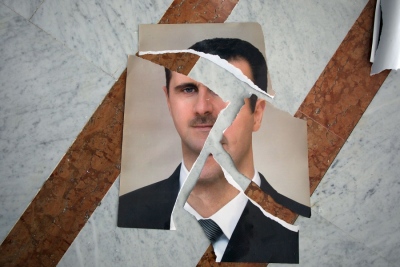
A judicial decision that causes a political earthquake in Syria and opens a new, highly explosive chapter in relations between Damascus and Moscow brings Bashar al-Assad back into the spotlight.
A Syrian court sentenced former president Bashar al-Assad to death in absentia, finding him guilty of a series of heavy crimes connected to repression in the country.
According to the state Syrian Arab News Agency (SANA), the court assigned responsibility to the former Syrian leader for premeditated murders, torture, arbitrary arrests, and crimes against humanity.
The decision acquires even greater political weight as Bashar al-Assad currently resides in Russia, where he fled following the collapse of his government in December 2024.
From presidential palace to death sentence: the shock decision for Bashar al-Assad
The verdict constitutes one of the most dramatic developments following the fall of the Assad regime.
According to reports broadcast by SANA, the court found Bashar al-Assad guilty of premeditated murder of more than one person, including children, as well as torture, arbitrary detentions, and crimes against humanity.
The sentence imposed on him is the ultimate penalty.
However, a huge obstacle exists: the former president is outside Syria, specifically in Russia.
Thus, the judicial decision automatically transforms into an extremely sensitive diplomatic issue.
Scathing verdict: an entire era on trial
For more than two decades, Bashar al-Assad constituted the absolute center of power in Syria.
Now, his name stands at the top of a legal case involving some of the heaviest charges that can be attributed to a former head of state.
His conviction occurred in absentia, but the political message of the new Syrian authorities is clear: they seek accountability for individuals they deem responsible for the darkest pages of the war.
Shock also for Atef Najib: death penalty for Assad's cousin
The court's crosshairs did not target only Bashar al-Assad.
Sentenced to death was also his cousin and former brigadier general Atef Najib, who served as head of the political security division in Daraa province.
Atef Najib was found guilty of repression, mass arrests, and actions connected to the events of 2011.
He was also accused of participation in the suppression of protests and torture of detainees.
Unlike Bashar al-Assad, Atef Najib failed to flee Syria after the fall of the previous government.
The great thriller with Russia: will Moscow ever extradite him?
The largest practical question now concerns Russia.
Bashar al-Assad is located on Russian territory and, according to information to date, has received asylum along with members of his family.
In October 2025, the interim president of Syria, Ahmed al-Sharaa, visited Moscow within the framework of talks to restart relations between Russia and Syria.
Reuters had reported then that the possibility of a Syrian request for the extradition of Bashar al-Assad could feature among the topics discussed by the two sides.
The issue acquires even greater significance following the death sentence.
Without the handover or arrest of the former president, the sentence remains unenforceable in practice.
At the same time, Russian Foreign Minister Sergey Lavrov had stated in January that the new Syrian authorities had not raised the issue of prosecuting the former president with Moscow for a long period.
Whether the new judicial decision will alter this balance constitutes one of the key questions now.
Luxury, Russian lessons, and online games: reports on Assad's new life in Moscow
Following his flight from Syria, international media outlets have repeatedly published reports regarding Bashar al-Assad's life in Russia.
The German newspaper Die Zeit, citing a source close to the family, reported that the former president settled with relatives in Moscow and spent a significant portion of his time playing online games.
Later, the British Guardian reported that Bashar al-Assad, who trained as an ophthalmologist prior to his political career, was engaging again with his medical training and learning Russian.
A picture in complete contrast to the one that dominated for decades: of the all-powerful president of Syria ruling from Damascus.
«Ghosts» of the old regime in Moscow - the Hossam Louka case
Bashar al-Assad is not the only high-ranking figure of the previous Syrian government reported to have fled to Russia.
On August 9, it was reported that former head of Syrian intelligence services Hossam Louka had been located in Russia.
According to an investigation by the BBC, journalists managed to track his footsteps via a notebook found at his house in Damascus.
The notebook contained 155 handwritten contacts of relatives, military officials, doctors, and other individuals.
Through cross-referencing phone numbers, journalists claimed they located a Russian number connected to Hossam Louka.
When contacted, the man avoided speaking at length, citing security reasons.
The BBC later reported that another number connected to the former official appeared to be in use in two suburbs of Moscow.
Concurrently, a senior government source in Lebanon reportedly stated to the British network that after the fall of the previous government, Hossam Louka traveled using a valid Russian passport issued under a different name.
The day after: A death sentence that opens a new chapter
The conviction of Bashar al-Assad does not mean the sentence can be executed as long as he remains outside Syria and under Russian protection.
It constitutes, however, one of the strongest moves by the new Syrian authorities in their effort to assign responsibility to individuals connected with the previous regime.
For the man who ruled Syria for 24 years, the reversal is historic.
From absolute power in Damascus, to exile in Moscow.
From the presidential chair, to a death sentence in absentia.
And now, the major question is whether this judicial decision will remain a symbolic verdict or trigger a new, far more dangerous diplomatic conflict surrounding the fate of Bashar al-Assad.
www.bankingnews.gr






Readers’ Comments