

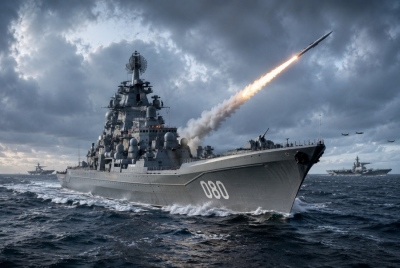
One of Russia's most powerful and expensive warships is preparing to return to operational service, following a modernization process that lasted nearly three decades. The nuclear-powered heavy cruiser "Admiral Nakhimov" now constitutes one of the most heavily armed units of the Russian Navy, with its new arsenal featuring Zircon hypersonic missiles and a vast array of launchers. The ship's modernization has evolved into one of the most costly programs for the Russian Navy, with expenses surpassing 200 billion rubles.
"Admiral Nakhimov" against aircraft carrier strike groups
According to the scenario presented in the Russian publication, the primary mission of the "Admiral Nakhimov" could be countering NATO aircraft carrier strike groups. The vessel, which operates at a speed of approximately 32 knots, can conduct long-duration operations thanks to its nuclear propulsion system. The operational scenario dictates that, before the cruiser even makes direct contact with the enemy, a Ka-31 helicopter will undertake the reconnaissance mission. The helicopter's "Oko" radar system is reportedly capable of tracking targets within a radius of approximately 200 kilometers and transmitting the data to the ship's command center.
The "Zircon" missiles alter response times
The major advantage of the "Admiral Nakhimov" is, according to the report, its Zircon hypersonic missiles. Their speed can reach up to Mach 9, while their range is reported to extend up to 1,000 kilometers. At a distance of 400 kilometers, the flight time is calculated to be a mere 2 to 3 minutes. This means that, in this specific operational scenario, the timeframe between target detection and missile launch is drastically reduced. Sergey Yesenin contends that this capability creates an extremely challenging environment for the opponent, as responding to such a strike must occur within a few minutes.
176 launchers – A missile "umbrella" over the fleet
The "Admiral Nakhimov" reportedly features a total of 176 vertical launchers, of which 80 are dedicated to offensive weaponry and 96 to anti-aircraft missiles. This configuration enables it to simultaneously engage multiple threat categories, ranging from surface warships and submarines to land-based targets. The ship also boasts formidable air defense, with the S-400 system forming its primary protective "umbrella." The objective is not merely the defense of the cruiser itself, but also providing air cover for the remaining vessels in the naval task group.
The "silent fortress" that cannot operate alone
Despite its immense power, the "Admiral Nakhimov" is not a vessel that can operate effectively on its own. Military analyst Andrey Kashkarov points out that a warship of this magnitude will be escorted by other naval vessels, essentially forming a small naval squadron. The rationale is simple: while the "Admiral Nakhimov" possesses massive firepower, it simultaneously represents a highly high-value target for the enemy forces. Every deployment of such a ship into open waters is expected to be closely monitored by satellites, aircraft, and submarines.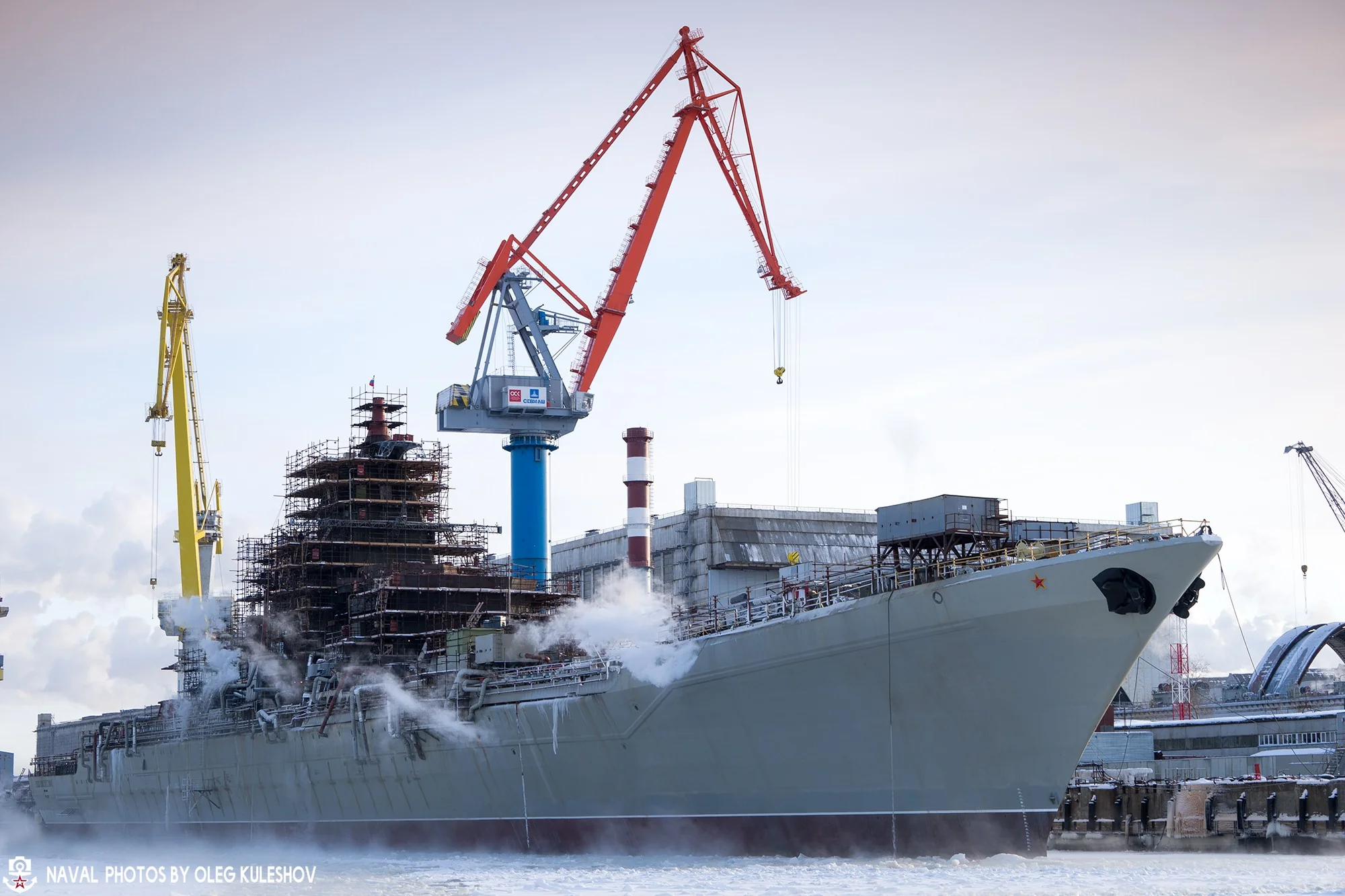
The major financial question: 200 billion rubles
Herein lies the major financial paradox of the entire modernization program. The refitting of the "Admiral Nakhimov" cost over 200 billion rubles, making it one of the most expensive ventures of the Russian Navy since the collapse of the Soviet Union. Recent reports place the total expenditure near 200 billion rubles, even though the program had launched with a much lower initial budget estimate. Sergey Yesenin characterizes the ship as an exceptionally costly investment for the Russian state. The underlying question is whether a giant and extremely expensive cruiser represents the most effective choice for reinforcing the Russian Fleet, or if these same funds could have been allocated to build a larger fleet of smaller, agile warships.
The threat of uncrewed surface vessels
The technological superiority of the "Admiral Nakhimov" does not imply that it is entirely invulnerable to attacks. Particular concern stems from naval surface drones, as a massed attack from multiple vectors could cause saturation of target detection and air defense systems. Andrey Kashkarov warns that, despite its upgraded defense capabilities, a coordinated assault involving vast numbers of drones and decoys could pose a grave risk even to such a powerful capital ship. In other words, the core issue is not simply whether a system can intercept a single missile or drone, but whether it can handle dozens of threats simultaneously.
The Arctic at the core of Russian strategy
The "Admiral Nakhimov" is anticipated to play a pivotal role in the Arctic theater. Andrey Kashkarov assesses that such a cruiser can serve as a mobile command control center for a naval force and as a core element of a regional anti-access system. Irina Karapetova, a military translator and associate professor at the Financial University under the Government of the Russian Federation, argues that the warship could assist in controlling Arctic maritime approaches, safeguarding Russian economic interests, and securing the Northern Sea Route.
A floating symbol of Russian naval dominance
The "Admiral Nakhimov" is ultimately much more than just another standard warship. It represents a massive technological and financial gamble for Russia, aimed at integrating nuclear propulsion, long-range hypersonic strike weapons, and robust air defenses into a single naval platform. Whether this investment of over 200 billion rubles will prove operationally effective in a real combat scenario remains an open question. What is certain is that the return of the "Admiral Nakhimov" to active duty bolsters Russian naval power and introduces a formidable new component to Moscow's strategic planning—particularly across the Arctic and North Atlantic.
www.bankingnews.gr








Readers’ Comments