

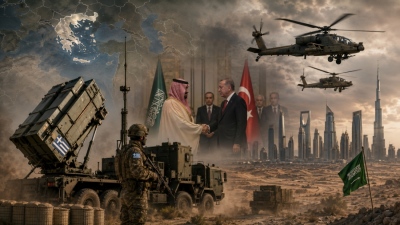
The Greek Patriot missile battery remains stationed in Saudi Arabia, while Athens considers deploying two Apache attack helicopters to the United Arab Emirates to counter drone attacks. At the same time, the Mecca Agreement creates new realities in the Gulf and confronts Athens with a difficult strategic paradox: Greece provides critical defense assets to protect Riyadh, while Saudi Arabia deepens its defense cooperation ties with Turkey, the principal regional rival of Athens. In this context, Greek military involvement is deepening within a conflict outside its immediate geographical perimeter, even as the surrounding regional strategic environment becomes increasingly complex.
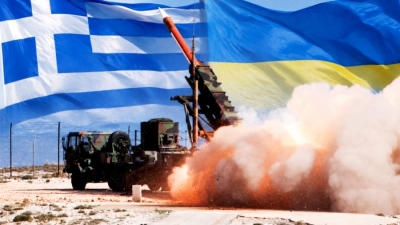
Patriot systems at the epicenter
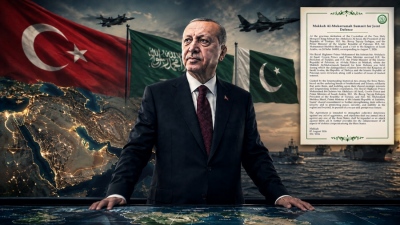
Since 2021, Athens has provided Saudi Arabia with a Patriot battery alongside essential military personnel to strengthen the kingdom's air defense and protect critical infrastructure from regional threats. However, Saudi Arabia, which has accepted Greek military assistance for years, entered an agreement that brings Riyadh much closer to Turkey and Pakistan. Specifically, the agreement between Turkey, Saudi Arabia, and Pakistan establishes a defense cooperation mechanism and a mutual defense clause. The accord, signed in Mecca, states that any armed attack against one of the three countries will be considered an attack against all, according to the official announcement. Turkish Foreign Minister Hakan Fidan even compared this clause to NATO Article 5, maintaining that an armed assault against one signatory state will be treated as an attack against all. If this new framework acquires the operational depth described by its signatories, Turkish defense diplomacy secures a vital new channel for military cooperation in the Gulf. This unfolds in a region where Greece has invested substantial diplomatic and military capital over recent years, attempting to reinforce Gulf strategic alliances.
The contradiction is stark... On one hand, Greece provides one of its most vital air defense assets to safeguard Saudi Arabia, while the Saudi political leadership simultaneously chooses to institutionalize closer military alignment with Turkey. Consequently, the strategic environment surrounding the Greek military footprint has fundamentally shifted, forcing Athens to re-evaluate the costs, benefits, and risks of maintaining its presence.
Apache helicopters to the Emirates
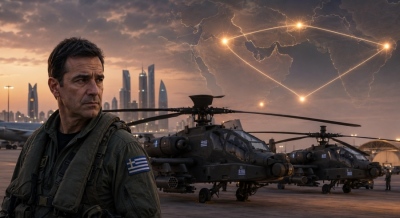
Another dimension of the Greek military presence in the Gulf involves plans to send two Greek AH-64D Apache attack helicopters to the United Arab Emirates. According to sources, preparation of the aircraft and aircrews has already begun, with the redeployment expected to take place when conditions permit. The Greek Apache deployment is intended to join base defense operations alongside other international forces, tasked with countering unmanned aerial vehicle attacksand protecting critical infrastructure.
"Farcical that Greek Patriots remain in Saudi Arabia"
Sharp criticism regarding the deployment of Greek Patriot systems in Saudi Arabia was leveled by geostrategic analyst Savvas Kalenteridis, who raised questions about the concessions Greece has secured and linked the issue to shifting Middle East geopolitical balances. Speaking on Open TV, Savvas Kalenteridis argued that Greek citizens remain uninformed about the contractual framework governing the weapon system's presence in Saudi Arabia. "As Greek citizens, we never learned the framework of this agreement or what Greece gains from deploying a weapon system that is extraordinarily expensive and crucial for our national defense security," he stated. He emphasized that the Patriot system has spent years protecting a strategically vital Saudi location, questioning the concrete benefits Athens has received in return. The geostrategic analyst focused heavily on the growing defense cooperation among regional states and Turkey's expanding role. Under these new circumstances, he characterized the continued presence of Greek Patriots in Saudi Arabia as "farcical at best," dismissing claims that their presence serves broader Greek strategic interests in the Red Sea region. He further posed the question of what would happen in the event of a Greco-Turkish conflict and how the regional defense commitments assumed by those states might impact such a development.
Turkey seeks to expand its geopolitical weight
Referring to Ankara's maneuvers, Savvas Kalenteridis assessed that Turkey primarily seeks to expand its geopolitical footprint and boost Turkish defense exports to Saudi Arabia. He connected these moves to older concepts regarding the formation of a broader Sunni defense alliance, noting that potential Egyptian participation would render these developments far more significant. According to the analyst, Greece must closely monitor these emerging balances and actively strengthen its bilateral relationships with key partners, including India defense partnerships, the United Arab Emirates, and Israel.
www.bankingnews.gr


Readers’ Comments