

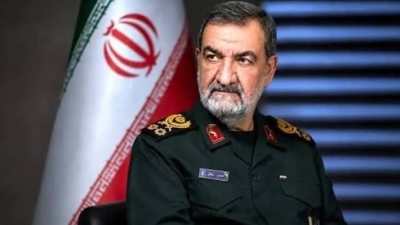
A man who knows Iran's military apparatus like few others takes over one of the most critical positions within the state mechanism in Iran. The individual in question is 71-year-old Mohsen Rezaei, a veteran commander of the Revolutionary Guards Corps and close military advisor to Supreme Leader Mojtaba Khamenei, who assumes the role of Secretary of the Supreme National Security Council, sending a clear message of determination to the US political leadership. The choice of Rezaei can be considered anything but accidental. He represents one of the most experienced figures in the Iranian military and political apparatus, a man situated at the core of power for more than five decades who has tied his name to the very establishment of the Islamic Revolutionary Guard. His appointment at the helm of the National Security Council acquires even greater significance during a period when Washington is attempting to pressure Tehran militarily and politically, while the possibility of renewed negotiations remains open on the international diplomatic stage.
From the IRGC to the decision-making center
Rezaei is not a diplomat moving to a safe posting. He is an IRGC man to his core. During the Iran-Iraq war in the 1980s, he assumed command of the Revolutionary Guards and remained at their helm for many years. At the same time, he participated in shaping the structural foundation of the IRGC, helping transform them into one of Iran's most powerful institutions. This is precisely what imparts exceptional weight to his new security position. Iranian-American academic Vali Nasr argues that Rezaei possesses far greater influence within the Revolutionary Guards than his predecessor, Mohammad Bagher Zolghadr. This assessment, if confirmed in practice, means that the military dimension of Iranian strategy gains even greater weight within the decision-making center. And this is precisely the aspect that concerns the US Defense Department.
"Trump was defeated"
Rezaei has already made sure to clarify that he does not view the conflict with the US from a position of weakness. In recent statements, he argued that Iranian counterattacks forced American forces in the region to relocate, claiming that Tehran shattered Washington's plans. Furthermore, he characterized the American effort as failed and asserted that Trump suffered yet another severe military strategic defeat. The political significance of this rhetoric is substantial. Tehran does not project itself as the weak link in a conflict that must be ended at all costs. On the contrary, it attempts to present the situation as a showdown in which Iran has managed to withstand American pressure and maintain its capacity to respond. This redefines the groundwork for any future diplomatic negotiation process.
"The negotiations are over"
Herein lies perhaps the most striking message behind the selection of Rezaei. The new Secretary of the National Security Council has declared that negotiations with the US are "over," while describing talks as a bridge that can be used to cross over, rather than a permanent commitment. In other words, Tehran does not appear willing to enter a process where Washington assumes it holds all the cards. Quite the opposite. The choice of a man with deep roots in the IRGC can be interpreted as an effort to ensure that any political agreement rests upon a foundation of military strength rather than a retreat under pressure. This explains why this personnel change in national security leadership carries exceptional weight.
Hormuz as a "red line"
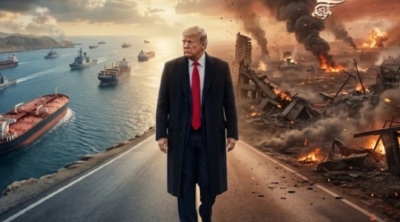
Even more characteristic is Rezaei's stance regarding the Strait of Hormuz. The Iranian official has warned that if the American blockade of Iranian ports continues, American ships and military forces in the region will face severe risks and casualties. This is a warning that Washington cannot easily ignore. Hormuz represents one of the planet's most vital energy arteries. Therefore, Iran's capability to threaten the smooth operation of the region grants Tehran a major strategic advantage. Iran does not need to possess the economic or military power of the US to inflict immense costs. It is enough to make any American escalation option costly and hazardous. That is where one of Tehran's strongest bargaining chipslies.
Khamenei's man facing Trump
Rezaei's rise becomes even more notable due to his relationship with Mojtaba Khamenei. Rezaei was already serving as a military advisor to the Supreme Leader, a role that placed him within an intimate circle of trusted figures. He now moves into a position from which he can directly influence the coordination of Iranian national security policy. Vali Nasr assesses that this move may reflect an effort by Mojtaba Khamenei to consolidate his control over the IRGC and the decision-making process, especially ahead of a potential agreement with the US. If this assessment proves correct, the message is clearer still: Tehran is not preparing to negotiate out of weakness. It is preparing to negotiate only if it can do so from a position of power.
Iran does not back down
The selection of Rezaei demonstrates that the Iranian leadership intends to keep the military factor at the core of its strategy. A man who fought in the Iran-Iraq war, built the IRGC, served at the peak of the military establishment, and has repeatedly challenged the effectiveness of American policy against Iran is now centered in national security. For Washington, this means that applying pressure on Tehran will not necessarily translate into an Iranian strategic withdrawal. For Tehran, conversely, the new balance serves as a signal that military strength, threats surrounding Hormuz, and counterattack capabilities remain firmly on the table. In this context, Rezaei does not simply assume an office. He undertakes to manage the most critical segment of Iranian strategy during a period when conflict with the US remains open, and the question is not whether Tehran will be pressured, but the cost it is prepared to impose on Washington to avoid backing down completely.
www.bankingnews.gr



Readers’ Comments