

In a... resounding intervention supporting immigration policy in Greece, US President Donald Trump reshared the interview given by Greek Minister of Migration and Asylum, Thanos Plevris, to Breitbart News, presenting Athens as one of the European examples of the tougher stance that has prevailed along borders in recent years.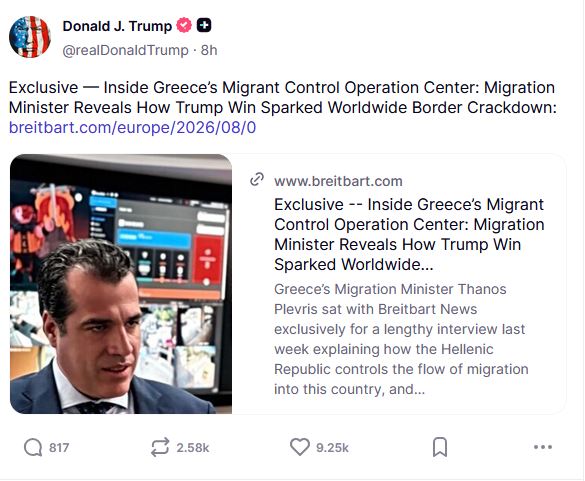
The Greek minister, speaking to the American media outlet, directly linked Trump's return to the White House with the shift in European migration policy toward stricter rules, asserting that the policy change in the US created a new political environment in Europe as well. "The best thing President Trump did was changing immigration policy in the US and also in Europe," he explicitly noted, while also declaring: "I am an admirer of President Trump."
"Enough is enough" on migration
According to Thanos Plevris, this shift is not limited to Greece, but concerns Europe more broadly. As he asserted, countries like Germany, France, the Netherlands, Denmark, and Sweden have moved toward stricter policies, as public opinion demands greater control over irregular migration flows. "The message from our citizens is clear: Enough is enough!", he emphasized. He asserted that Trump's return to power served as a catalyst for this shift, given that, according to his assessment, previous American policy had encouraged a more open management model regarding European border control. Thanos Plevris also mentioned that Greece has adopted certain practices from the American asylum system, noting that Athens and Washington now maintain a memorandum of understanding on asylum systems and exchange proven best practices.
Greece's "war room"
In the interview, the minister presented to Breitbart the "Centaur" operations center at the Ministry of Migration and Asylum, which serves as a centralized monitoring hub for reception facilities. The Greek minister explicitly characterized it as a central war room. From this center, as he explained, Greek authorities can monitor facilities operating across the entire country in real time. In total, as he stated, there are 33 structures being monitored on a 24-hour continuous basis. This presentation was utilized by the minister to describe the operational control model that Greece now implements, in conjunction with new legislation covering asylum seeker management.
The new legislation
Thanos Plevris explained that, under the new Greek legislation implemented since September 2025, people arriving in Greece who are assessed as holding a refugee profile are transferred to open facilities and can proceed with the formal asylum process. Conversely, for those who, according to Greek evaluation, do not hold a refugee profile, mandatory detention is mandated while their application is being examined. The minister stated that approximately 30% of arrivals correspond, according to data he presented, to people considered to hold a refugee profile, while the remaining 70% primarily concerns individuals from countries that Athens considers safe, such as Bangladesh, Pakistan, and Egypt. In cases where an asylum request is rejected, the Greek minister asserted that the new legislation provides for a prison sentence ranging from two to five years, while simultaneously offering the option of voluntary return to the country of origin to avoid mandatory prison terms. According to the minister, this policy has already influenced the decisions of prospective migrants.
From 3,200 arrivals down to 802
Greece's Minister of Migration and Asylum provided Breitbart with specific data regarding arrivals from Egypt via Libya, comparing the first half of 2025 with the corresponding period of 2026. As he noted, during the first half of 2025, 3,200 irregular arrivals from Egypt via Libya were recorded, while only 69 forced migrant returns were carried out. In the first half of 2026, according to the data he presented, arrivals dropped to 802, while returns increased to 330. "From 3,200 down to 800," he noted characteristically, asserting that this shift proves that a stricter policy acts as a strong effective deterrent. At the same time, he added that during the first half of 2026, returns to countries of origin increased by 40% compared to the previous period, attributing the development directly to the new statutory framework.
The Evros fence as a Greek "wall"
At the center of the interview was the Evros border wall, which Thanos Plevris linked directly to Trump's policy along the southern US border. "Without the fence, we would have thousands of migrants," he stated, adding that Greece deploys soldiers and police officers to the region. When the Breitbart journalist referenced the American border wall along the Mexican border, the Greek minister highlighted the importance of physical and artificial barriers along land borders. "With a fence, soldiers, and police officers, you can achieve zero migration flows," he remarked. This stance aligns with the minister's broader argument that effective control over physical land borders is a primary tool for curbing irregular arrivals. He recalled the 2020 crisis when, according to his statements, approximately 20,000 people attempted to cross the Greek-Turkish border daily. As he asserted, the Evros fence proved to be a critical factor in preventing unlawful border entry. At the same time, he mentioned that European leaders visited the region back then and expressed their firm support for Greece, realizing that Greek borders simultaneously constitute the external physical borders of the EU.
70% reduction in migrant flows
The minister further asserted that within a single year, Greece recorded a 70% reduction in total migration flows. He attributed this development both to cooperation with the Turkish Coast Guard and to the new Greek legislation, arguing that the key element is sending a clear message to prospective migrants. "When you enter a country illegally and I put you in detention, that means you send a message to your relatives back home that 'I am in detention' and 'they want to send me back,'" he said. For Plevris, deterrence works precisely through this message: Greece no longer represents an easy destination for anyone attempting to enter irregularly and remain in the sovereign host country.
The sharp swipe at Spain
The minister's reference to Spain carries particular interest. The Minister of Migration and Asylum criticized Spanish policy which, as he argued, allows irregular migrants to obtain legal documentation under specific conditions, asserting that such a provision acts as a major pull factor, attracting new migration waves. According to him, Spain currently faces approximately 1.2 million applications from irregular migrants seeking to obtain legal residency documents. "If you can choose a country to go to, this acts like a magnet," he asserted. Greece, as he emphasized, pursues a fundamentally different approach, holding that broad regularization policies generate incentives for fresh arrival surges.
The "battle" against human traffickers
Thanos Plevris placed special emphasis on the role of human smugglers, whom he accused of constantly seeking loopholes in European legislation. As a prime example, he cited the case of minors. According to the minister, traffickers had begun encouraging families to send 16- or 17-year-old boys to Europe because the previous legal framework provided greater protection for minors against mandatory administrative detention. "Traffickers constantly try to identify loopholes," he noted. In his assessment, organizers of illegal smuggling routes care nothing for the safety of the people they transport, focusing strictly on financial profit. He even referenced dangerous maritime routes from Libya toward Crete or Italy, noting that people are crammed into tiny vessels for an exceptionally hazardous sea journey.
"Strict but fair policy"
The Greek minister presented the Mitsotakis government's overall migration strategy as a model combining rigorous border enforcement with structured asylum processing for those meeting established criteria. "We maintain a strict but fair policy," he stated, describing this approach as a core commitment of the administration since 2019. At the same time, he connected this change in Greek policy to the broader political realignment across Europe, pointing out that, in his view, an increasing number of governments now consider stricter enforcement rules essential.
From Trump to Europe
Meanwhile, Thanos Plevris maintains that Donald Trump's return to the American presidency created a new political environment in which European governments can now adopt tougher policies without facing the same political pressure that existed in previous years. "When Trump returned," he noted, "it was very important that the US altered its national policy direction."
www.bankingnews.gr










Readers’ Comments