

Israel no longer hides its preference: an agreement between the United States and Iran over the Strait of Hormuz is not necessarily considered a positive development for Tel Aviv.
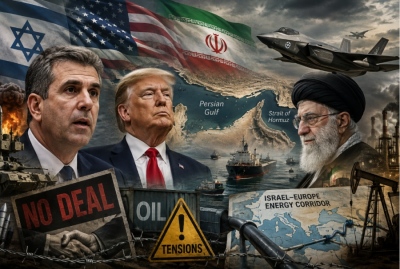
This stance was expressed in an unusually clear manner by the Energy Minister of Israel, Eli Cohen, who stated that from the Israeli side it would be preferable for there to be no agreement with Tehran, so that pressure on Iran can continue.
«From our perspective, it would be better for there to be no agreement. We can continue to exert pressure on Iran», Cohen told the Israeli Channel 14.
The statement acquires particular significance as Washington, Tehran, and Oman attempt to find a formula that will allow the safe restart of navigation through the Strait of Hormuz.
Israel, however, appears to view the issue differently.
Tel Aviv does not want an «easy» exit for Tehran
For the Israeli government, the issue is not merely freedom of navigation.
The critical question is what Iran will gain in return for opening Hormuz and whether an American-Iranian agreement will reduce the pressure exerted on Tehran.
Eli Cohen has already warned that Israel does not consider itself bound by an American-Iranian agreement if Iran restores its nuclear or ballistic program.
In May he had stated that Israel will be ready to act if Tehran attempts to restore those capabilities.
This creates a fundamental problem for Washington: the agreement that Donald Trump wants in order to stabilize the region and energy markets is not necessarily the agreement that Israel wants to contain Iran in the long term.
Hormuz as Tehran's strategic weapon
The Strait of Hormuz is not merely a maritime trade route.
It constitutes one of the planet's most critical energy chokepoints.
Approximately one-fifth of global oil and natural gas trade historically passes through the area.
That is why every agreement for the reopening of the Strait carries immense economic and geopolitical consequences.
Recent US efforts to reach an agreement with Iran have already prompted a fall in international oil prices, as markets price in a potential restoration of flows.
For Israel, however, the issue is far broader - and it does not appear to back down from the pressure it exerts on the USA.
If Iran re-acquires the capability to control the terms of transit through Hormuz while simultaneously securing economic or political concessions from Washington, Tehran could emerge from the crisis with significant negotiating gains.
This is precisely what Tel Aviv wants to prevent.
The new mechanism and the agreement with Oman
Recent developments show that the issue is not necessarily heading toward a simple return to the status quo that existed before the war.
Iran and Oman are in negotiations for a temporary safe transit mechanism.
According to the latest information, the arrangement under discussion could provide for different management of the entry and exit of ships from the Strait.
Iran is said to retain a role in managing entry into the Persian Gulf, while exit will take place through an area controlled by Oman.
The exact form of the agreement remains subject to negotiation.
Tehran has made clear that it does not merely desire a return to the previous situation.
Iranian Deputy Foreign Minister Kazim Garibabadi stated on August 5 that talks with Oman have entered the final phase and that the temporary mechanism could last from two to four months.
The full opening of the Strait, however, will depend on the stance of the United States.
Israel keeps the military option open
The Israeli stance is not limited to rejecting an agreement.
Tel Aviv has repeatedly made clear that it wants to maintain freedom of military action against Iran.
Already during previous negotiations, an Israeli official had stated that Washington had informed Israel that in talks it would demand Tehran remove nuclear material, stop uranium enrichment, and address the threat of ballistic missiles.
At the same time, the Israeli side insisted on maintaining its own freedom of action.
The message is clear: Even if Washington agrees with Tehran, Israel does not consider that this automatically closes the Iran dossier.
The Israeli alternative to Hormuz
There is, however, also an important economic dimension to Israel's stance.
Tel Aviv is attempting to reduce the region's strategic dependence on the Strait of Hormuz by promoting alternative energy routes.
Eli Cohen has proposed the creation or expansion of a pipeline connecting oil-producing Gulf countries with Europe via Israel. According to him, such an infrastructure could significantly limit dependence on Hormuz while offering an alternative route in case of problems in the Red Sea as well.
Here lies perhaps the largest strategic dimension of Israeli policy.
Israel does not simply want to manage a crisis around Hormuz.
It wants, in the long run, to reduce the value of Hormuz as a tool of geopolitical blackmail for Iran.
Why Israel prefers pressure
Cohen's statement thus acquires greater meaning.
If a US-Iran agreement occurs leading quickly to a lifting of pressure, restoration of trade flows, and economic concessions to Tehran, Israel fears that Iran will be able to regroup.
Conversely, maintaining pressure allows Tel Aviv and Washington to continue demanding restrictions on Iran's nuclear and missile programs.
This is the core strategic divergence.
Trump is primarily interested in ending the war, opening Hormuz, and stabilizing energy markets.
Israel is primarily interested in not allowing Iran to emerge from the crisis with enough capabilities to rebuild its nuclear and missile arsenal.
The two goals are not necessarily compatible.
The great rift between Washington and Tel Aviv
The disagreement over Hormuz can therefore evolve into one of the most critical points of friction between the United States and Israel.
Trump has already postponed a new major attack against Iran, under pressure also from Gulf states that fear a new military escalation will trigger even greater attacks on their infrastructure. At the same time, Washington pursues a new negotiation over the nuclear program and Hormuz.
Israel, by contrast, has left open the possibility of moving even without American participation, should it judge that Iran is restoring its nuclear or ballistic capabilities.
And this exact difference explains why Eli Cohen's statement on Hormuz is more than a simple position of a minister.
It reveals Israel's strategic priority:
not a quick return to normalcy, but an agreement that will genuinely limit Iran's power.
For Tel Aviv, a Hormuz that opens without substantial concessions from Tehran may simply mean that Iran bought time.
And that is precisely the scenario Israel considers nightmarish.
www.bankingnews.gr








Readers’ Comments