

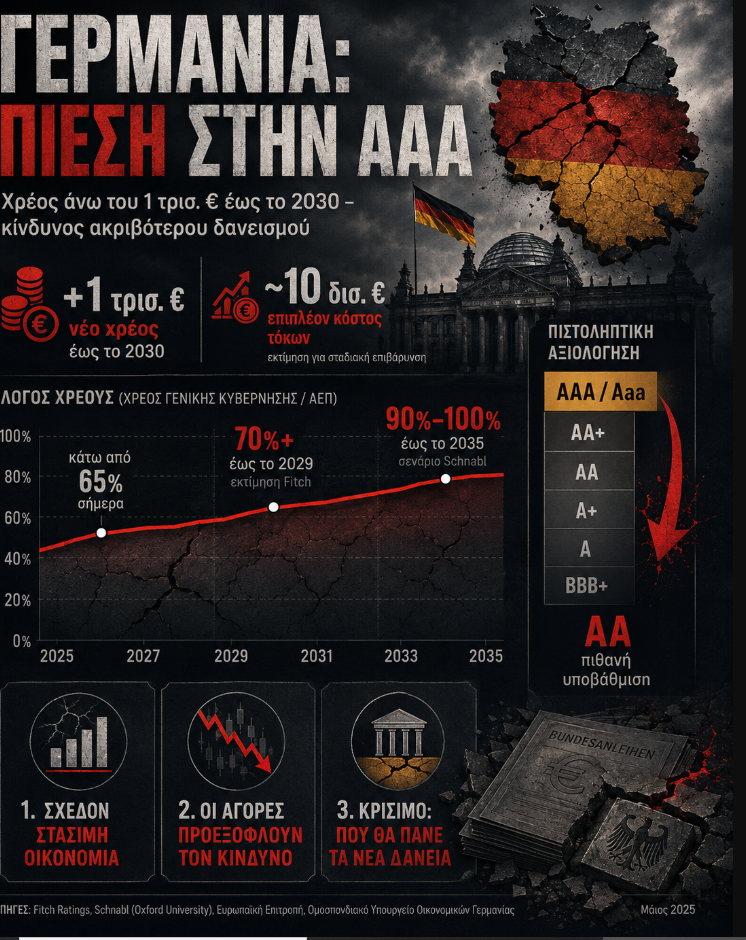
Germany is expected to assume additional debt of over 1 trillion euros by 2030, at a time when its economy remains nearly stagnant while its economic model is in crisis due to competition from China.
According to a report by Handelsblatt, concerns are intensifying within the German government - which are becoming indications - that rating agencies may downgrade the country's creditworthiness.
Economists warn, speaking to Berliner Zeitung, that the effects could reach citizens by significantly downgrading their standard of living.
New mortgage and construction loans may become more expensive, while in the long run higher taxes and cuts in public spending cannot be ruled out.
The economist of the ZEW institute, Friedrich Heinemann, estimates that a credit rating downgrade could burden Germany with about 10 billion euros in additional interest costs. However, the consequences may be felt even before rating agencies proceed with any official move.
Why Germany's top credit rating is under pressure
Until today, Germany belongs to the limited circle of countries with the highest credit rating.
Leading rating agencies Fitch and S&P maintain the country at the AAA tier, while Moody’s rates it with Aaa - in all cases, the highest possible tier.
The outlook also remains stable.
This allows the German government to borrow at relatively low cost.
However, as debt increases, so do the risks - particularly if the long-awaited economic recovery fails to materialize.
A senior government official told Handelsblatt: «If debt remains high, but growth does not accelerate, rating agencies could begin to question Germany's AAA rating».
A similar position was expressed by another member of the government: «Not immediately, but in the coming years we could find ourselves under pressure, if things continue as they have until today».
Warnings about a potential loss of the top rating have also been voiced by economists, including the chief economist of LBBW, Moritz Krämer, and the president of ifo, Clemens Fuest.
«Downgrade is a strong scenario»
«I consider a downgrade likely», stated Gunther Schnabl, director of the Flossbach von Storch Research Institute, to Berliner Zeitung.
As he explains, Germany has consciously chosen a path of significantly higher public borrowing, without however having proceeded to the same degree with necessary reforms.
This makes it harder to achieve growth that would allow the country to «escape» the burden of debt.
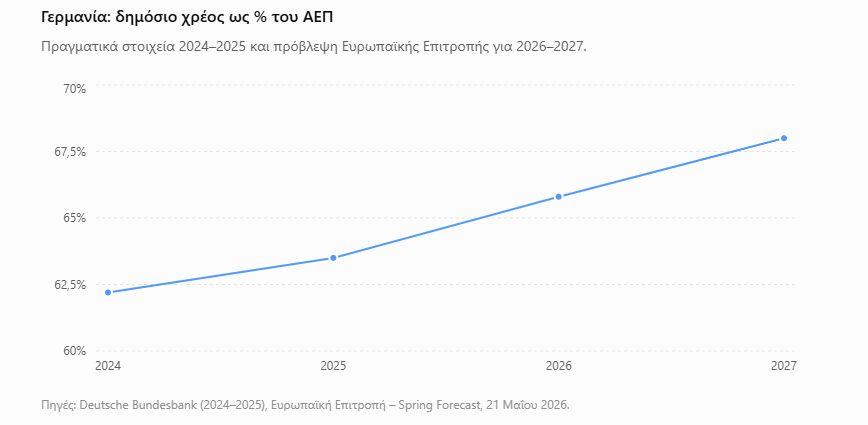
According to the economist, Germany's debt ratio - namely public debt as a percentage of annual GDP - could rise from just below 65% today to 90%-100% by 2035.
At the same time, high debt in other major economies of the Eurozone increases pressure on Germany, which is considered the main pillar of stability in the monetary union.
No sudden «shock» expected in markets - for now
A possible downgrade, nonetheless, is not expected to cause a sudden shock to financial market interest rates.
«The rating agency simply confirms what the market has known for a long time», explains Schnabl.
Investors constantly evaluate the economic situation and, when risks increase, demand higher bond yields even prior to an official downgrade.
«The event of the downgrade itself will hardly cause a shock to markets, as they usually price in fundamental economic data over time», he notes.
Fitch evaluates the situation less pessimistically.
«Germany possesses significant fiscal margin for maneuver», stated a spokesperson for Fitch Ratings.
The country benefits, among other things, from a large and diversified economy, strong institutions, and its key position in capital markets.
These advantages continue to support Germany's rating, «even if risks have now become more apparent».
According to Fitch, decisive is not only the amount of new debt Germany assumes.
Great importance lies in whether additional loans will boost growth and, consequently, maintain debt on a sustainable trajectory.
Without a sustainable improvement in the economy's growth potential, further debt increases would exert «pressure on the credit rating».
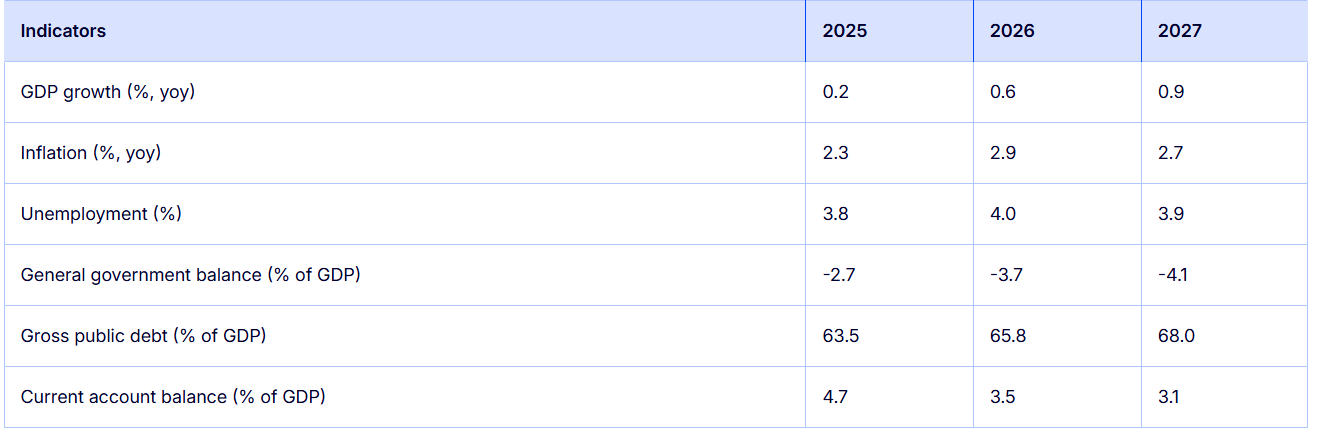
Fitch already estimates that the debt ratio will exceed 70% of GDP by 2029.
«Investment grade is not immediately threatened»
Clemens Fuest also considers the immediate significance of a potential rating change to be limited.
As the credit picture of other major economies, such as France, the USA, and Britain, also deteriorates, Germany's relative position remains strong.
«It would become truly critical only if Germany's rating as an investment grade country were threatened», notes the president of ifo.
Between today's top rating and the threshold of investment grade, however, there are several tiers. «This is not on the horizon for the near future», emphasizes Fuest.
Higher interest rates will increase the cost of mortgages
Nevertheless, the trajectory of German debt is not without consequences for citizens.
«Government bonds are often considered the benchmark interest rate of a risk-free market, upon which the risk premium and profit margin corresponding to each borrower are added», explains Schnabl.
Banks use this yield as a point of reference for long-term financing.
«A rise in government bond interest rates therefore implies higher long-term interest rates for private individuals as well».
Particularly exposed would be those buying real estate or needing new financing after the expiration of an existing loan.
Conversely, for a mortgage already in effect with a fixed interest rate, the monthly installment does not change.
How much exactly mortgage rates would increase solely due to the rise in public debt cannot be calculated.
Mortgage rates are also influenced by inflation, monetary policy, and the general trajectory of financial markets.
Approximately 10 billion euros in additional interest costs
Higher interest rates would simultaneously burden the federal budget itself.
«A credit rating downgrade could initially lead to an interest rate increase of 0.1 to 0.3 percentage points», estimates Friedrich Heinemann, head of the Research Department for Corporate Taxation and Public Finance at the Leibniz Centre for European Economic Research (ZEW).
With public debt at approximately 3 trillion euros, even a small increase in borrowing costs would entail a significant additional burden.
«I would therefore expect, for the time being, an additional cost in the range of 10 billion euros», notes Heinemann.
This burden would not appear all at once. It would increase gradually as old bonds mature and are replaced by new ones with higher interest rates.
Warning for higher taxes and spending cuts
Every additional euro directed toward debt servicing limits available funds for other public expenditures.
«In the long term, either taxes will have to be raised or spending will have to be cut», warns Heinemann.
He also links the trajectory of the credit rating with political stability.
Political complications...
In his assessment, electoral successes of AfD and Die Linke could make reforms harder and cause concern among investors.
«If, instead, we assume debt to finance pensions, this severely damages Germany's credit rating», Heinemann argues.
Conversely, Heinemann considers financing defense spending and infrastructure investments through borrowing to be justified.
The critical question: Where new loans will be directed
Whether Germany will maintain its top credit rating will not be judged, therefore, solely by the level of debt.
Decisive will also be where new capital is directed and whether these investments will contribute to strengthening economic growth.
A possible downgrade would not lead overnight to a surge in mortgage rates or taxes.
It would, however, constitute a visible warning signal for a development whose cost the German state and its citizens may have already begun to bear.
www.bankingnews.gr













Readers’ Comments