

From collecting a single photograph and «dead mailboxes» to assassinations, penetration into leadership, and the cultivation of internal corruption, the Israeli HUMINT model appears as a multi-layered machine.
The ultimate goal, according to cases and testimonies that have come to light, is not merely the theft of information: it is the capability to influence the very way the adversary thinks, operates, and decides.
The image of a spy as a person who steals a secret, photographs a military facility, or hands a file to some handler describes only the lowest level of a much more complex world, reveals analysis by The Cradle regarding the inner workings of Mossad.
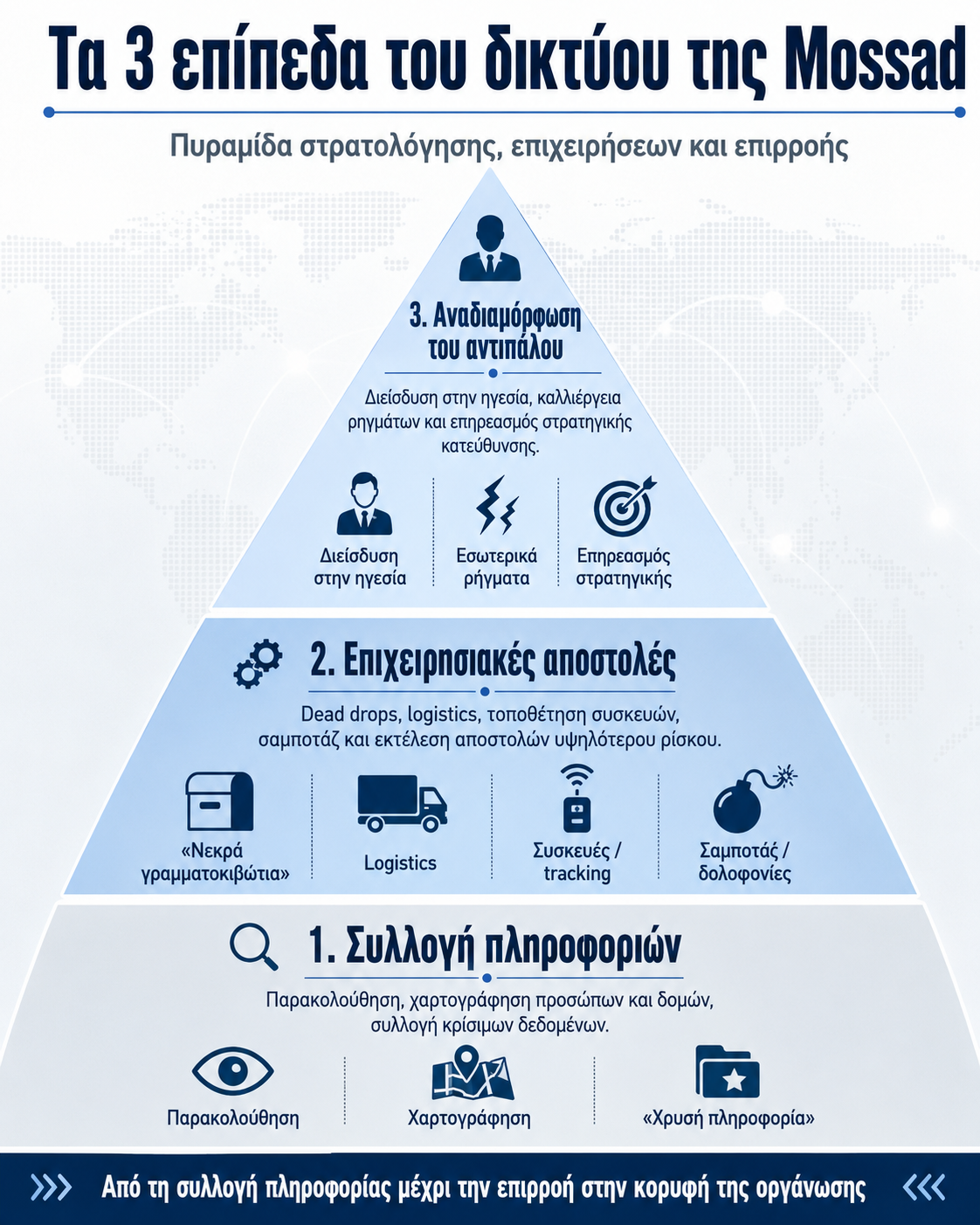
In the case of Israel, human intelligence operations described in past cases, security officials' testimonies, and open Israeli studies refer to a real pyramid of agents.
At the base stand collectors of partial information and executors of low-risk missions.
Higher up are those who gain access to military structures, training lines, and operational systems.
And at the top are the far more dangerous cases: people who can influence the leadership, internal balances, and ultimately the strategic direction of an organization itself.
This is perhaps the most concerning element.
Espionage ceases to operate exclusively as an information mechanism and transforms into a tool for redesigning the adversary from within.

The Israeli «industry» of studying intelligence failure
One of the distinctive features of the Israeli system is that the study of intelligence services is not restricted to the closed corridors of state agencies.
Universities, research centers, former officers, and armed forces personnel actively participate in the analysis of intelligence collection, failures, and penetration methods.
A characteristic example was the second annual Israeli conference on intelligence studies, held at the Hebrew University of Jerusalem on October 28 and 29, 2025, on the topic «transformations of espionage after failure».
The choice of topic was not accidental.
Following Operation Al-Aqsa, the Israeli security community found itself facing the question of how a state that had invested vast resources in technical surveillance, wiretaps, and human intelligence collection failed to predict an attack of such scale.
This self-criticism holds special significance because it shows that the Israeli approach does not treat intelligence as a static product.
It constantly studies how people are recruited, tested, trained, and transformed from simple informants into operational tools.

First level: Building the «mosaic»
At the base of the pyramid lies information collection.
A photograph. A route. A car. The departure time of an official.
The people he meets. The type of mobile phone he uses. The spot where he parks.
Individually, such pieces of information might seem insignificant.
When joined together, however, they create an operational mosaic.
A recruited agent might not even know what exactly he is constructing.
He might monitor the movements of a person without knowing that another agent records his communications and a third checks the house he visits.
Precisely this fragmented operation protects the network.
If one person is arrested, he does not necessarily have the ability to reveal the entire operation.
In a case described in Lebanon, a man was reportedly instructed to place special equipment in a vehicle and drive through specific areas, collecting data from residential and organizational routers and attempting their electronic penetration.
The mission shows how much the concept of human intelligence has changed.
The agent no longer needs to steal a physical folder.
He can simply carry technical equipment that will steal thousands of digital data points on his behalf.

When the agent becomes a sensor
Even more characteristic is a case from the Gaza Strip.
According to security sources cited in the source material, a battalion in northern Gaza had been penetrated prior to the present war by a man who occupied approximately the third position in its command hierarchy.
Despite his high rank, he lacked access to the full map of the tunnels.
The solution chosen by his Israeli handlers was extremely simple and at the same time revealing: they gave him military boots similar to those of the fighters, inside which a tracking device had been concealed.
He did not need to draw the map.
He simply needed to walk.
The physical body of the agent was thus transformed into a mobile mapping sensor.
When the breach was uncovered, according to the same sources, the organization radically altered the construction and usage of the tunnels: separate routes, fragmented access, and compartmentalization of knowledge so that no fighter knew the entire network.
This is precisely the ongoing battle between espionage and counterintelligence.
Every successful penetration creates a new security measure.
And every new measure forces the opposing agency to develop a different method.

The «golden intelligence»
At the top of intelligence collection lies what in Israeli military terminology is described as yediat zahav, meaning «golden intelligence».
It is not necessarily a vast volume of data.
It can be a single, unique piece of information arriving at the right moment.
A house.
A car.
A specific time.
The confirmation that a target is inside a room minutes before an air strike.
The assassination of Yahya Ayyash constitutes one of the most famous historical examples of using a human collaborator in an operation of this type.
The collaborator who contributed to the operation was linked not only to identifying the target but also to the booby-trapped mobile phone used in the assassination.
In such cases, the agent is essentially «burned».
His value lies in the single piece of information or single action that can change the outcome of an operation.

From money and vehicles to booby-trapped weapons
The second level is purely operational.
It begins with seemingly simple tasks: transferring money, hiding phones, renting houses, purchasing vehicles, or establishing dead drops, spots where an agent leaves material for someone else to pick up.
As trust increases, so does the risk.
Agents may be asked to place tracking devices, insert chips into weapon systems, or even tamper with ammunition.
One of the most impressive cases described concerns a man working in a weapon manufacturing workshop for an Islamic organization in Gaza.
According to sources in the original text, this specific agent placed tracking devices inside rockets while simultaneously weakening the explosive material in their warheads.
Responsibility is attributed to him for locating and ultimately killing dozens of operatives between 2008 and 2012.
If the description is accurate, it represents a textbook example of the real power of successful penetration.
You do not need to win a battle if you can make the adversary's weapons reveal his location.
Transition to assassinations through local collaborators
For many years, a basic assumption prevailed among Palestinian and Lebanese security apparatuses: high-value assassinations were executed by Israeli operational agents.
The assassination of Hamas commander Mahmoud al-Mabhouh in Dubai in 2010 reinforced this perception, as security cameras recorded a multi-member team traveling with foreign passports.
However, subsequent cases indicated a different evolution.
The assassination of Mazen Fuqaha in Gaza in 2017 constituted a crucial precedent.
Years later, on February 5, 2026, Benjamin Netanyahu publicly acknowledged Israeli responsibility for the operation, stating that the execution was carried out through the recruitment of Palestinian Ashraf Abu Leila.
This case overturned the old assumption that final execution had to be done by Israeli hands.
The local agent could now be transformed from an informant into an assassin.
Iran and the true form of networks
A similar discussion emerged during the Israel-Iran war in June 2025.
The Israeli public narrative presented a large part of ground operations as the work of Mossad operatives who had penetrated deep into Iran.
The investigations and arrests that followed, however, showed a more complex picture according to the material.
A large portion of the people allegedly involved were residents of Iran itself.
Some might not even have known the final purpose of the equipment they transported, believing they were participating in ordinary smuggling for financial gain.
This is another fundamental characteristic of modern networks.
The most effective collaborator is not always the one who knows the most.
Sometimes it is the one who knows precisely what is necessary to complete a single mission.

The third level: You do not steal information – you change the opponent
Here lies the truly strategic dimension.
At the highest level, the goal is no longer to learn where a commander is located or where missiles are stored.
The goal is to understand who could succeed a leader, which operative is a «hawk» and which a «dove», what personal rivalries exist, and which rifts can be widened.
An agent, for example, might monitor exclusively the social life and political language of a leading figure.
Not to immediately organize his assassination, but to map the entire political balance around him.
Here, assassination acquires a different meaning.
Eliminating a person can create a vacuum in the hierarchy. The critical question then becomes who will fill the void.
If the likely successor is known, predictable, or even more favorable to the adversary's goals, targeted assassination turns into a tool of political engineering.
The CIA and the power of suspicion
The method is not exclusively Israeli.
Former CIA officer John Kiriakou has described a different mechanism used against the organization of Abu Nidal.
According to his account, the CIA failed to penetrate the organization effectively.
So instead of recruiting an agent, it attempted to create the impression that an agent already existed.
Suspicion did the rest.
Operatives began accusing other operatives of treason, and internal bloodshed followed.
The agency no longer needed to destroy the organization.
It had created the conditions for the organization to begin destroying itself.
The ideal agent is the one who becomes a leader
The most dangerous scenario, however, is the rise of a recruited person into the upper echelons.
For this to happen, credibility is needed.
And credibility requires «successes».
The source material describes the case of an official in the Al-Aqsa Martyrs' Brigades who reportedly gained prestige following an attack on an Israeli military vehicle.
Subsequent investigation, according to the same account, concluded that the vehicle had been driven remotely toward an explosive device that had already been uncovered by Israeli intelligence services.
The «success» had therefore been allowed.
The goal was not to avoid a minor operational loss.
It was to create a hero inside the opposing organization.
If an agency can manufacture the credibility of an agent, it can potentially guide him much higher than he could reach on his own.

The real target: Corrosion from within
At the highest level, espionage is no longer just about secrets.
It is about relationships, money, families, ambitions, personal weaknesses, and corruption.
Agents may be encouraged to inflate internal failures, obstruct successful operations, create financial transactions that expose officials, or foster the belief that the sacrifices of fighters are used by the leadership for personal enrichment.
The effectiveness of such a strategy lies precisely in the fact that it does not need to invent all the problems.
It is enough to identify the real ones.
And then enlarge them.
This is also the deeper message of the entire pyramid of agents described.
The most valuable service of a spy is not always the information he delivers.
It can be the mistrust he creates.
The conflict he triggers.
The wrong decision he encourages.
The leadership he helps elevate.
Israeli intelligence services appear, through these cases, to invest even a decade in mapping a single person: when he wakes up, what he eats, whom he trusts, whom he dislikes, what he fears, and where his personal weakness lies.
Because at the highest level of espionage, the goal is not merely to know the enemy.
It is to know the enemy so well that at some point you can influence his choices without him realizing that the choice was not entirely his own.
And this is perhaps the most dangerous form of power: not destroying an opponent from the outside, but creating the conditions for him to begin unraveling from within.
www.bankingnews.gr











Readers’ Comments