

The energy security of all of Europe hangs on a tightrope, as natural gas stocks decrease dangerously and adequacy in view of the upcoming winter is placed in immediate jeopardy, particularly if the armed conflict with Iran continues or if low temperatures cause demand to skyrocket.
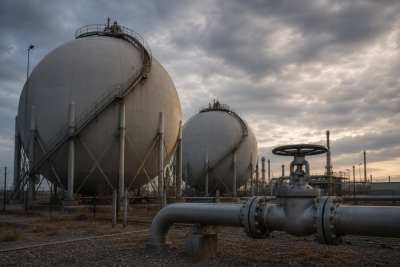
The situation appears particularly worrying in Germany, the largest consumer of natural gas in the block, where storage levels stood at just 47% of national capacity in early August, according to the latest figures from the Swiss Federal Office of Energy (SFOE) reported by Politico.
This is the lowest filling percentage ever recorded, a development with huge significance for the EU, as German infrastructure represents over 20% of the total storage capacity of the Union.
Berlin's obsession with the free market doctrine
Despite pressure and appeals to Berlin to intervene immediately and compel state-controlled giants SEFE and Uniper to purchase natural gas at any price, the German government refuses to abandon the free market model.
A representative of the German Ministry of Energy made clear that replenishment constitutes a responsibility of traders, warning that a state-directed intervention would further constrain the market and cause prices to skyrocket to even higher levels.
The overturn of the summer model and INES warnings
Sebastian Heinermann, CEO of Germany's leading natural gas storage association, INES, sounded the alarm, emphasizing that levels are historically low and that insistence on market rules is outdated, since financial incentives no longer exist for traders. Traditionally, utility companies purchased cheap gas in the summer to sell it for a profit in the winter, but high summer prices - a consequence of the war in Iran and climate change - completely overturned this dynamic.
Lower EU targets and fears of shortages starting in November
Following Russia's invasion of Ukraine in 2022, the EU had enacted a mandatory filling target of 90%, which was nonetheless reduced to 80% after the outbreak of the war in Iran to avoid panic buying. Despite the reduction, European stocks stand at just 58%, 16 percentage points below the five-year average and at the lowest point since 2011.
Although the European Commission reassures that there is no risk, analysis by Rapidan estimates that stocks will reach just 65% by November, rendering achievement of the target impossible without noticeably higher prices.
The risk of dependence on LNG and the threat to neighboring countries
The situation is worsened by Europe's strategic shift in recent years, as it replaced long-term contracts with Russia with short-term purchases of liquefied natural gas (LNG), remaining exposed to disruptions in the Strait of Hormuz.
At the same time, the fragmented energy sector of the EU is unable to compete with the centralized economies of Asia, which consistently outbid to secure cargoes.
If the winter proves exceptionally severe, the lack of adequacy in Germany may drag down neighboring countries to which it is obligated to provide emergency assistance, such as Austria, Switzerland, Italy, and Denmark.
Emergency measures, comparison with the Netherlands, and SEFE estimates
To address the problem, INES proposed reducing network charges and abolishing the conversion fee, while Berlin plans a new emergency reserve covering 10% of domestic capacity, which will however be implemented starting next summer.
On the other hand, the Netherlands intervened dynamically by allocating 1.2 billion euros to state-owned EBN for faster replenishment of its reserves.
From its side, SEFE maintains that the target of 70% remains achievable without state intervention, noting that 78% of German capacity has already been booked, although acknowledging that this does not necessarily guarantee the corresponding physical quantities of gas.
www.bankingnews.gr


Readers’ Comments