

Greece has left behind the most dramatic chapter of the financial crisis, yet the exit from the debt crisis did not translate into a corresponding improvement in the daily life of workers.
The country now exhibits an increase in produced economic output, a better fiscal image, an increase in tourism, a rise in exports, and a return of investments.
However, behind the macroeconomic indicators lies a different reality: millions of workers continue to feel economically trapped.
The main problem of the Greek economy today is not only unemployment, as it was in the previous decade.
It is a deeper mechanism that maintains the country on a low growth trajectory: low wages, low productivity, limited investments, and a high cost of living.
Greece managed to stabilize its economy, but has not yet managed to create a new production model leading to higher incomes.
The result is a paradox: the economy is growing, yet the average worker does not feel richer.
The wage increased numerically, but not in real terms
The minimum wage in Greece increased significantly in recent years and as of April 2026 amounts to 920 euros gross, under the Greek system of 14 payments per year.
In European comparisons, Eurostat converts the amount to an equivalent 12-month basis so that it is comparable with other countries.
With this methodology, the Greek minimum wage corresponds to approximately 1,073 euros per month.
This image, however, does not fully capture reality.
A country's position on wage tables does not automatically show the standard of living of workers.
The critical element is purchasing power, namely how many goods and services a worker can acquire with their income.
And at this point Greece appears much weaker.
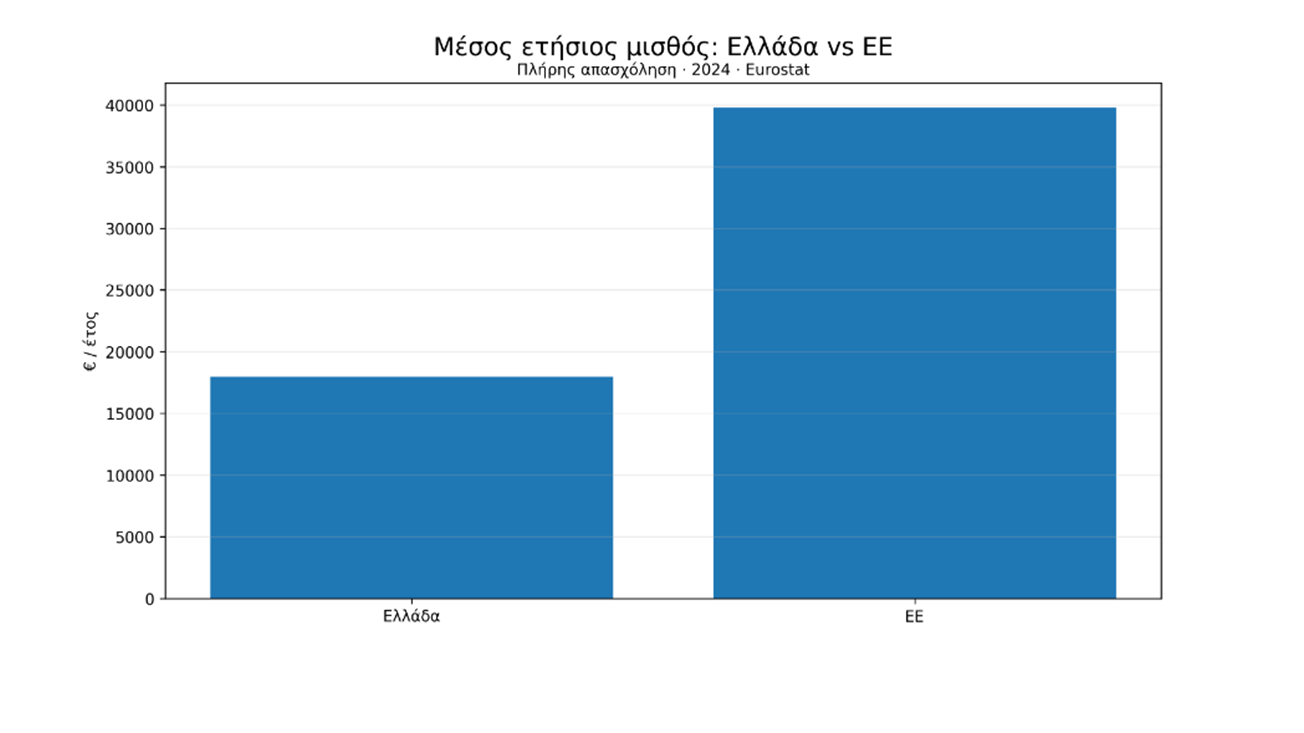
Although the Greek minimum wage is nominally in the middle category of the European Union, after adjusting for the cost of living its position drops significantly.
Countries such as Portugal, Poland, Croatia, Lithuania, Slovenia, and other economies of Central and Eastern Europe exhibit better purchasing power.
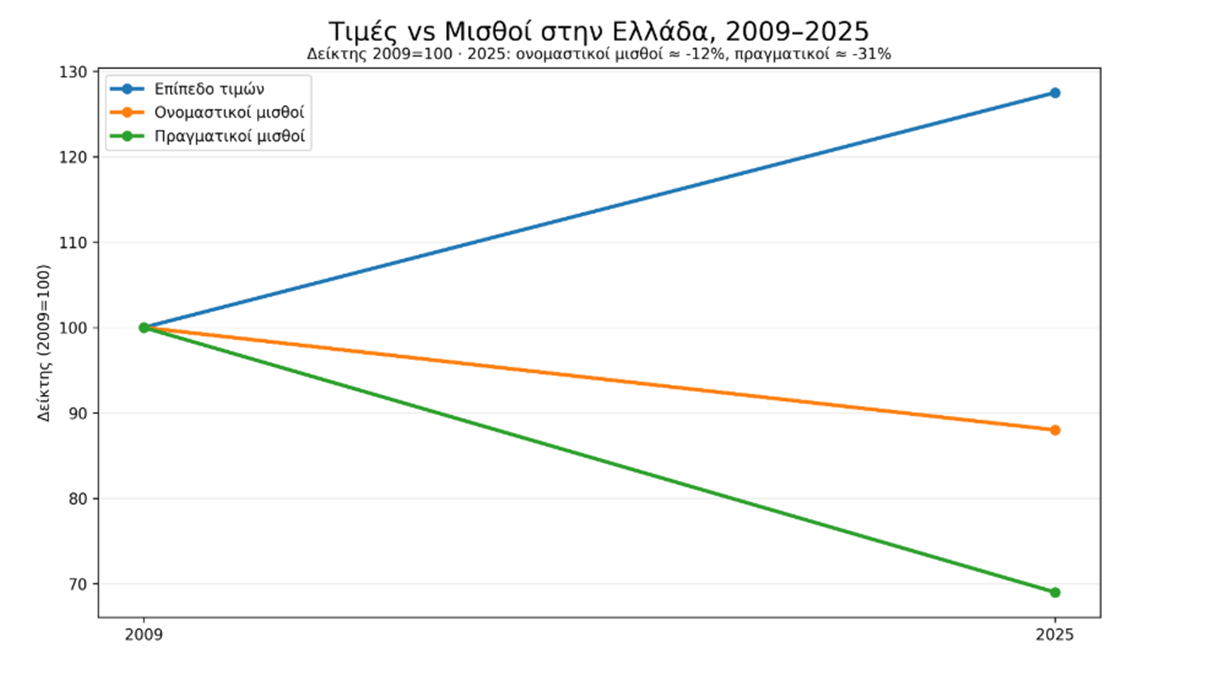
The reason is simple: many prices in Greece have approached European levels, while wages have not.
The cost of living absorbs the increases
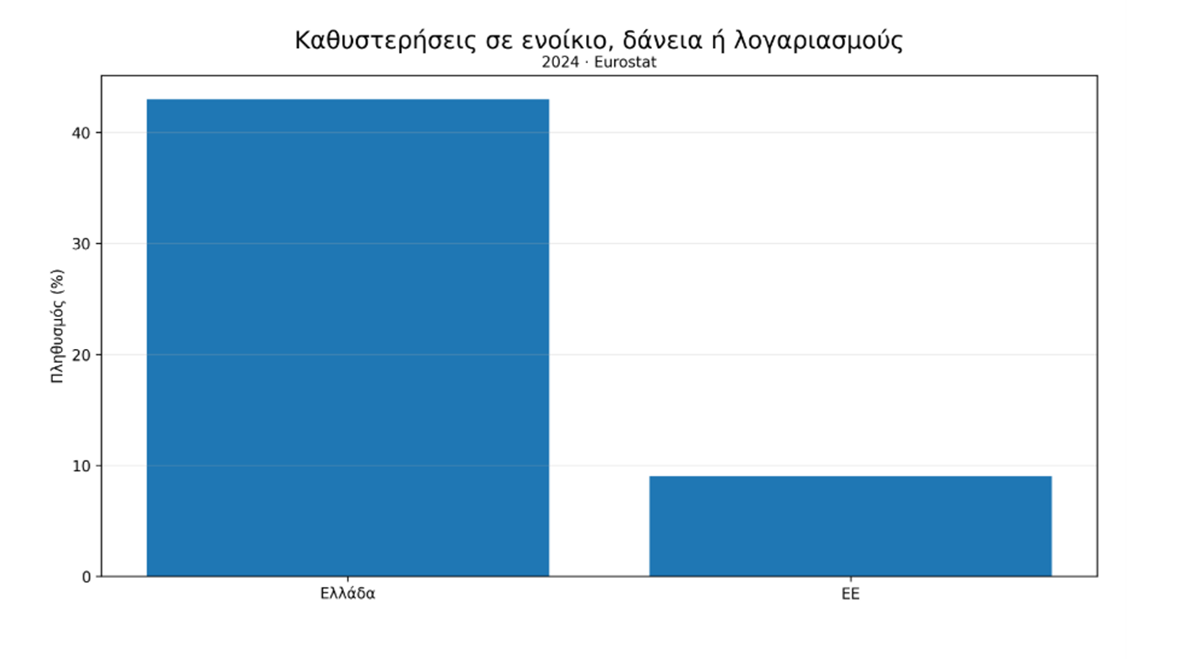
The greatest pressure for Greek households no longer comes solely from prices in stores. It comes primarily from housing costs.
Rents in Athens, Thessaloniki, and tourist areas increased sharply in recent years due to limited housing supply, tourism pressure, and increased demand.
For a worker receiving the minimum wage or a low-middle wage, housing now absorbs a disproportionately large portion of income.
This creates a new form of financial pressure.
A worker may have full-time employment, but after paying:
• rent,
• energy,
• food,
• transportation,
• taxes and insurance contributions,
has a minimal amount available for savings or improving their standard of living.
Greece thus risks creating a generation of workers who are not unemployed, but remain economically vulnerable.
Greek workers remain poorer than in 2009
The most important comparison is not with other countries, but with the past of Greece itself.
Before the debt crisis, in 2009, wages were at much higher real levels.
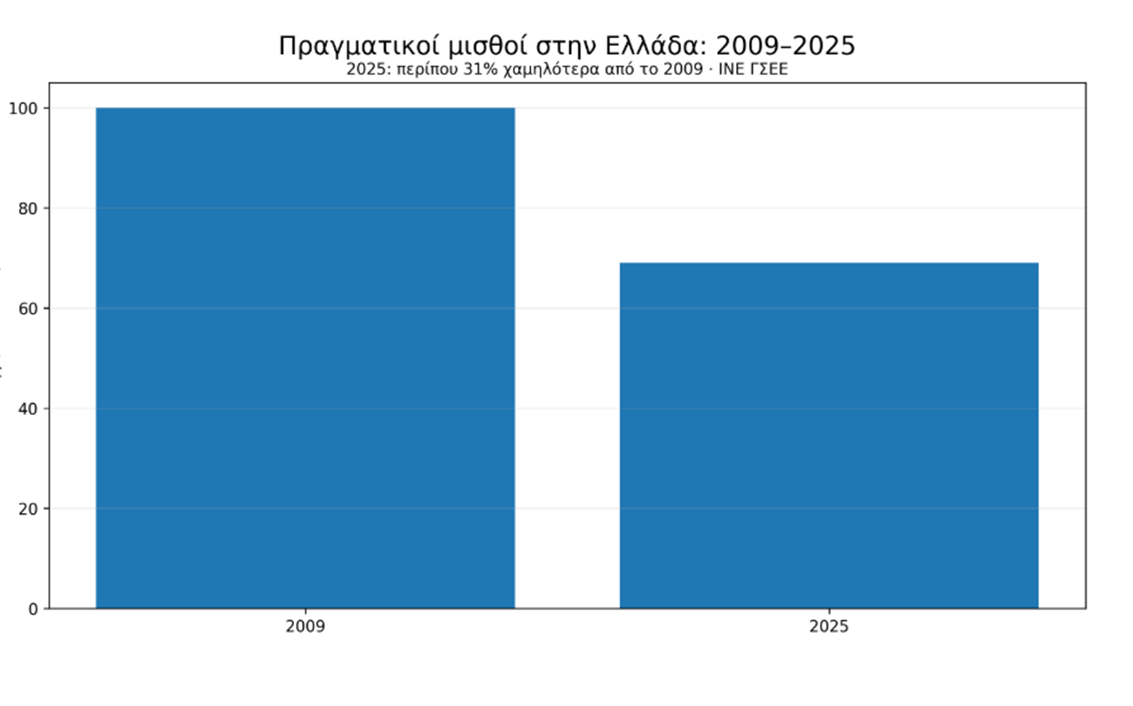
According to data attributed to the annual report of the Institute of Labor of the General Confederation of Greek Workers (INE GSEE), real average wages in 2025 remained approximately 31% lower than 2009 levels.
This means that the average worker, despite the economic recovery and the reduction of unemployment, can purchase about one third fewer goods and services than they could before the crisis.
Here lies the great contradiction of the Greek economy.
The indicators show growth, but the daily experience of many citizens shows stagnation.
The increase in GDP does not automatically translate into an increase in prosperity.
If income does not increase faster than the cost of living, society does not feel the growth.
The problem of the low wage model
One of the most characteristic problems of the Greek labor market is the small distance between the minimum and average wage.
The minimum wage corresponds to over 60% of the median gross wage.
This does not mean that the minimum wage is particularly high.
It means that a large portion of workers is located near the bottom of the wage scale.
The Greek labor market exhibits intense downward compression.
A worker with several years of experience or more skills often sees little financial difference compared to someone starting now.
The consequences are serious:
• the incentive to acquire new skills is reduced,
• the link between education and pay is weakened,
• the flight of young people abroad is reinforced.
Greece invested significant resources in educating a generation of highly trained workers, but often cannot offer them corresponding economic prospects.
The real cause: low productivity
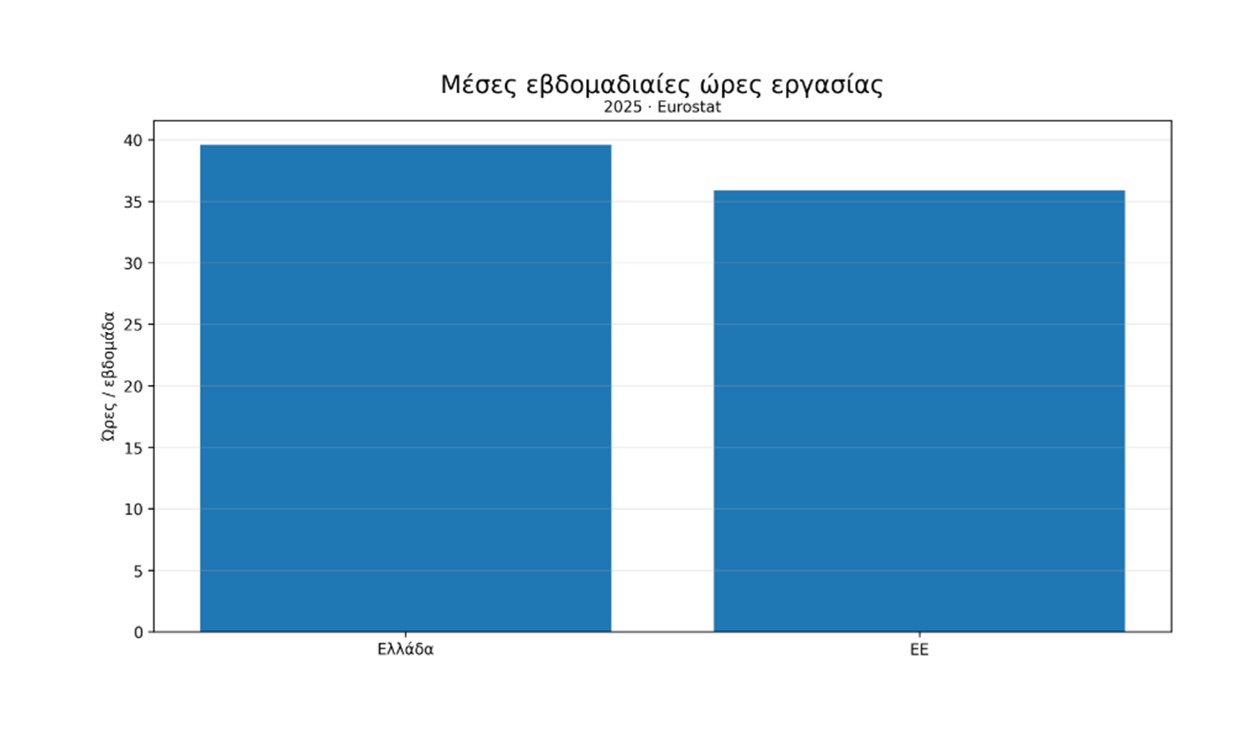
The deeper problem of Greece is not simply that wages are low.
It is that the economy produces less value per worker than the most developed European economies.
Productivity remains the key.
An economy can offer high wages only when its workers produce high added value.
In Greece, however, a large part of economic activity is based on sectors that create limited margins for pay increases:
• tourism,
• catering,
• retail,
• small businesses,
• seasonal labor.
These sectors are necessary, but cannot alone lead to income levels corresponding to Northern Europe.
The problem is connected with:
• the small size of enterprises,
• low investments in technology,
• limited research and development,
• slow digitalization,
• the weak link between universities and production.
Cheap labor is not a growth strategy
For many years Greece tried to boost its competitiveness through low labor costs.
However, this strategy has limits.
There is always a country where wages are lower.
An economy cannot compete indefinitely by reducing labor costs, because ultimately it also reduces the purchasing power of its society.
Real growth requires a different direction:
• investments in technology,
• industrial upgrading,
• innovation,
• research,
• education,
• production of high-value products and services.
High wages are not created because they are decided politically.
They are created because the economy can produce more value.
Human capital is the lost major bet
The greatest loss of the previous decade was not only the reduction in income.
It was the loss of human capital.
Thousands of young scientists and skilled workers left the country seeking better pay and prospects.
This exit had a double cost: on one hand, the available high-skilled workforce was reduced, while on the other, the ability of the economy to increase its productivity was limited.
A country cannot become richer when it loses the people who can make it more productive.
Serious allegations that resources from European funds for Research are not absorbed are indicative of the unhealthy state that prevails: no one with elementary professional dignity and qualifications will stay to act as an... intermediary for all kinds of extra-institutional centers of power that exploit the country's real wealth.
The next major challenge for Greece
Greece has achieved much in stabilizing its economy. However, the next phase requires different policies.
What is needed:
• wage increases across the entire labor spectrum,
• boosting productivity,
• investments in new sectors,
• better working conditions,
• real controls in the labor market,
• affordable housing policies,
• a tax system that does not excessively burden low incomes.
The real success of an economy is not measured only by GDP, surpluses, or market ratings.
It is measured by a simple question: Can a person who works full time live with dignity, support a family, acquire housing, and plan their future?
Greece managed to survive after the crisis.
The next bet is to be able to prosper.
Because a country does not become rich when it simply creates more jobs.
It becomes rich when the workers holding those jobs can truly live better.
These should concern the political system and the public sphere... if an elementary level of seriousness existed... But...
www.bankingnews.gr







Readers’ Comments